

What Is ASTM D6068 Plastic J R Curve Fracture Toughness?
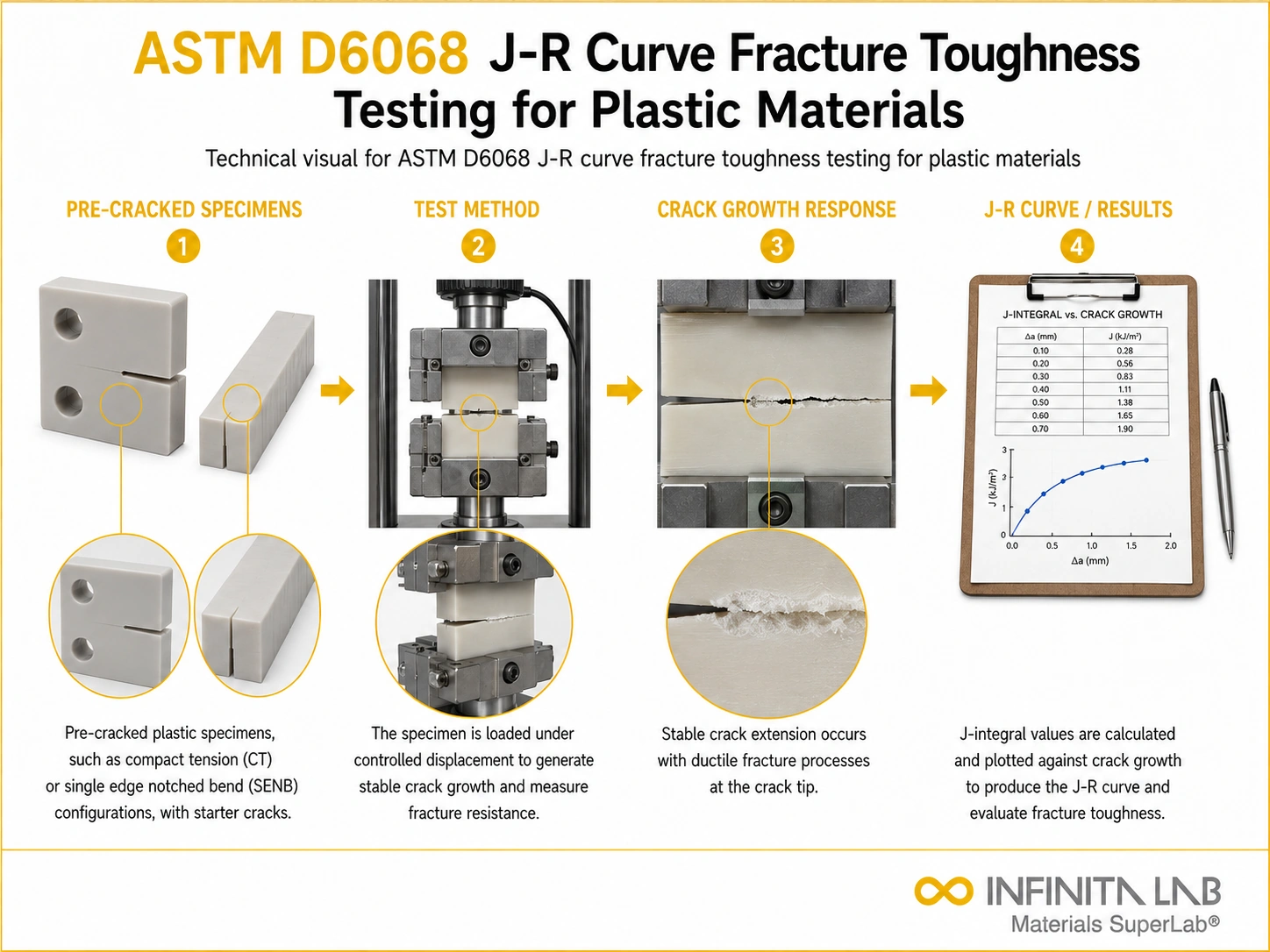
ASTM D6068 provides a method for determining the J-R (J-integral resistance) curves of plastic materials. These curves describe the material’s resistance to crack initiation and growth under loading conditions.
The standard is widely used in fracture mechanics to evaluate the toughness and crack propagation behavior of plastics in structural and engineering applications.

Applications and Benefits of ASTM D6068 Plastic J R Curve Fracture Toughness Testing
Scope
ASTM D6068 focuses on measuring the fracture resistance of plastic materials using J-integral concepts. It evaluates how materials behave under applied stress in the presence of cracks.
The test evaluates:
- Crack initiation resistance
- Crack growth behavior
- Fracture toughness of plastics
- Energy absorption during crack propagation
- Structural reliability of materials
Applications
- Structural plastic components
- Automotive and aerospace materials
- Pressure vessels and piping systems
- Engineering thermoplastics
- Failure analysis and material research
- Quality control in plastic manufacturing
Benefits
- Provides accurate fracture toughness data
- Helps predict material failure behavior
- Supports the design of crack-resistant materials
- Improves safety and reliability
- Enables comparison of plastic materials
Our ASTM D6068 Testing Procedure
Sample Preparation
Notched plastic specimens are prepared according to standard geometry.
1Crack Initiation & Loading
Specimens are subjected to controlled loading to initiate cracks.
2Crack Growth Monitoring
Crack extension is measured during loading.
3Data Recording & Evaluation
J-R curve is generated and analyzed as per ASTM requirements.
4ASTM D6068 Test Parameters and Requirements
| Parameter | Details |
|---|---|
| Applicable Materials | Plastic materials (thermoplastics and thermosets) |
| Test Method | Fracture mechanics using J-integral approach |
| Specimen Type | Notched specimens |
| Test Temperature | Approximately 23°C ± 2°C |
| Measured Outputs | J-integral values, crack growth resistance curve |


- Universal testing machine
- Crack measurement devices (clip gauge or optical system)
- Specimen preparation tools
- Environmental conditioning chamber
- Data acquisition and analysis system
Equipment and Instrumentation Used for ASTM D6068 Testing
What You Receive: Test Report, Data, and Certification
- J-R curve (fracture resistance curve)
- Crack initiation toughness values
- Crack growth resistance data
- Fracture behavior analysis
- Test condition summary
- ASTM compliance report
ASTM D6068 Plastic J R Curve Fracture Toughness FAQs
ASTM D6068 is a standard test method used to determine J-R curves of plastic materials, describing the relationship between crack growth resistance and crack extension under elastic-plastic fracture conditions.
ASTM D6068 helps evaluate fracture toughness of plastics, enabling engineers to predict failure behavior, improve material selection, and ensure safety and reliability in structural and engineering applications.
A J-R curve represents the resistance of a material to crack growth, plotting the J-integral value against crack extension, providing insight into ductile fracture behavior of plastic materials.
ASTM D6068 involves loading a notched plastic specimen under controlled conditions, measuring crack growth and energy release rate to generate the J-R resistance curve for fracture analysis.
The test requires a universal testing machine, crack measurement devices, data acquisition systems, and properly prepared specimens to accurately determine fracture resistance properties.
Why Choose Infinita Lab for Plastic J R Curve Fracture Toughness Testing
At the core of this breadth is our network of 2,000+ accredited laboratories across the USA, offering access to over 10,000 testing methods and analytical services. From advanced materials characterization (SEM, TEM, RBS, XPS) to mechanical, chemical, environmental, biological, and standardized ASTM/ISO-compliant testing, we deliver unmatched flexibility, specialization, and scale. You are never limited by geography, facility, or methodology — Infinita Lab connects you to the right expertise and testing solution, every time.

Need ASTM D6068 Plastic J R Curve Fracture Toughness Testing You Can Rely On?
Send query us at hello@infinitalab.com or call us at (888) 878-3090 to learn more about our services and how we can support you.





