

What Is ASTM D953 Plastic Bearing Strength?
ASTM D 953 evaluates the bearing strength of plastic materials when subjected to compressive loading through a pin or bolt. This test simulates real-world conditions where plastics experience localized stress in joints, fasteners, or load-bearing assemblies, making it essential for mechanical performance assessment.
The method determines the resistance of plastics to deformation and failure under bearing loads, helping engineers select suitable materials for structural and fastening applications. It is widely applied across thermoplastics and thermosets to ensure reliability, durability, and design safety in load-concentrated conditions.

Applications and Benefits of ASTM D953 Plastic Bearing Strength Testing
Scope
ASTM D 953 covers the determination of bearing strength of plastics using a standardized loading configuration and specimen geometry. It provides consistent procedures for evaluating material performance under compressive stress at contact points.
- Applicable to rigid and semi-rigid plastics
- Evaluates resistance to localized compressive deformation
- Suitable for both thermoplastics and thermosetting materials
- Can be used for quality control and material comparison
- Supports design validation of mechanically fastened joints
Applications
- Evaluation of plastic components with bolted or pinned joints
- Material selection for load-bearing assemblies
- Performance validation in structural plastic parts
- Quality control in plastic manufacturing
- Comparative analysis of different plastic formulations
Benefits
- Provides accurate assessment of localized strength behavior
- Helps prevent joint failure and material deformation
- Supports safer and more reliable product design
- Enables material comparison under standardized conditions
- Enhances confidence in fastening and assembly performance
Our ASTM D953 Testing Procedure
Sample Preparation
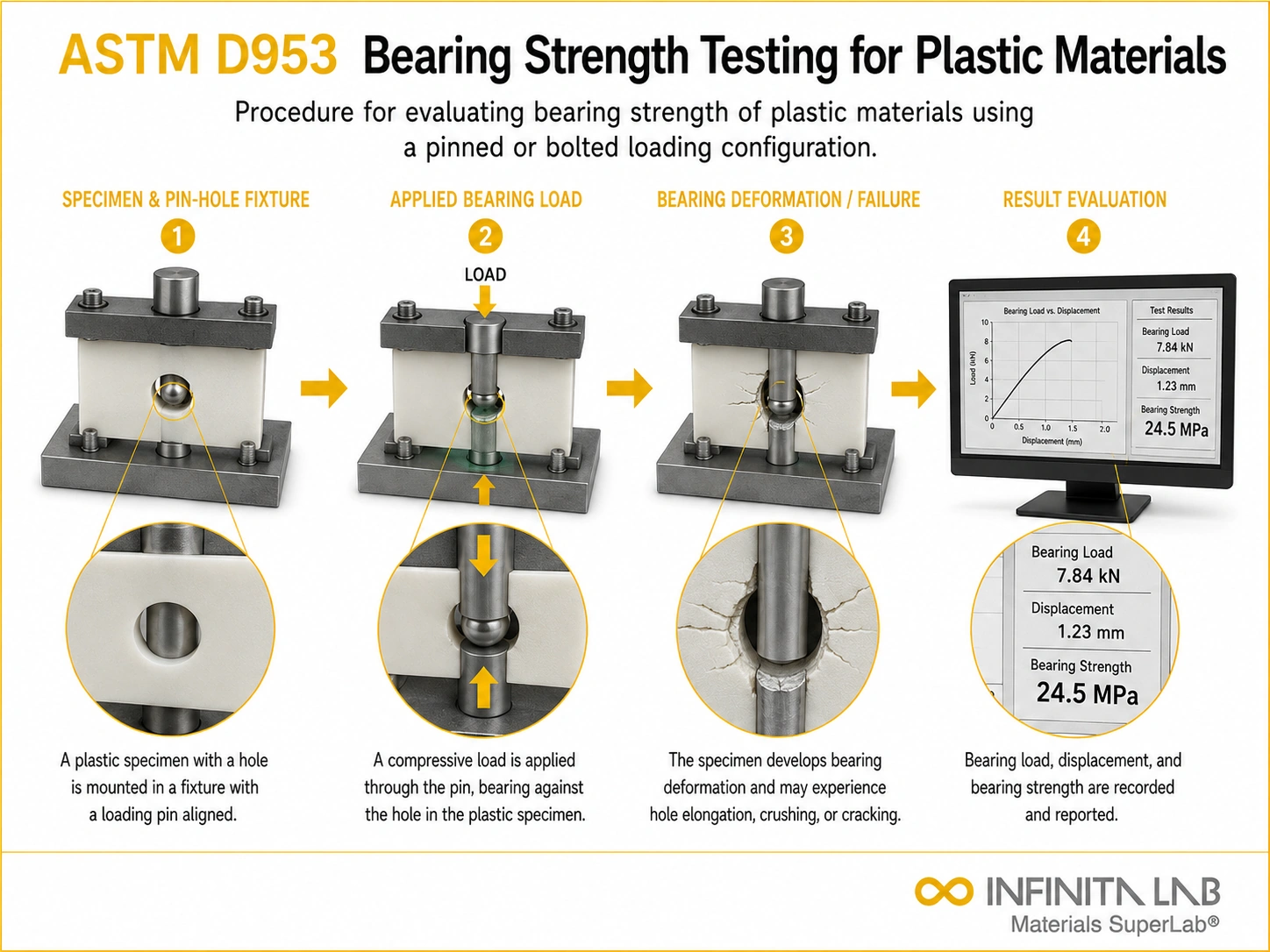
A standardized plastic specimen with a defined hole is prepared according to specified dimensions.
1Fixture Setup
The specimen is mounted in a test fixture with a pin or bolt aligned for load application.
2Load Application
Compressive force is applied at a controlled rate until deformation or failure occurs.
3Data Recording
Bearing strength and deformation values are recorded and analyzed.
4ASTM D953 Test Parameters and Requirements
| Parameter | Details |
|---|---|
| Specimen Type | Flat plastic sample with drilled hole |
| Load Type | Compressive bearing load via pin or bolt |
| Test Speed | Controlled crosshead speed as specified |
| Measurement Parameter | Bearing stress at yield or failure |
| Temperature Condition | Typically ambient unless specified |
| Failure Mode | Deformation or cracking around hole |
| Data Output | Load vs displacement and stress values |
| Units | Strength reported in MPa or psi |


- Universal Testing Machine (UTM)
- Bearing test fixture with loading pin
- Vernier caliper or micrometer
- Data acquisition system
- Specimen drilling and preparation tools
Equipment and Instrumentation Used for ASTM D953 Testing
What You Receive: Test Report, Data, and Certification
- Bearing strength values at yield and/or failure
- Load vs displacement curves
- Failure mode analysis
- Test report as per ASTM standards
- Observations on deformation behavior
ASTM D953 Plastic Bearing Strength FAQs
ASTM D 953 is used to measure the bearing strength of plastic materials under localized compressive loads. It helps evaluate how plastics perform when subjected to stress through fasteners such as bolts or pins in structural applications.
Bearing strength is critical because many plastic components are joined using fasteners. This test ensures that the material can withstand localized stress without excessive deformation or failure, improving safety and structural reliability.
Unlike tensile testing, which evaluates overall material strength, ASTM D 953 focuses on localized stress around a hole. It specifically assesses how materials behave in fastened or jointed configurations.
It helps engineers understand how plastics behave under localized loads, enabling better design of joints and assemblies. This reduces the risk of failure and improves product durability and safety.
It ensures that plastic materials meet required strength standards for fastening applications. Regular testing helps maintain consistency, detect defects, and ensure that products perform reliably under load conditions.
Why Choose Infinita Lab for Plastic Bearing Strength Testing?
When your Plastic Bearing Strength results have to hold up - for compliance, a customer audit, or an engineering decision - ASTM D953 accuracy and an unbiased third-party report matter more than price. Infinita Lab routes your ASTM D953 plastic bearing strength testing to ISO/IEC 17025-accredited U.S. partner labs with hands-on method experience, so you get defensible data, transparent reporting, and turnaround times built around your project deadline - not ours.

Need ASTM D953 Plastic Bearing Strength Testing You Can Rely On?
Send query us at hello@infinitalab.com or call us at (888) 878-3090 to learn more about our services and how we can support you.