


ASTM D7309: Microscale Combustion Calorimetry Flammability Testing Services
Accredited ASTM D7309 microscale combustion calorimetry flammability testing from Infinita Lab, performed to the exact standard requirements - accurate, reproducible results with full documentation for compliance, R&D, and quality control programs.
TRUSTED BY


Get ASTM D7309 compliant results - request your microscale combustion calorimetry flammability testing quote
- Overview
- Scope, Applications, and Benefits
- Test Process
- Specifications
- Instrumentation
- Results and Deliverables
What Is ASTM D7309 Microscale Combustion Calorimetry Flammability?
ASTM D7309, Standard Test Method for Determining Flammability Characteristics of Plastics and Other Solid Materials Using Microscale Combustion Calorimetry, establishes a laboratory procedure in which specimens of known, milligram-scale mass are thermally decomposed under controlled heating. At the same time, the heat released by the evolved gases is measured. It resembles thermal analysis techniques. Each specimen is heated at a constant rate between 0.2 and 2 K/s, either in an oxygen-free (anaerobic) environment or in an oxidizing (aerobic) one. The volatile decomposition products are swept into a high-temperature combustion stage, where excess oxygen fully oxidizes them. No thermometer produces the heat release figure. It’s calculated from the mass of oxygen consumed, based on oxygen-consumption calorimetry. Two procedures are defined. Method A uses anaerobic pyrolysis and yields quantities such as heat release capacity, fire growth capacity, the temperature at peak heat release, and an estimate of potential fire load. Oxidative pyrolysis is what Method B relies on, and it determines the net calorific value of the specimen directly. What can go in the cup? A material or composite in any form, including fiber, film, powder, pellet, or droplet. ASTM Committee D20 on Plastics maintains the standard, and the current active edition is D7309-26a; earlier editions such as D7309-21 are now historical. The technique grew out of Federal Aviation Administration research on the pyrolysis combustion flow calorimeter. One caveat matters. ASTM states that the method does not, by itself, incorporate all factors required for fire hazard or fire risk assessment, so results are intended for comparison and screening, along with research, rather than as a direct predictor of full-scale fire performance.

Applications and Benefits of ASTM D7309 Microscale Combustion Calorimetry Flammability Testing
Scope
ASTM D7309 is performed under controlled laboratory conditions, where small specimens are heated to specified temperatures, and the evolved gases are fully thermally oxidized.
The method evaluates:
- The standard establishes a procedure for determining flammability characteristics of plastics and other solid materials using microscale combustion calorimetry.
- Specimens of known mass, at the milligram scale, are thermally decomposed in either an anaerobic or an aerobic environment.
- Heating happens at a constant rate within the range of 0.2 to 2 K/s.
- Oxygen consumed while the volatile decomposition products are oxidized gives the heat they release.
- Anaerobic pyrolysis (Method A) estimates potential fire load and determines heat release capacity and fire growth capacity.
- For the net calorific value of the specimen, determined directly, use oxidative pyrolysis (Method B).
- Any material or composite material in any form qualifies as a specimen, such as fiber, film, powder, pellet, or droplet.
- It measures and describes material response to heat under controlled laboratory conditions. It does not by itself incorporate all factors required for fire hazard or fire risk assessment.
- Jurisdiction sits with ASTM Committee D20 on Plastics, and the current active edition is D7309-26a.
- Safety, health, and environmental practices? Those remain the user’s responsibility to establish before testing.
Applications
- Screening candidate polymers and flame-retardant formulations during materials development.
- Heat release capacity lets you rank the relative flammability of resins, composites, and coatings.
- Neat versus filled or additive-modified materials can be compared from very small quantities of sample.
- Quality control and lot-to-lot consistency checks on plastics and polymer-based components.
- Thermal decomposition behavior of research-grade or scarce materials, where large specimens are unavailable, can be investigated.
- Picking promising candidates to carry forward into larger-scale fire tests.
Benefits
- Only milligram quantities of material are needed, which conserves expensive or hard-to-make samples.
- Data come out repeatable and quantitative from a rapid, small-scale laboratory test.
- Pyrolysis and combustion happen in separate stages, giving insight into what a material releases and when.
- Many specimen forms work, from films and fibers to powders and pellets.
- It’s a cost-effective screening step before committing to expensive larger-scale fire testing.
- Methods A and B cover both anaerobic and oxidative conditions.
Our ASTM D7309 Testing Procedure
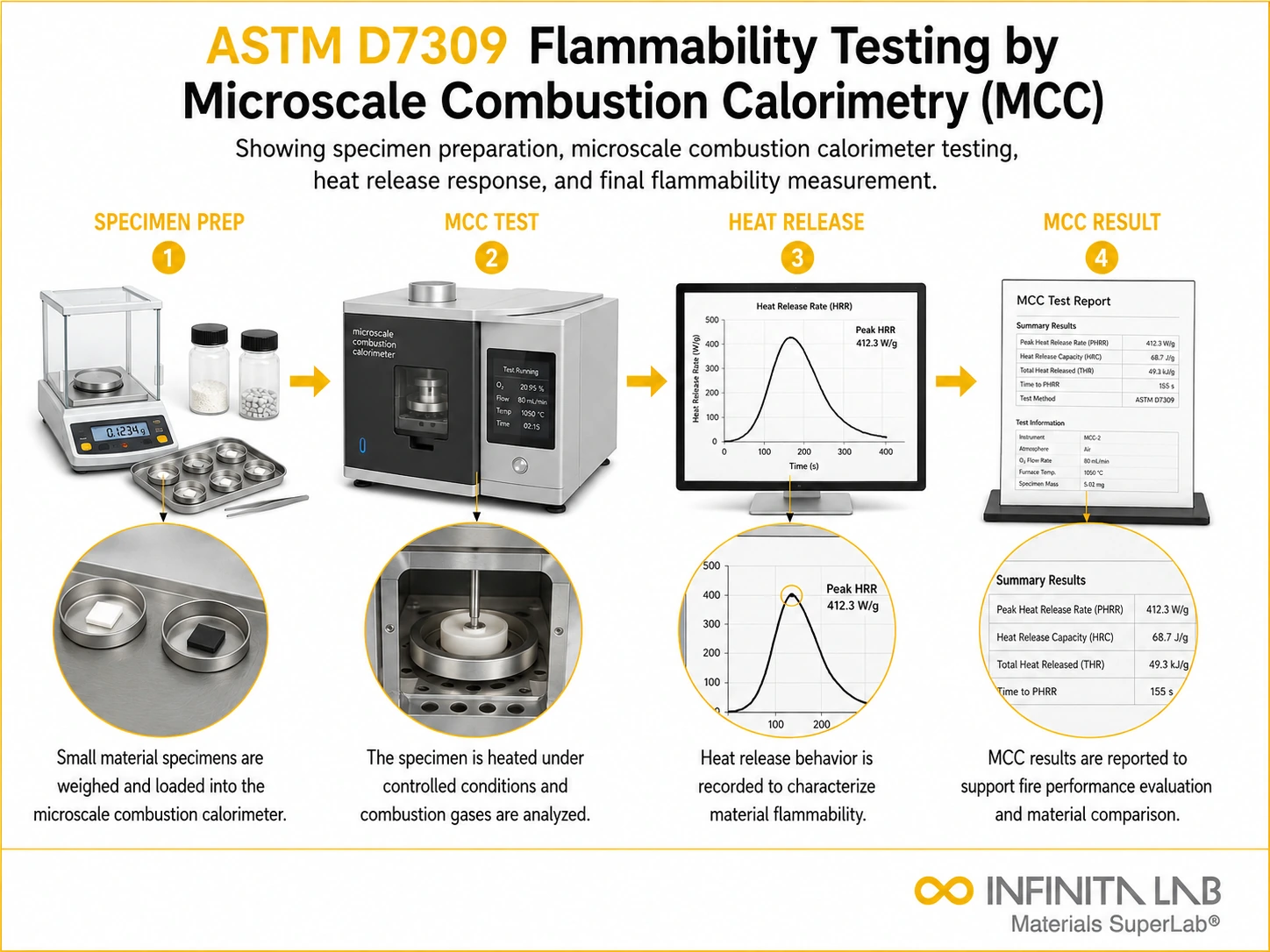
Sample Weighing & Placement
The specimen is weighed and placed in the cup to ensure proper thermal contact.
1Chamber Sealing & Controlled Heating
The sample chamber is sealed, and the specimen is heated at a programmed rate.
2Gas Transport & Combustion
Decomposition gases are transferred to the combustion chamber and ignited.
3Data Acquisition
HRR, THR, and PHRR values are recorded and normalized to sample mass.
4ASTM D7309 Test Parameters and Requirements
| Parameter | Details |
|---|---|
| Applicable Materials | Plastics and solid composites |
| Sample Mass | 1–10 mg |
| Sample Condition | Free from moisture and solvents |
| Sample Preparation | Powdered or uniformly shaped |
| Heating Environment | Controlled laboratory conditions |


- Microscale Combustion Calorimeter – the integrated instrument. It pyrolyzes the specimen, burns the evolved gases, and measures oxygen depletion.
- Pyrolyzer – heats the milligram-scale specimen at a controlled, constant rate in an anaerobic or oxidizing gas stream.
- High-Temperature Combustor – completely oxidizes the volatile pyrolysis products in excess oxygen.
- Oxygen Analyzer – measures oxygen consumed so that heat release can be calculated.
- Analytical Microbalance – weighs each specimen precisely before testing.
- Gas Flow Control and Scrubbing System – regulates carrier and oxidizer gases and removes combustion products that could interfere with oxygen measurement.
- Data Acquisition Software – records heat release versus time and temperature, then computes the derived flammability parameters.
Equipment and Instrumentation Used for ASTM D7309 Testing
What You Receive: Test Report, Data, and Certification
- Heat release capacity, reported in J/g-K, for Method A testing.
- The peak heat release rate, plus the temperature at which it occurs.
- Total heat release. Method B also provides the net calorific value.
- Heat release rate curves versus temperature and time for each specimen.
- A formal test report describing the specimen, method, heating conditions, and results, with raw data files available on request.
ASTM D7309 Microscale Combustion Calorimetry Flammability FAQs
The term "flammability" refers to a material's ease of ignition, its intensity of burning and heat release after ignition, its tendency to spread fire, and the pace at which it produces smoke and harmful combustion products during gasification and burning.
Hydrocarbon-based plastics are frequently enhanced with additives to increase their resistance to flammability. It's critical to realize that a plastic substance with a UL 94 rating has the potential to catch fire, spread a flame, and cause an incident.
Other polymers, such as polypropylene (PP) and polyethylene (PE), will burn at 400°C or lower temperatures and melt at 130–160°C, because of their comparatively low melting.
Fire testing using a microscale combustion calorimeter evaluates a material’s flammability by heating a small sample under controlled conditions and measuring the heat released during combustion. The results help assess heat-release capacity and fire behavior.
A small material sample is heated at a controlled rate in an inert atmosphere, causing thermal decomposition. The released gases are mixed with oxygen and combusted, and the heat-release rate is measured to evaluate the material’s flammability.
Why Choose Infinita Lab for Microscale Combustion Calorimetry Flammability Testing
When your Microscale Combustion Calorimetry Flammability results have to hold up - for compliance, a customer audit, or an engineering decision - ASTM D7309 accuracy and an unbiased third-party report matter more than price. Infinita Lab routes your ASTM D7309 microscale combustion calorimetry flammability testing to ISO/IEC 17025-accredited U.S. partner labs with hands-on method experience, so you get defensible data, transparent reporting, and turnaround times built around your project deadline - not ours.

Need ASTM D7309 Microscale Combustion Calorimetry Flammability Testing You Can Rely On?
Send query us at hello@infinitalab.com or call us at (888) 878-3090 to learn more about our services and how we can support you.


Request a Quote
Submit your material details and receive testing procedures, pricing, and turnaround time within 24 hours.
 Quick Turnaround and Hasslefree process
 Confidentiality Guarantee
 Free, No-obligation Consultation
 100% Customer Satisfaction
