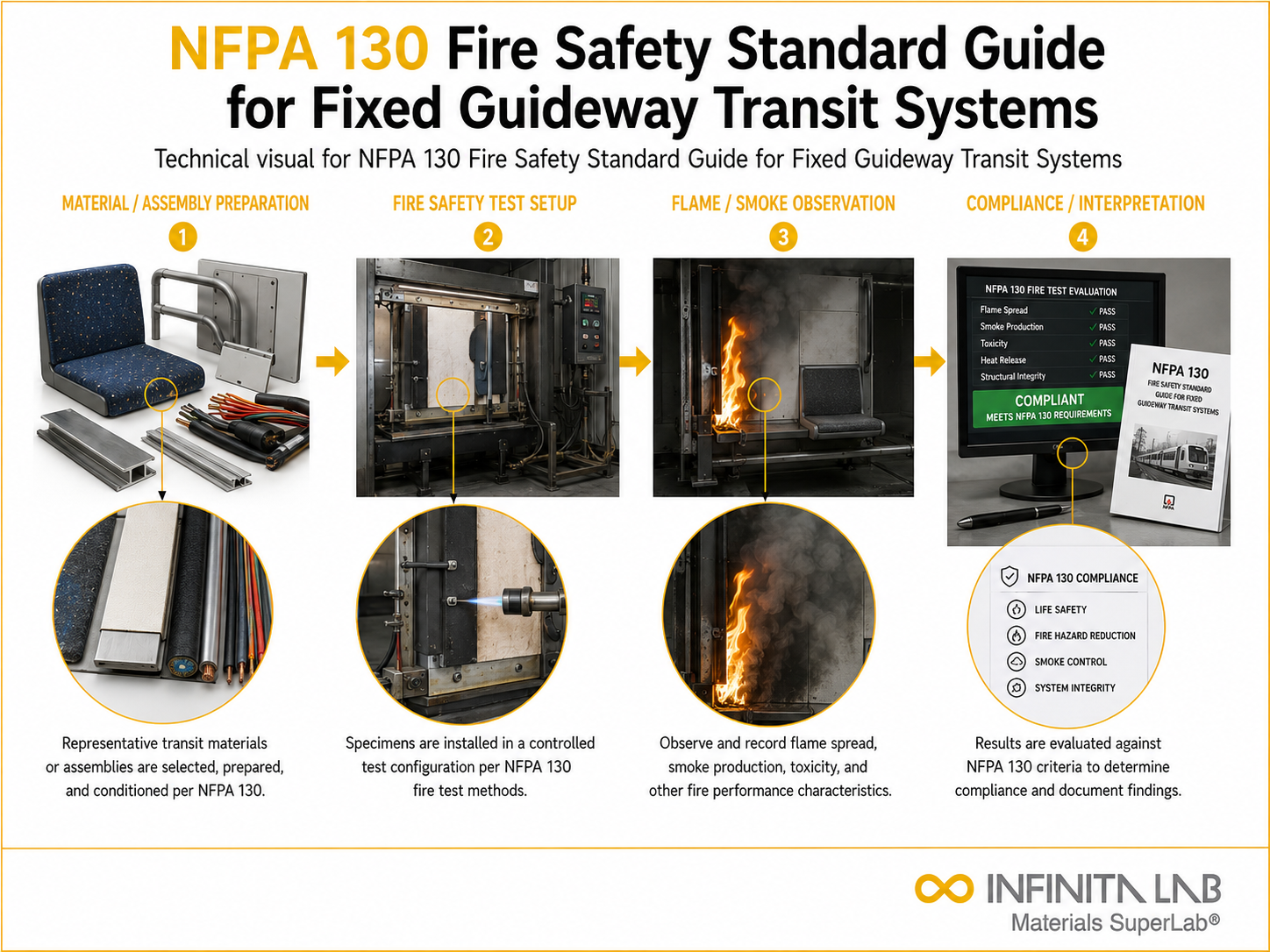


What Is NFPA 130 Fire Safety Guide?
NFPA 130 is the Standard for Fixed Guideway Transit and Passenger Rail Systems, establishing the fire safety performance requirements for materials, systems, and components used in rail vehicles, stations, and tunnels. The standard mandates flammability, smoke, and flame spread testing for three distinct material categories — electrical cables and wiring, structural and interior components, and seating and cushioning materials — each governed by a separate test regime with different acceptance criteria. A single NFPA 130 submission covers multiple test methods, and transit engineers and rail OEM qualification teams must specify the correct method for each material category.
NFPA 130 compliance is required for procurement and type approval of rolling stock and station materials by transit authorities across the US and internationally. Material qualification test reports are a contractual deliverable in rail vehicle supply agreements and station fit-out specifications. Test data produced outside accredited laboratory conditions or using incorrect test configurations is routinely rejected by transit authority fire safety reviewers.

Applications and Benefits of NFPA 130 Fire Safety Guide Testing
Scope
NFPA 130 applies to materials used in fixed guideway transit vehicles, stations, platforms, and tunnels, covering three distinct material categories — each with a separate test method and acceptance criteria. Cables and wiring are tested per IEEE 1202 vertical cable tray flame test; structural and interior components per ASTM E162 (flame spread index) and ASTM E662 (smoke density); and seating and cushioning materials per ASTM E1354 cone calorimeter. Selecting the correct test method for each material category is critical — test reports using incorrect configurations are routinely rejected by transit authority fire safety reviewers.
- Cables and wiring — IEEE 1202 vertical cable tray flame test for flame propagation along bundled cable assemblies
- Structural and interior panels — ASTM E162 radiant panel (Is ≤ 35) and ASTM E662 smoke chamber (Ds ≤ 200 at 4 min, ≤ 450 at 20 min)
- Seating and cushioning — ASTM E1354 cone calorimeter for heat release rate, total heat release, and smoke production
- ASTM E84 surface burning characteristics referenced for tunnel and station finish materials where specified by the authority
- BS 5852 cigarette and match ignition testing required for seating materials on some authority specifications
- Covers new material qualification, replacement material approval, and re-qualification after supplier or formulation change
- Full raw data, specimen conditioning records, and operator observations required — summary-only reports are not accepted
Applications
- Rail vehicle interior material qualification for rolling stock type approval submissions to transit authorities.
- Cable and wiring system qualification for traction power, signalling, and control cable bundles installed in rail vehicles and tunnels.
- Station interior finish material approval for platform ceilings, wall cladding, flooring, and signage substrates.
- Seating and upholstery material qualification for passenger vehicle seats in metro, light rail, and commuter rail applications.
- Re-qualification testing when material supplier, formulation, or manufacturing process changes affect a previously approved material.
- Design-stage flammability screening to identify non-compliant materials before prototype build and formal type approval submission.
Benefits
- Covers all three NFPA 130 material categories — cables, structural components, and seating — in a single coordinated test program, avoiding multiple laboratory engagements.
- Correct test configuration per material category — vertical cable tray for wiring, radiant panel for interior composites, cone calorimeter for seating — ensures results are accepted by transit authority fire safety reviewers.
- Accredited laboratory test reports with full raw data, specimen conditioning records, and operator observations satisfy transit authority submission requirements without supplementary requests.
- Design-stage screening identifies non-compliant materials before prototype build, reducing rework and type approval program delays.
Our NFPA 130 Testing Procedure
System Design Review
Evaluate rail system design against NFPA 130 fire safety and life safety requirements.
1Fire Protection Implementation
Install fire detection, suppression, and ventilation systems as specified.
2Testing & Commissioning
Conduct functional tests for alarms, smoke control, and emergency systems.
3Report & Approval
Compile compliance reports and obtain approval from relevant authorities.
4NFPA 130 Test Parameters and Requirements
| Parameter | Details |
|---|---|
| Fire Detection Systems | Automatic smoke and heat detection. |
| Fire Suppression | Sprinkler systems or approved alternatives. |
| Emergency Ventilation | Smoke management and exhaust systems in tunnels and stations. |
| Egress Design | Defined evacuation time limits and exit capacity. |
| Specimen conditioning | 23°C ± 3°C, 50% ± 5% RH, minimum 24 hours per test method |
| Performance Criteria | Temperature and smoke tenability limits |
| Key acceptance values | Is ≤ 35 (E162), Ds ≤ 200 at 4 min and ≤ 450 at 20 min (E662) |
| Supplementary tests | ASTM E84 (surface burning), BS 5852 (seating ignition) where specified |


Smoke and Heat Detectors
Fire Alarm Control Panels
Smoke Control / Ventilation Systems
Airflow & Temperature Sensors
Emergency Lighting Systems
Public Address & Communication Systems
Fire Suppression Systems (Sprinklers)
Monitoring & Control Panels
Equipment and Instrumentation Used for NFPA 130 Testing
What You Receive: Test Report, Data, and Certification
Fire Safety Compliance Report
Smoke Control Test Results
Evacuation Time Analysis
System Functional Test Reports
Fire Protection System Certification
Risk Assessment Documentation
NFPA 130 Fire Safety Guide FAQs
NFPA 130 provides fire protection and life safety standards for fixed guideway transit and passenger rail systems, including underground, surface, and elevated systems, to ensure safe evacuation and reduce fire-related hazards.
NFPA 130 addresses cables and wiring (tested per IEEE 1202 vertical cable tray), structural and interior components (tested per ASTM E162 and E662), and seating and cushioning materials (tested per ASTM E1354 cone calorimeter). Each category has separate test methods and acceptance criteria.
Yes, provided the laboratory holds the necessary equipment and accreditation for IEEE 1202, ASTM E162, ASTM E662, and ASTM E1354. Coordinating all material categories through a single laboratory simplifies report management and ensures consistent specimen conditioning and documentation standards for the authority submission package.
Under NFPA 130, required tests depend on material type and typically include ASTM E162 for flame spread, ASTM E662 for smoke generation, ASTM E119 for structural fire resistance, and BSS 7239 for evaluating toxic gas emissions.
Interior structural and panel materials must achieve a flame spread index Is ≤ 35 per ASTM E162 and specific optical density Ds ≤ 200 at 4 minutes and ≤ 450 at 20 minutes per ASTM E662. Exact criteria may vary by material location within the vehicle or station — authority specifications should always be confirmed before testing.
Why Choose Infinita Lab for Fire Safety Guide Testing
At the core of this breadth is our network of 2,000+ accredited laboratories across the USA, offering access to over 10,000 testing methods and analytical services. From advanced materials characterization (SEM, TEM, RBS, XPS) to mechanical, chemical, environmental, biological, and standardized ASTM/ISO-compliant testing, we deliver unmatched flexibility, specialization, and scale. You are never limited by geography, facility, or methodology — Infinita Lab connects you to the right expertise and testing solution, every time.

Need NFPA 130 Fire Safety Guide Testing You Can Rely On?
Send query us at hello@infinitalab.com or call us at (888) 878-3090 to learn more about our services and how we can support you.





