


NFPA 701: Flammability Testing Services
NFPA 701 is a fire test standard published by the National Fire Protection Association (NFPA) that evaluates the fire retardant properties of textiles, films, and other materials used in public spaces. The standard specifies the procedures for testing the flammability of these materials and sets minimum performance requirements for their flame resistance.
TRUSTED BY


Get NFPA 701 compliant results — request your flammability testing quote
- Overview
- Scope, Applications, and Benefits
- Test Process
- Specifications
- Instrumentation
- Results and Deliverables
What Is NFPA 701 Flammability?
NFPA 701 is the standard published by the National Fire Protection Association that defines test methods for evaluating the flame propagation characteristics of textiles, films, and flexible materials installed in public and commercial occupancy spaces. The standard specifies two distinct test methods — Method 1 for lightweight single-layer fabrics and Method 2 for heavier, multilayer, or vinyl-coated materials — each involving controlled vertical flame application, with acceptance determined by afterflame duration, char length, and flaming drip behavior. NFPA 701 compliance is required or referenced by the International Fire Code (IFC), NFPA 1 (Fire Code), and local Authority Having Jurisdiction (AHJ) requirements for materials used in theaters, hotels, schools, convention centers, and other assembly occupancies across the United States.
The standard is the primary flame resistance certification recognized by fire marshals, AHJs, and building code officials when approving materials for installation in public spaces. Materials that pass NFPA 701 demonstrate that they self-extinguish within two seconds of flame removal and produce a char length no greater than 6.5 inches — criteria that reflect the minimum flame resistance threshold needed to prevent rapid fire propagation in occupied buildings. For textile and fabric product manufacturers, importers, and interior contractors, NFPA 701 compliance documentation is frequently a prerequisite for product acceptance, venue approval, and certificate of occupancy.

Applications and Benefits of NFPA 701 Flammability Testing
Scope
NFPA 701 evaluates the flammability behavior of single- and multi-layer textile materials, films, and combination fabric assemblies under controlled flame exposure conditions. The standard determines whether materials self-extinguish, resist flame propagation, and produce acceptable char residue levels following direct flame application.
NFPA 701 flammability testing evaluates:
- Flame propagation resistance of textiles and films after controlled flame exposure
- Self-extinguishing behavior and char length following ignition source removal
- Flaming drip and burning particle generation during and after flame application
- Fire performance of single-layer, multilayer, and composite textile assemblies
- Compliance against NFPA 701 minimum flame resistance thresholds
Applications
- Stage curtains and theatrical drapes — Proscenium curtains, borders, legs, scrims, cycloramas, and soft goods in theaters, concert halls, and performance venues where AHJ approval requires documented NFPA 701 compliance
- Window treatments and decorative drapes — Curtains, blinds, and fabric panels installed in hotel guest rooms, lobbies, ballrooms, restaurants, and commercial office spaces
- Tent and temporary structure fabric — Event tents, canopy sidewalls, and temporary enclosure membranes used for public assemblies, festivals, and outdoor events requiring fire marshal sign-off
- Fabric partitions and room dividers — Soft-wall systems, acoustic panels, and hanging textile partitions in schools, healthcare facilities, conference centers, and open-plan commercial spaces
- Banners, backdrops, and exhibition materials — Trade show displays, exhibit hall backdrops, branded banners, and hanging graphics in convention centers and public exhibition spaces
- Textile wall and ceiling systems — Fabric-wrapped wall panels, stretched ceiling systems, and decorative fabric installations in hospitality and retail interiors
- Flexible films and membrane materials — PVC films, polyolefin membranes, and coated fabrics used in temporary or permanent public assembly structures
- Replacement and re-qualification of existing installations — Materials previously certified under an earlier NFPA 701 edition requiring re-testing for current code compliance, or materials that have undergone washing or chemical re-treatment in service
Benefits
- Avoid building permit rejection and venue installation delays
- Protect against liability in the event of a fire incident
- Prevent costly product recalls and re-sourcing
- Validate that flame retardant treatments survive laundering before market release
- Reduces fire risk in public environments
- Avoid repeat testing costs from incorrect sample submission
- Demonstrate compliance across multiple SKUs from a single test program
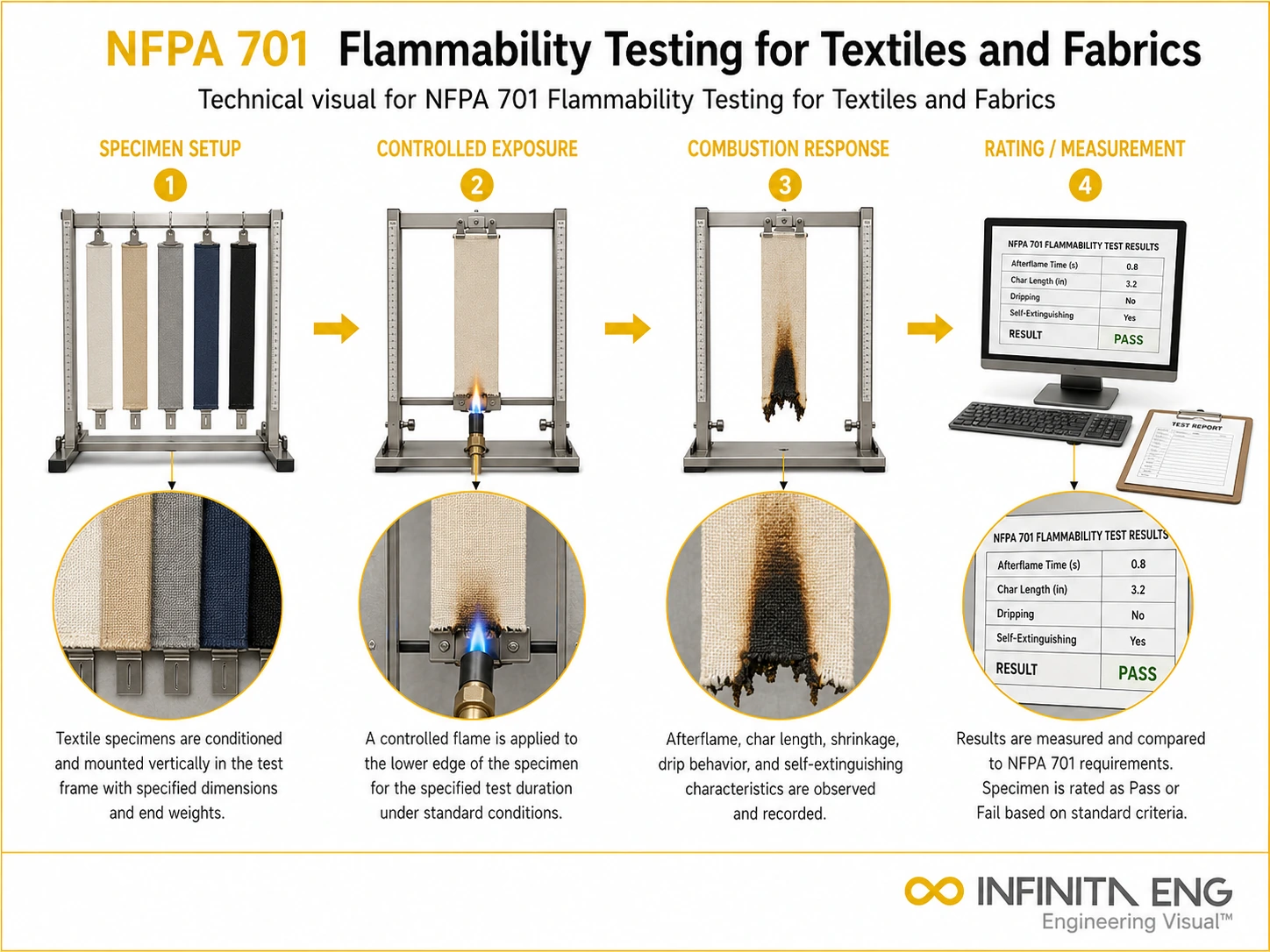
Our NFPA 701 Testing Procedure
Sample Preparation
Specimens are cut to required dimensions, conditioned to specified temperature and humidity levels, and mounted within the test apparatus per NFPA 701 requirements.
1Flame Exposure Application
Specimens are mounted vertically and exposed to an open flame for ~12–15 seconds.
2Flame Observation
After-flame time, char length, and flaming residue are recorded.
3Data Analysis
Results are evaluated against acceptance criteria to determine flame propagation behavior.
4NFPA 701 Test Parameters and Requirements
| Parameter | Details |
|---|---|
| Applicable Materials | Textiles, films, multilayer fabric assemblies, and flexible materials for public and commercial interior applications |
| Test Methods | Method 1 (lightweight fabrics), Method 2 (heavy fabrics) |
| Acceptance Criteria | After-flame <2 sec, char length <6.5 inches |
| Sample Orientation | Vertical mounting |
| Measured Parameters | Char length, afterflame time, flaming drip behavior, and flame propagation |
| Measured Outputs | Flame resistance parameters and formal pass/fail compliance determination |
| Flame Exposure Duration | 12 seconds (Method 1); ~15 seconds (Method 2) |
| Conditioning Requirements | 70 ± 2°F, 65 ± 5% RH, minimum 24 hours prior to testing |


- Calibrated NFPA 701 flame exposure test apparatus
- Specimen conditioning chamber with temperature and humidity control
- Measurement tools for char length and afterflame duration
- Flaming drip observation and recording equipment
- Data acquisition and test logging system
- Certified reference materials for apparatus calibration
Equipment and Instrumentation Used for NFPA 701 Testing
What You Receive: Test Report, Data, and Certification
- Flame exposure test records, including specimen and conditioning details
- Measured char length, afterflame time, and flaming drip data
- Pass/fail compliance determination per NFPA 701 thresholds
- Test condition and specimen preparation summary
- NFPA 701 compliance report
NFPA 701 Flammability FAQs
NFPA 701 ensures that the fabric used in the public domain helps to eliminate fire hazards. Compliance helps protect the occupants, which in turn supports fire safety requirements for materials installed in buildings.
A specimen passes if afterflame time is less than 2 seconds after removal of the ignition source, char length does not exceed 6.5 inches, and there are no flaming drips or burning particles that ignite the tissue paper placed below the specimen. All three criteria must be met — a specimen that passes on char length but produces igniting flaming drips fails the test.
The testing procedure, as per the NFPA 701 protocol, involves burning a textile specimen in a controlled flame, after which the afterflame time and char length are examined to assess compliance with fire safety standards.
NFPA 701 tests assess flame spread characteristics under controlled conditions that may not be representative of actual fire scenarios involving multiple materials, ventilation conditions, and various ignition sources.
Method 1 applies to single-layer fabrics and draperies (small scale), while Method 2 applies to heavier fabrics like vinyl-coated drapes, tents, and tarps (large scale).
Generally, no. It is primarily required for public spaces like hotels, theaters, and schools.
Why Choose Infinita Lab for Flammability Testing
At the core of this breadth is our network of 2,000+ accredited laboratories across the USA, offering access to over 10,000 testing methods and analytical services. From advanced materials characterization (SEM, TEM, RBS, XPS) to mechanical, chemical, environmental, biological, and standardized ASTM/ISO-compliant testing, we deliver unmatched flexibility, specialization, and scale. You are never limited by geography, facility, or methodology — Infinita Lab connects you to the right expertise and testing solution, every time.

Need NFPA 701 Flammability Testing You Can Rely On?
Send query us at hello@infinitalab.com or call us at (888) 878-3090 to learn more about our services and how we can support you.



Request a Quote
Submit your material details and receive testing procedures, pricing, and turnaround time within 24 hours.
 Quick Turnaround and Hasslefree process
 Confidentiality Guarantee
 Free, No-obligation Consultation
 100% Customer Satisfaction
