


Fire Flammability Testing Services
Fire testing is a process used to ensure the safety of materials used in construction, and other applications, by assessing their fire resistance and flammability. Standards and protocols used include ASTM, UL, API, NFPA, UBC, ANSI, IMO, ULVW, AITM, FAA, and IEEE. Tests include those for building construction and materials, fire doors, fire stops, valves, roof fire tests, rapid rise fire tests, and flammability tests.
TRUSTED BY


Get compliant results — request your fire flammability testing quote
- Overview
- Scope, Applications, and Benefits
- Test Process
- Specifications
- Instrumentation
- Results and Deliverables
What Is Fire Flammability?
Fire and flammability testing evaluate how materials and products ignite, burn, spread flame, and generate smoke and toxic gases under defined fire exposure conditions. These tests are critical for demonstrating compliance with fire safety regulations, building codes, transport standards, and consumer product safety requirements.
Comprehensive flammability characterisation covers ignition resistance, flame spread rate, heat release rate, smoke generation, and fire propagation behaviour, supporting material selection, product design, and regulatory certification across construction, transportation, electronics, and consumer products industries.

Applications and Benefits of Fire Flammability Testing
Scope
Fire and flammability testing are used to evaluate how materials respond when exposed to heat, flame, and combustion conditions. These tests help determine ignition behaviour, flame propagation characteristics, heat output, smoke generation, and compliance with safety standards, making them essential for product design, regulatory approval, and material selection.
It typically evaluates:
- Ignition resistance and Limiting Oxygen Index (LOI) to measure the minimum oxygen concentration required to sustain combustion
- Vertical, horizontal, and radiant flame spread to assess how quickly flames propagate across the material surface
- Heat Release Rate (HRR) and Total Heat Release (THR) to quantify the intensity and total energy emitted during burning
- Smoke density and optical obscuration to evaluate visibility reduction and smoke generation in fire conditions
Applications
- Building materials (wall panels, insulation, flooring)
- Electrical and electronic component flammability classification
- Automotive interior materials FMVSS 302
- Aerospace cabin materials FAR 25.853
- Textiles and upholstery (NFPA 701, BS 5852)
Benefits
- Ensures compliance with national and international fire codes
- Supports product certification and market access
- Reduces liability from fire-related product failures
- Guides flame retardant additive selection and optimisation
- Provides pass/fail data for building and transportation approvals
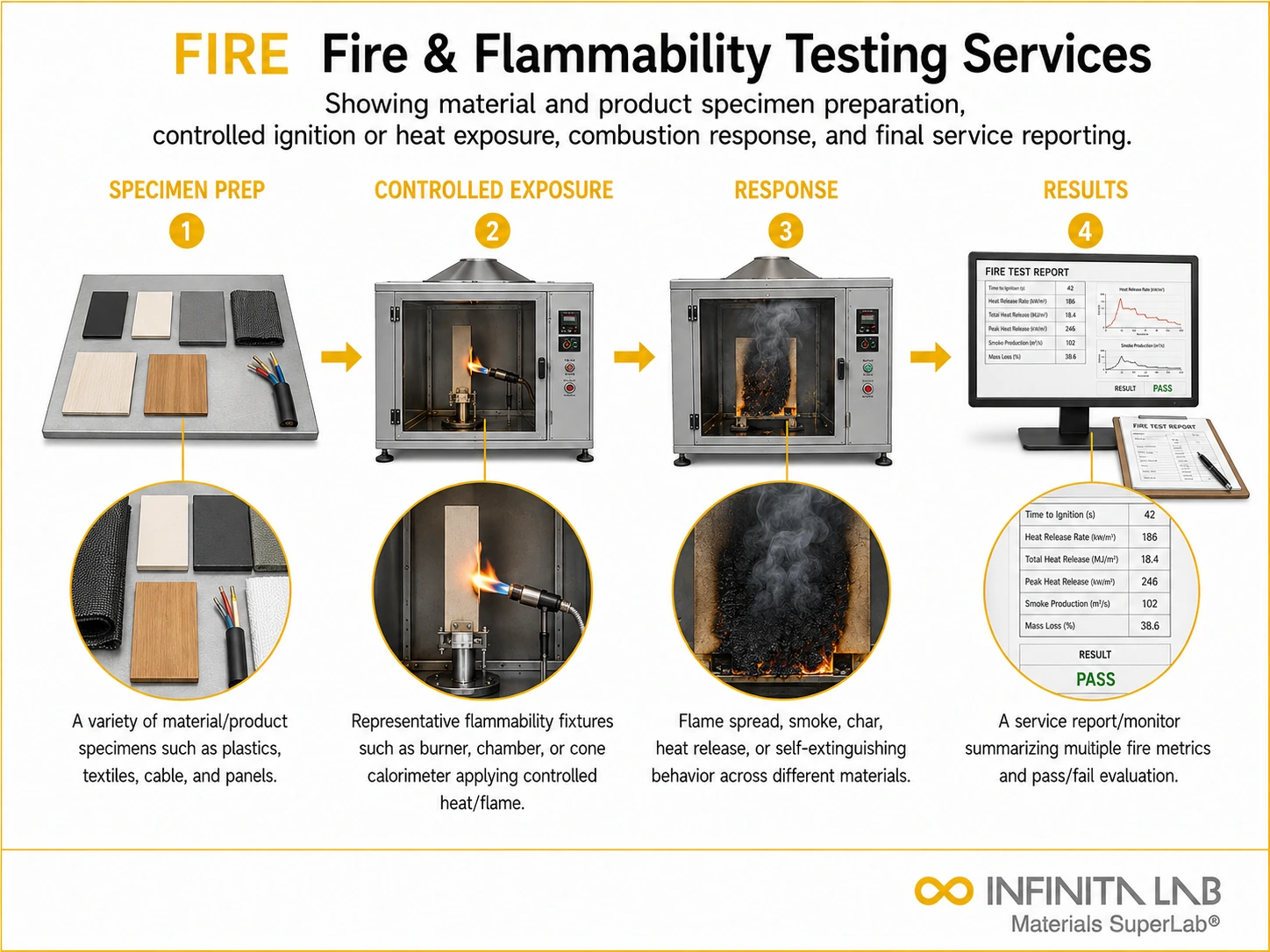
Our Testing Procedure
Specimen Conditioning
Specimens are conditioned as per the required temperature and humidity conditions.
1Flammability Exposure
Samples are exposed to the specified ignition source and test orientation.
2Burn Observation
Flame spread, after flame, afterglow, dripping, and char length are recorded.
3Classification & Reporting
Results are classified per the standard and reported.
4Test parameters and requirements
| Parameter | Details |
|---|---|
| Standards | UL 94, ASTM D635, ASTM E84, ISO 11925-2, EN 13501-1 |
| Test Methods | Horizontal burn, vertical burn, radiant panel, cone calorimeter, LOI |
| Classification Systems | UL 94 (V-0 to HB), EN 13501-1 (A1–F), FAR ratings |
| Key Parameters | After flame time, flame spread rate, HRR, THR, smoke density |


- UL 94 flammability test chamber (vertical/horizontal)
- Cone calorimeter (ISO 5660)
- Radiant panel flame spread apparatus (ASTM E162)
- Limiting oxygen index apparatus (ASTM D2863)
- Smoke density chamber (ASTM E662)
- Forced draft oven for conditioning
Equipment and Instrumentation Used for Testing
What You Receive: Test Report, Data, and Certification
- Flammability classification per applicable standard (UL 94 V-0, HB, etc.)
- After flame and afterglow times, char length, drip observations
- HRR, THR, and smoke production rate (cone calorimeter)
- LOI values
- Full test report with pass/fail determination
Fire Flammability FAQs
UL 94 classifies plastics by their burning behaviour in standard vertical and horizontal burn tests. Classifications range from HB (slowest burning) through V-2, V-1, and V-0 (fastest self-extinguishing, no flaming drip) in vertical orientation, with 5VA and 5VB for more stringent requirements.
UL 94 is a small-scale pass/fail classification test, while the cone calorimeter (ISO 5660) provides quantitative fire performance data including heat release rate, total heat release, smoke production, and mass loss rate, enabling material comparison and fire model input data.
LOI measures the minimum oxygen concentration (in an O₂/N₂ mixture) required to sustain combustion of a downward-burning specimen. Higher LOI values indicate greater flame resistance; materials with LOI > 26 are generally considered self-extinguishing in air.
Yes. Building materials are typically evaluated per EN 13501-1 (Euroclasses) or ASTM E84 (surface burning characteristics). Plastics are most commonly tested per UL 94 or ASTM D635. Automotive and aerospace interiors have dedicated standards (FMVSS 302, FAR 25.853).
UL 94 requires a minimum of 20 specimens (5 specimens × 2 sets × 2 orientations for V-0/V-1/V-2 classification), or 5 specimens per method for HB screening. Additional specimens may be required for complete multi-thickness classification.
Why Choose Infinita Lab for Fire Flammability Testing?
At the core of this breadth is our network of 2,000+ accredited laboratories across the USA, offering access to over 10,000 testing methods and analytical services. From advanced materials characterization (SEM, TEM, RBS, XPS) to mechanical, chemical, environmental, biological, and standardized ASTM/ISO-compliant testing, we deliver unmatched flexibility, specialization, and scale. You are never limited by geography, facility, or methodology — Infinita Lab connects you to the right expertise and testing solution, every time.

Looking for an Accredited Partner for Fire Flammability Testing?
Send query us at hello@infinitalab.com or call us at (888) 878-3090 to learn more about our services and how we can support you.



Request a Quote
Submit your material details and receive testing procedures, pricing, and turnaround time within 24 hours.
 Quick Turnaround and Hasslefree process
 Confidentiality Guarantee
 Free, No-obligation Consultation
 100% Customer Satisfaction
