


Limiting Oxygen Concentration LOC Testing Services
Combustible dust testing is the laboratory examination of finely divided combustible particulate materials that may pose a combustion/flash-fire or explosion danger when suspended in air or another oxidizing medium. The Limiting Oxygen Concentration (LOC) is a type of combustion dust testing that provides a relative estimate of the dust cloud’s deflagration characteristics
TRUSTED BY


Get compliant results — request your limiting oxygen concentration LOC testing quote
- Overview
- Scope, Applications, and Benefits
- Test Process
- Specifications
- Instrumentation
- Results and Deliverables
What Is Limiting Oxygen Concentration LOC?
The Limiting Oxygen Concentration (LOC) test determines the minimum concentration of oxygen required to support combustion of a material in a controlled environment. It is a critical parameter used to evaluate the flammability characteristics and fire resistance of materials.
This test is widely used for polymers, textiles, coatings, and other combustible materials to assess their behavior in oxygen-enriched or oxygen-depleted conditions. By identifying the oxygen threshold required for sustained burning, the LOC test helps in fire risk assessment, material selection, and development of flame-retardant products.

Applications and Benefits of Limiting Oxygen Concentration LOC Testing
Scope
The LOC test evaluates the combustion behavior of materials by determining the oxygen concentration required to sustain flame under controlled laboratory conditions.
- Applicable to polymers, plastics, textiles, and coatings
- Measures minimum oxygen level required for sustained combustion
- Supports fire safety and flammability classification
- Used in development of flame-retardant materials
- Evaluates material performance in controlled gas mixtures
- Applicable for research and quality control purposes
- Helps assess fire hazards in different environments
- Suitable for both rigid and flexible materials
- Supports compliance with fire safety standards
Applications
- Fire safety evaluation of materials
- Development of flame-retardant products
- Polymer and textile flammability testing
- Material selection for safety-critical applications
- Research in combustion behavior
Benefits
- Quantifies flammability characteristics
- Supports fire risk assessment
- Helps improve material safety performance
- Enables comparison of flame resistance
- Assists in regulatory compliance
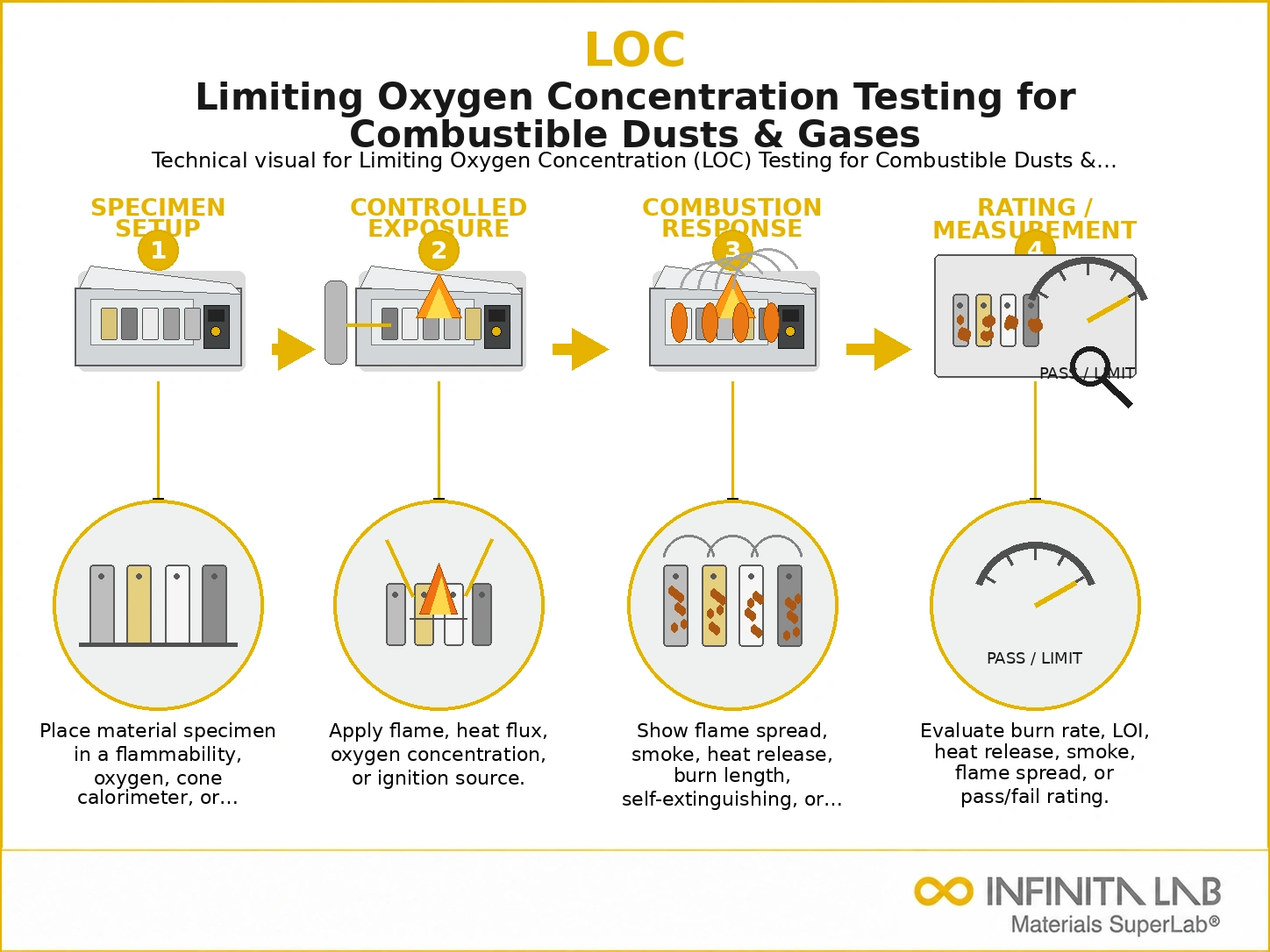
LOC Test Process
Sample Preparation
Material specimen is prepared to standard dimensions and conditioned.
1Gas Mixture Setup
Controlled oxygen and nitrogen mixture is established in the test chamber.
2Ignition and Observation
Sample is ignited and oxygen concentration is adjusted to sustain or extinguish flame.
3LOC Determination
Minimum oxygen concentration supporting combustion is recorded.
4LOC Test Technical Specification
| Parameter | Details |
|---|---|
| Method | Controlled combustion in variable oxygen-nitrogen atmosphere |
| Measurement Type | Minimum oxygen concentration for sustained burning |
| Sample Type | Polymers, textiles, coatings, and solid combustible materials |
| Loading Type | Ignition under controlled gas flow conditions |
| Units | % oxygen concentration (O₂%) |
| Gas Control | Precise oxygen and nitrogen flow regulation |


- Oxygen index test apparatus
- Gas flow controllers (oxygen and nitrogen)
- Vertical combustion chamber
- Ignition source (pilot flame)
- Flow meters and control valves
Equipment and Instrumentation Used for Testing
What You Receive: Test Report, Data, and Certification
- Limiting oxygen concentration (LOC) value (%)
- Flammability classification data
- Comparative material performance analysis
- Test observation and combustion behavior report
- Compliance and certification documentation
Limiting Oxygen Concentration LOC FAQs
LOC defines the minimum oxygen percentage required to sustain combustion. Materials with higher LOC values require more oxygen to burn, indicating better flame resistance, while lower LOC values indicate higher flammability under normal atmospheric conditions.
Unlike ignition tests that provide qualitative results, LOC offers a quantitative threshold of oxygen concentration, enabling precise comparison of materials and better prediction of fire behavior under varying environmental conditions.
Controlled oxygen levels isolate combustion behavior from environmental variability, allowing accurate determination of the minimum oxygen concentration required for sustained burning.
LOC provides an indication of how materials behave in oxygen-limited environments, though actual fire conditions may involve additional factors like heat flux and ventilation.
It provides a standardized measure of flammability, helping ensure materials meet regulatory requirements and reduce fire hazards in practical applications.
Why Choose Infinita Lab for Limiting Oxygen Concentration LOC Testing
At the core of this breadth is our network of 2,000+ accredited laboratories across the USA, offering access to over 10,000 testing methods and analytical services. From advanced materials characterization (SEM, TEM, RBS, XPS) to mechanical, chemical, environmental, biological, and standardized ASTM/ISO-compliant testing, we deliver unmatched flexibility, specialization, and scale. You are never limited by geography, facility, or methodology — Infinita Lab connects you to the right expertise and testing solution, every time.

Looking for an Accredited Partner for Limiting Oxygen Concentration LOC Testing?
Send query us at hello@infinitalab.com or call us at (888) 878-3090 to learn more about our services and how we can support you.



Request a Quote
Submit your material details and receive testing procedures, pricing, and turnaround time within 24 hours.
 Quick Turnaround and Hasslefree process
 Confidentiality Guarantee
 Free, No-obligation Consultation
 100% Customer Satisfaction
