


ASTM D7565: Wet Layup FRP Composite Tensile Testing Services
ASTM D7565M explains the preparation of the sample and tensile testing of Fiber-Reinforced Polymer (FRP) composite materials. This method is applicable for strengthening materials and measuring the tensile properties of FRP composites. The values are measured in either SI units or inch-pound units.
TRUSTED BY


Get ASTM D7565 compliant results — request your wet layup FRP composite tensile testing quote
- Overview
- Scope, Applications, and Benefits
- Test Process
- Specifications
- Instrumentation
- Results and Deliverables
What Is ASTM D7565 Wet Layup FRP Composite Tensile?
ASTM D7565/D7565M covers the determination of tensile properties of fibre-reinforced polymer (FRP) composite laminates used in externally bonded (EB-FRP) strengthening of concrete structures. The standard applies to carbon, glass, and aramid FRP sheets and fabrics bonded to beams, columns, and slabs by the wet lay-up process. The “M” suffix denotes the metric version of the same standard — engineers outside the US typically specify D7565M, and both designations are equally valid for compliance purposes.
Unlike ASTM D3039, which covers structural composite laminates in a general manufacturing context, D7565 is explicitly tied to infrastructure strengthening applications. It addresses dry fabric test coupons and wet lay-up cured laminates, and its three primary design outputs — tensile strength (ffu*), rupture strain (εfu*), and elastic modulus (Ef) — feed directly into ACI 440.2R design equations for flexural, shear, and confinement strengthening of reinforced concrete members.

Applications and Benefits of ASTM D7565 Wet Layup FRP Composite Tensile Testing
Scope
ASTM D7565/D7565M covers uniaxial tensile testing of FRP composite specimens fabricated from carbon, glass, or aramid fibre sheets and fabrics using the wet lay-up process, specifically for use in externally bonded FRP strengthening of concrete structures. Specimens are prepared as either dry fabric coupons or cured wet lay-up laminates and tested to determine laminate-level tensile properties at the specified fibre orientation and thickness. The standard is explicitly referenced by ACI 440.2R and ICC-ES AC178 as the required test method for EB-FRP strengthening system qualification, distinguishing it from general-purpose composite tensile standards such as ASTM D3039.
- Applies to CFRP, GFRP, and AFRP sheets and fabrics used in externally bonded concrete strengthening
- Covers both dry fabric test coupons and wet lay-up cured laminate specimens
- Both D7565 (imperial) and D7565M (metric) designations are valid; D7565M is typically specified outside the US
- Fibre orientation: 0° unidirectional for primary tensile property determination
- Specimen dimensions: 25 mm wide × 250 mm long (nominal)
- Minimum specimen count: 5 per test condition
- Primary design outputs: tensile strength (ffu*), rupture strain (εfu*), and elastic modulus (Ef)
- Data required by ACI 440.2R and ICC-ES AC178 for EB-FRP strengthening system qualification and product certification
- Distinctly different from ASTM D3039 — D7565 is infrastructure-specific and tied to wet lay-up fabrication and ACI design framework
Applications
- Concrete beam flexural strengthening qualification where D7565 tensile data is contractually required for EB-FRP system approval.
- Column confinement FRP wrap systems for seismic retrofit and axial load capacity enhancement of reinforced concrete columns.
- Shear strengthening of reinforced concrete walls and beams using externally bonded FRP sheets.
- Slab-column connection strengthening where punching shear capacity is enhanced using bonded FRP laminates.
- Masonry wall out-of-plane strengthening systems requiring laminate tensile qualification per project specification.
- Product evaluation and ICC-ES listing for FRP strengthening systems requiring compliant D7565/D7565M test data.
- Batch quality control during EB-FRP strengthening installation to confirm consistency with the qualified system properties.
Benefits
- Provides the three ACI 440.2R design properties — ffu*, εfu*, and Ef — directly from laminate-level testing rather than relying on dry fibre manufacturer data.
- Both imperial (D7565) and metric (D7565M) designations supported, enabling compliance for US and international infrastructure projects.
- Explicitly recognised by ACI 440.2R and ICC-ES AC178, making test reports directly usable for structural design submission and product certification.
- Distinguishes wet lay-up laminate performance from idealised factory composite data, reflecting actual installed system properties.
- Applicable across CFRP, GFRP, and AFRP strengthening systems, covering the full range of EB-FRP products used in infrastructure rehabilitation.
- Supports both new product qualification and project-specific material verification for reinforced concrete strengthening programs.
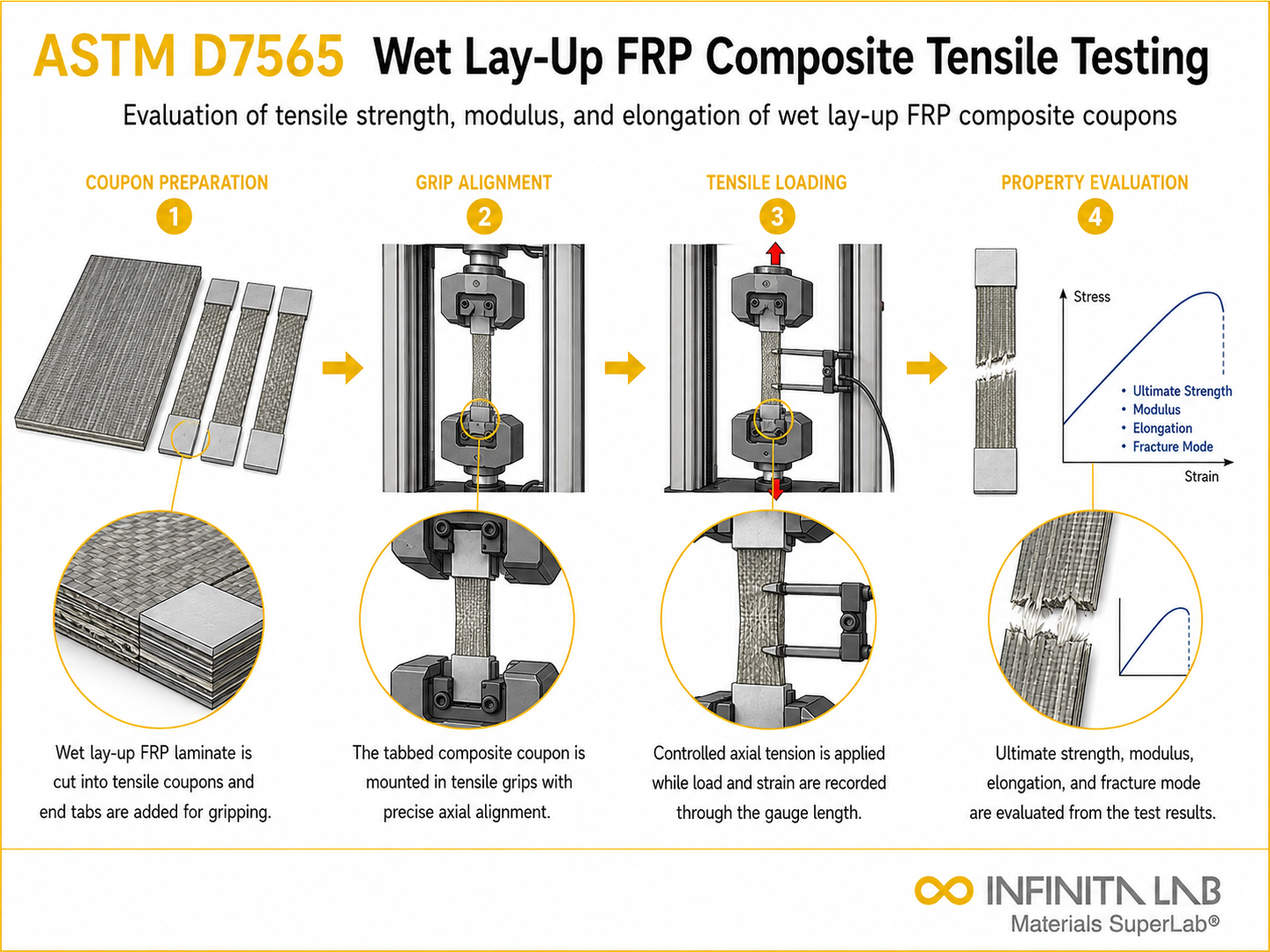
Our ASTM D7565 Testing Procedure
Specimen Preparation
Prepare straight-sided FRP specimens to specified dimensions, apply tabs if required, and condition as per test requirements.
1Instrumentation Setup
Mount strain gauges or an extensometer on the specimen and set up the UTM with proper alignment and gripping.
2Tensile Loading
Apply axial tensile load at a controlled rate until specimen failure.
3Data Analysis & Reporting
Calculate tensile strength, modulus, and strain at failure, and report results
4ASTM D7565 Test Parameters and Requirements
| Parameter | Details |
|---|---|
| Specimen type | Straight-sided flat composite coupon |
| Typical Thickness | Commonly 1–5 mm |
| Specimen dimensions | 25 mm wide × 250 mm long (nominal) |
| Gauge Length | Commonly 50 mm or as required |
| Fibre orientation | 0° unidirectional |
| Loading Mode | Uniaxial tensile loading |
| Measured Parameters | Ultimate tensile strength, Strain at failure |
| Minimum specimen count | 5 per test condition |


- Universal Testing Machine (UTM)
- Load Cell
- Extensometer
- Strain Gauges
- Mechanical or Hydraulic Grips
- Data Acquisition System (DAQ)
- Environmental Chamber
- Alignment Verification Tools
Equipment and Instrumentation Used for ASTM D7565 Testing
What You Receive: Test Report, Data, and Certification
- Ultimate Tensile Strength
- Tensile Modulus of Elasticity
- Strain at Failure
- Stress–Strain Curve
- Load vs. Displacement Data
- Failure Mode Classification
- Test Report
ASTM D7565 Wet Layup FRP Composite Tensile FAQs
ASTM D7565 is a tensile test standard for fiber-reinforced polymer laminates, in which specialized gripping techniques are used to avoid any damage, and the maximum tensile load supported per unit width of the composite material system is measured.
The ASTM D7565 is different from other plastic tests because the values are normalized by width instead of thickness, which is more applicable for thin layers of FRP where the thickness is not consistent.
ASTM D7565 is mainly employed in civil infrastructure projects such as bridge repair, seismic retrofitting, commercial building repair, and marine structures where fiber-reinforced polymer laminates are used to improve the tensile strength of the structure.
ASTM D7565 specifies that rectangular composite coupons shall have bonded end tabs, which prevent damage to fibers in the grip area and allow for the measurement of tensile strength per unit width.
In contrast to tensile standards based on thickness, ASTM D7565 emphasizes load capacity per width. This is a more accurate representation of the in-situ behavior of externally bonded FRP systems on concrete, steel, or masonry structures.
Why Choose Infinita Lab for Wet Layup FRP Composite Tensile Testing?
At the core of this breadth is our network of 2,000+ accredited laboratories across the USA, offering access to over 10,000 testing methods and analytical services. From advanced materials characterization (SEM, TEM, RBS, XPS) to mechanical, chemical, environmental, biological, and standardized ASTM/ISO-compliant testing, we deliver unmatched flexibility, specialization, and scale. You are never limited by geography, facility, or methodology — Infinita Lab connects you to the right expertise and testing solution, every time.

Need ASTM D7565 Wet Layup FRP Composite Tensile Testing You Can Rely On?
Send query us at hello@infinitalab.com or call us at (888) 878-3090 to learn more about our services and how we can support you.



Request a Quote
Submit your material details and receive testing procedures, pricing, and turnaround time within 24 hours.
 Quick Turnaround and Hasslefree process
 Confidentiality Guarantee
 Free, No-obligation Consultation
 100% Customer Satisfaction
