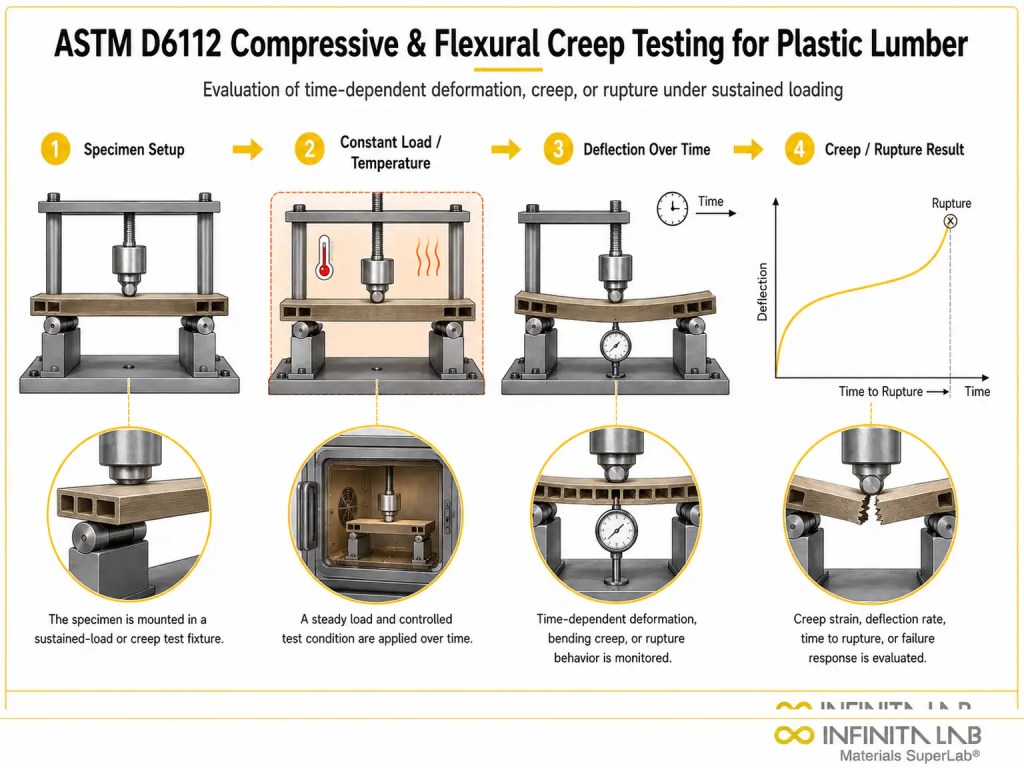


What Is ASTM D6112 Plastic Lumber Compressive Flexural Creep?
ASTM D6112 defines standardized procedures to evaluate the long-term creep behavior and creep-rupture performance of plastic lumber under compressive and flexural loading conditions. It helps determine how materials deform over time when subjected to constant stress levels.
The test is essential for assessing durability and structural reliability of plastic lumber used in load-bearing or outdoor applications. It provides insights into time-dependent deformation, failure limits, and material stability, ensuring safe design and performance over extended service periods.
Applications and Benefits of ASTM D6112 Plastic Lumber Compressive Flexural Creep Testing
Scope
This test method covers the determination of creep deformation and creep-rupture characteristics of plastic lumber materials under sustained loads in controlled environments. It evaluates both compressive and flexural loading conditions to simulate real-world applications.
Includes:
- Measurement of time-dependent deformation under constant load
- Determination of creep modulus and strain behavior
- Evaluation of creep-rupture time and stress limits
- Testing under compressive and flexural modes
- Suitability for plastic lumber and similar structural profiles
Applications
- Decking and outdoor structural components
- Plastic lumber used in bridges and walkways
- Marine and waterfront structures
- Fencing and railing systems
- Load-bearing plastic profiles in construction
- Recycled plastic structural products
Benefits
- Predicts long-term deformation behavior
- Ensures structural safety over time
- Helps in material selection and design optimization
- Identifies creep-rupture limits
- Supports quality control and product development
- Enhances reliability in outdoor applications
Our ASTM D6112 Testing Procedure
Specimen Preparation
Plastic lumber samples are prepared with specified dimensions and conditioned before testing.
1Load Application
A constant compressive or flexural load is applied to the specimen for a defined duration.
2Creep Monitoring
Deformation is continuously measured over time under sustained loading conditions.
3Failure Evaluation
Time to rupture or maximum deformation is recorded to determine creep-rupture characteristics.
4ASTM D6112 Test Parameters and Requirements
| Parameter | Details |
|---|---|
| Loading Modes | Compressive and flexural |
| Test Type | Creep and creep-rupture |
| Temperature | Controlled or ambient conditions |
| Duration | Short-term to long-term (hours to months) |
| Measurement | Strain or deflection vs time |
| Stress Levels | Multiple stress levels can be applied |
| Specimen Type | Plastic lumber profiles |
| Output | Creep curve and rupture data |
| Environment | Controlled humidity and temperature |


- Universal Testing Machine (UTM) with creep setup
- Creep frames or loading rigs
- Deflection gauges or LVDTs
- Environmental chamber (if required)
- Load application weights or dead-load systems
- Data acquisition system
Equipment and Instrumentation Used for ASTM D6112 Testing
What You Receive: Test Report, Data, and Certification
- Creep strain vs time curves
- Creep modulus data
- Time-to-rupture values
- Stress vs rupture relationship
- Deformation behavior analysis
- Test report with compliance details
ASTM D6112 Plastic Lumber Compressive Flexural Creep FAQs
ASTM D6112 is used to evaluate the long-term creep and creep-rupture behavior of plastic lumber under compressive and flexural loads. It helps determine how materials deform or fail over time when subjected to constant stress conditions.
Creep testing is important because plastic lumber is often used in structural applications where long-term loads are present. It ensures that the material maintains its shape, strength, and safety over extended periods without excessive deformation or failure.
Creep-rupture refers to the failure of a material after prolonged exposure to a constant load. It indicates the time at which the material breaks or fails due to continuous stress, even if the load is below its short-term strength.
Immediate deformation occurs as soon as a load is applied, while creep is the gradual deformation that happens over time under constant load. ASTM D6112 specifically measures this time-dependent deformation behavior.
Higher temperatures generally increase creep rates, leading to faster deformation and earlier failure. ASTM D6112 allows testing under controlled temperatures to study these effects on plastic lumber materials.
Why Choose Infinita Lab for Plastic Lumber Compressive Flexural Creep Testing?
At the core of this breadth is our network of 2,000+ accredited laboratories across the USA, offering access to over 10,000 testing methods and analytical services. From advanced materials characterization (SEM, TEM, RBS, XPS) to mechanical, chemical, environmental, biological, and standardized ASTM/ISO-compliant testing, we deliver unmatched flexibility, specialization, and scale. You are never limited by geography, facility, or methodology — Infinita Lab connects you to the right expertise and testing solution, every time.

Looking for an Accredited Partner for ASTM D6112 Plastic Lumber Compressive Flexural Creep Testing?
Send query us at hello@infinitalab.com or call us at (888) 878-3090 to learn more about our services and how we can support you.



