


ASTM D6992: Geosynthetic Accelerated Creep Stepped Isothermal Testing Services
ASTM D6992 aims to cover accelerated testing for tensile creep, and tensile creep-rupture properties using the Stepped Isothermal Method (SIM). Tensile tests are to be completed before SIM tests and the results are used to determine the stress levels for subsequent SIM tests. Its values are stated as per international standards.
TRUSTED BY


Get ASTM D6992 compliant results — request your geosynthetic accelerated creep stepped isothermal testing quote
- Overview
- Scope, Applications, and Benefits
- Test Process
- Specifications
- Instrumentation
- Results and Deliverables
What Is ASTM D6992 Geosynthetic Accelerated Creep Stepped Isothermal?
ASTM D6992 covers accelerated tensile creep and creep-rupture testing of geosynthetic materials using the Stepped Isothermal Method (SIM) — a time-temperature superposition (TTS) technique that compresses what would otherwise require 10,000+ hours of real-time testing into a single laboratory session lasting hours to days.
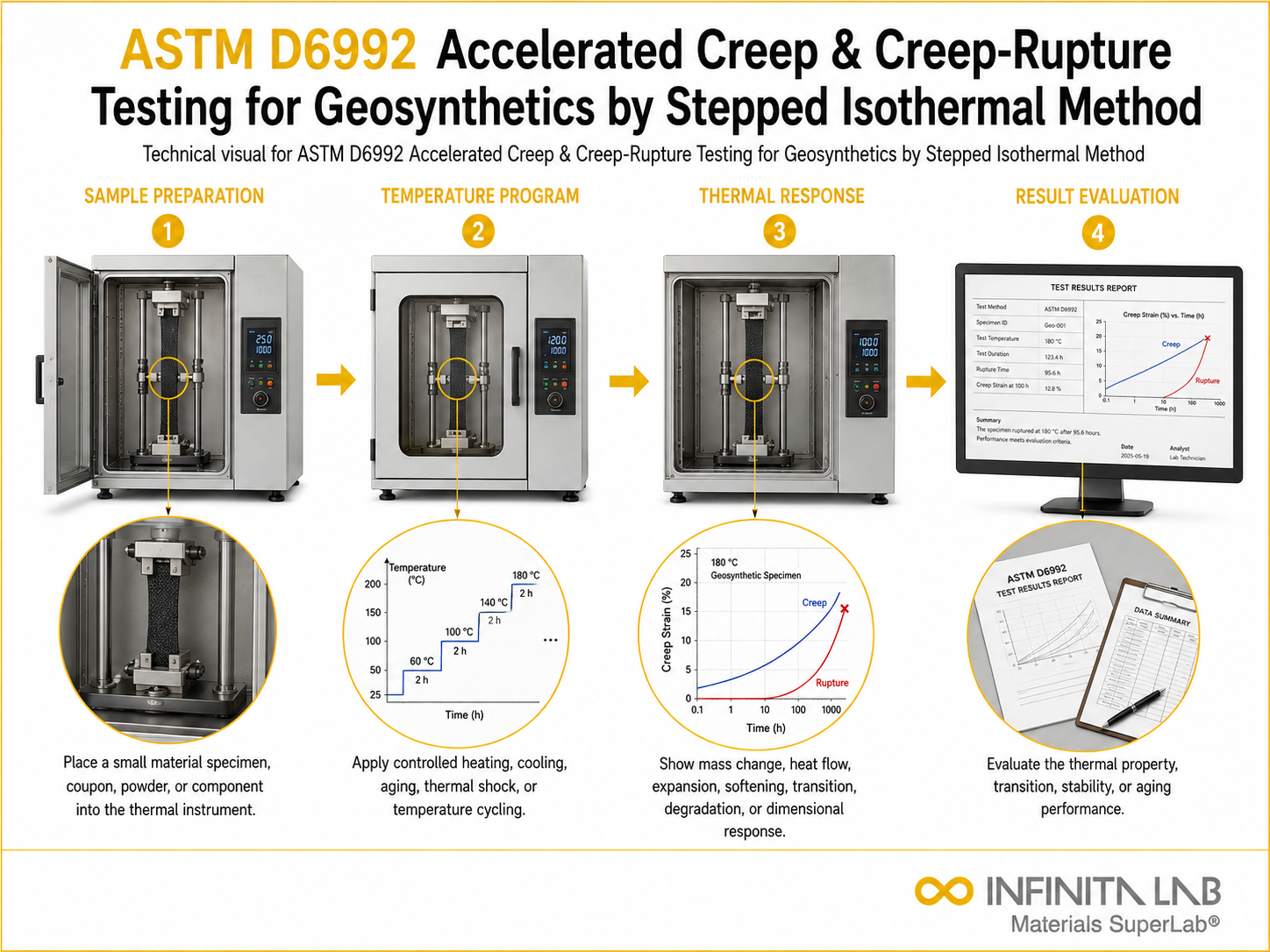
The principle: a geosynthetic specimen is held under constant tensile load while temperature is increased in a series of discrete steps. At each step, the material creeps faster because polymer chain mobility increases with temperature. The strain response at each temperature step is recorded and then mathematically shifted using TTS shift factors to construct a master creep curve — a single projected curve representing long-term creep behaviour at the reference (in-service) temperature, often extended to 100-year service life.
This is the fundamental distinction from conventional creep testing: SIM generates long-term predictions from short-duration tests. No extrapolation from limited data points, no years of test runtime.

Applications and Benefits of ASTM D6992 Geosynthetic Accelerated Creep Stepped Isothermal Testing
Scope
ASTM D6992 should not be confused with conventional geosynthetic creep testing under ASTM D5262. Both evaluate long-term tensile creep behaviour of geosynthetics, but differ significantly in methodology, test duration, and engineering application. ASTM D5262 measures creep in real time under constant load and temperature, running for months to years. ASTM D6992 uses the Stepped Isothermal Method (SIM) with time-temperature superposition (TTS) to compress long-term creep prediction into a test lasting hours to days. For design engineers working to FHWA or AASHTO guidelines, this distinction determines which standard to specify.
- D5262 records actual creep at constant load and temperature over extended periods — practical for compliance but cannot feasibly cover a 75–100 year design life
- D6992 applies incremental temperature steps to the loaded specimen and uses TTS to construct a master creep curve projecting 10,000+ hours of behaviour from a single short test
- D6992 is the accepted method under FHWA and AASHTO guidelines for deriving the creep reduction factor (RF_CR) used in MSE wall and reinforced slope design
- Where both are required, D5262 provides real-time verification data; D6992 provides the design-critical long-term prediction
Applications
- Product qualification testing.
- Quality control in panel manufacturing.
- Performance comparison of engineered wood products.
- Evaluation for furniture and cabinetry materials.
- Building material durability assessment.
- Mechanically Stabilized Earth (MSE) walls
- Reinforced steep slopes
- Embankments over soft ground
- Mining heap leach pads
Benefits
- Simulates real-world humidity fluctuations.
- Identifies dimensional stability issues.
- Supports product development and improvement.
- Enables standardized material comparison.
- Enhances reliability in end-use applications.
Our ASTM D6992 Testing Procedure
Specimen Preparation
Cut panel specimens to specified dimensions and condition them to the initial equilibrium moisture content.
1Humidity Cycling Exposure
Place specimens in a chamber and expose them to cyclic high and low humidity.
2Property Evaluation
Measure dimensional changes such as thickness swell and linear expansion after specified cycles.
3Data Analysis & Reporting
Compare results to initial values and report per ASTM guidelines.
4ASTM D6992 Test Parameters and Requirements
| Parameter | Details |
|---|---|
| Material Type | Wood-based fiberboard and particleboard panels |
| Specimen Conditioning | Pre-conditioned to constant mass |
| Exposure | Cyclic high and low relative humidity |
| Temperature | Controlled during testing |
| Output Format | Creep rupture envelope, Master creep curve, Rupture reduction factor |
| Specimen Width | 200 mm |
| Load Level | 10–60% of ultimate tensile strength (TULT) |
| Temperature Step Protocol | Generally 5 steps, with increments of 5–10°C, each maintained for approximately 1 hour |


- Environmental Chamber (Humidity & Temperature Controlled)
- Digital Thickness Gauge
- Vernier Caliper / Micrometer
- Analytical Balance
- Steel Scale / Measuring Rule
- Data Recording System
Equipment and Instrumentation Used for ASTM D6992 Testing
What You Receive: Test Report, Data, and Certification
- Thickness Swell (%)
- Linear Expansion (%)
- Weight Change (%)
- Visual Inspection Report (Warping, Cracking, Delamination)
- Humidity Cycle Details
- Creep Reduction Factor
- Dimensionless factor used to determine long-term design strength of geosynthetics
- Complete Test Report
ASTM D6992 Geosynthetic Accelerated Creep Stepped Isothermal FAQs
ASTM D6992 is a standard that describes a method for assessing the accelerated tensile creep and creep-rupture behavior of geosynthetic materials using time-temperature superposition and the stepped isothermal method.
Activation energy provides insight into the material's temperature sensitivity, which controls the material's long-term creep behavior.
The test conditions will be controlled using thermal chambers with precise temperature control systems to keep the temperatures isothermal during each step.
Yes, the test can predict the long-term performance of materials and estimate their lifetime in structural applications.
The method is mainly used for geosynthetic materials, including geotextiles, geogrids, and geomembranes.
Why Choose Infinita Lab for Geosynthetic Accelerated Creep Stepped Isothermal Testing
At the core of this breadth is our network of 2,000+ accredited laboratories across the USA, offering access to over 10,000 testing methods and analytical services. From advanced materials characterization (SEM, TEM, RBS, XPS) to mechanical, chemical, environmental, biological, and standardized ASTM/ISO-compliant testing, we deliver unmatched flexibility, specialization, and scale. You are never limited by geography, facility, or methodology — Infinita Lab connects you to the right expertise and testing solution, every time.

Need ASTM D6992 Geosynthetic Accelerated Creep Stepped Isothermal Testing You Can Rely On?
Send query us at hello@infinitalab.com or call us at (888) 878-3090 to learn more about our services and how we can support you.



Request a Quote
Submit your material details and receive testing procedures, pricing, and turnaround time within 24 hours.
 Quick Turnaround and Hasslefree process
 Confidentiality Guarantee
 Free, No-obligation Consultation
 100% Customer Satisfaction
