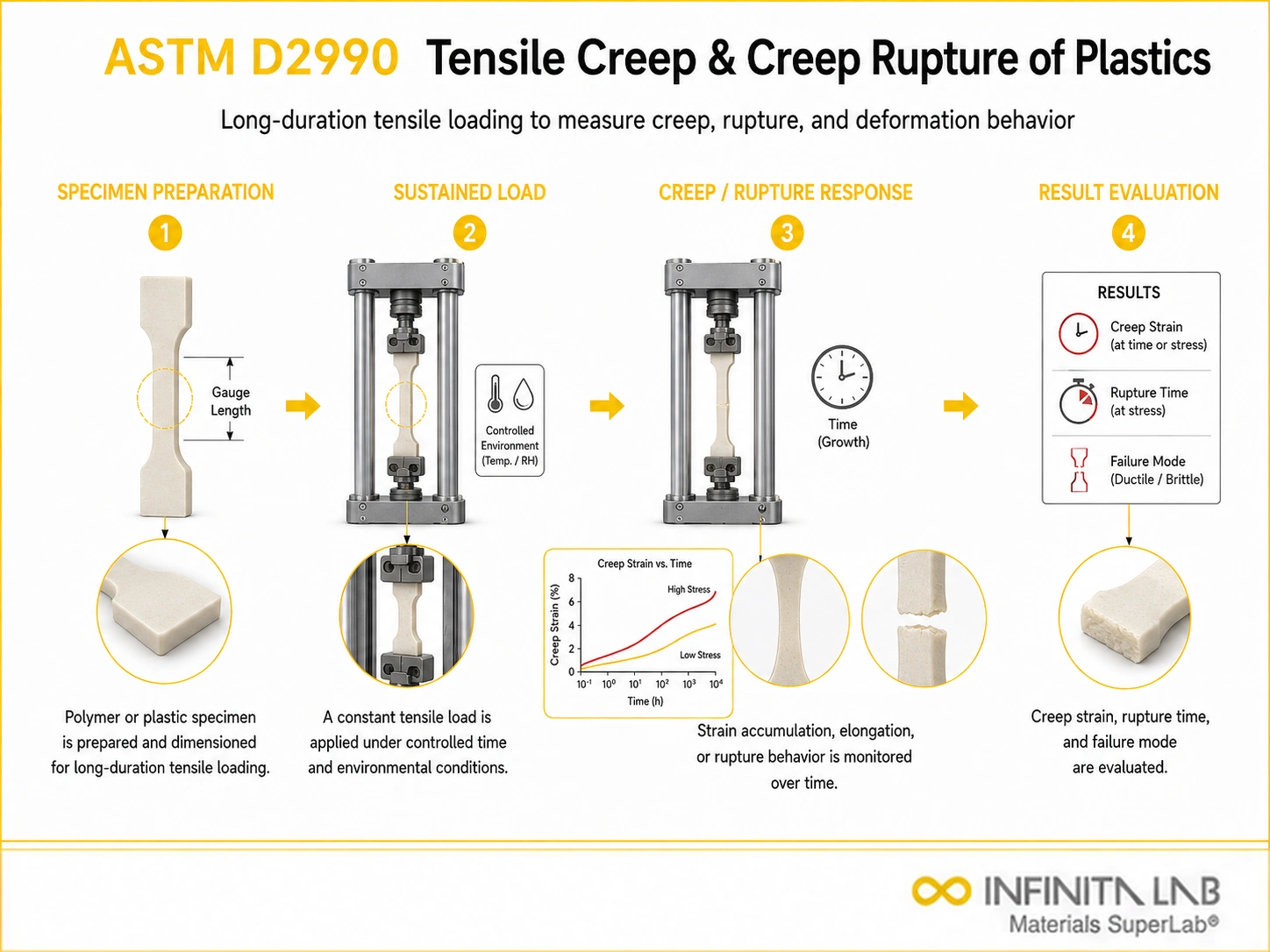


Overview
ASTM D 2990 is a standard procedure for testing the creep and creep-rupture properties of plastic materials under constant mechanical load. This test procedure is used to determine the deformation of plastic materials under constant stress.
This procedure requires applying a constant tensile, compressive, or flexural load to a plastic sample and measuring the deformation at regular time intervals. The results obtained are used to determine the material’s long-term properties.
ASTM D 2990 requires specific procedures for preparing the samples, loading, environmental conditions, and data recording. The procedure is widely accepted because of its accuracy and practicality.

Scope, Applications, and Benefits
Scope
ASTM D 2990 is employed to determine the long-term mechanical response of plastics and polymeric materials under constant mechanical loads. The test procedure helps in understanding the material’s time-dependent deformation characteristics.
ASTM D 2990 evaluates:
- Long-term creep deformation of plastics
- Creep-rupture characteristics
- Tensile, compressive, and flexural creep behavior
- Dimensional stability under constant load
- Time-dependent strain response
- Material durability
Applications
- Plastic pipes and fittings
- Structural plastic components
- Construction and building materials
- Automotive plastic parts
- Electrical enclosures
- Industrial polymer products
- Research and development
- Product life prediction
Benefits
- Provides standardized creep data
- Predicts long-term material performance
- Assists in material selection
- Supports product design validation
- Enables comparison between materials
- Improves reliability and safety
- Aids failure analysis
Test Process
Specimen Preparation & Setup
Plastic specimens are prepared to specified dimensions, conditioned, and mounted in the testing frame.
1Load Application
A constant tensile, compressive, or flexural load is applied and maintained throughout the test.
2Deformation Measurement
Strain or displacement is measured at defined time intervals during loading.
3Data Recording & Verification
Creep or creep-rupture data is recorded and verified in accordance with ASTM guidelines.
4Technical Specifications
| Parameter | Details |
|---|---|
| Applicable Materials | Plastic and polymeric materials |
| Loading Modes | Tensile, compressive, flexural |
| Test Temperature | Ambient or specified conditions |
| Measured Outputs | Strain vs. time, creep modulus, time to rupture |


- Creep and creep-rupture testing machine
- Load the application system
- Extensometers or displacement sensors
- Environmental control chamber
- Data recording software
- Calibration reference equipment
Instrumentation Used for Testing
Results and Deliverables
- Creep strain vs. time data
- Creep modulus results
- Time-to-rupture values
- Comparative material reports
- Compliance report
Frequently Asked Question
Creep: Creep is the time-dependent deformation of a material that occurs under constant load. It is important because it can lead to a loss of fit or failure of a structure over a period of months or years.
ASTM D2990 involves applying a constant load to a plastic sample and measuring the deformation with extensometers. The test is usually performed for hundreds or thousands of hours at a specified temperature.
Tensile creep is the measurement of the elongation of a material when subjected to a constant load. Compressive creep is the reduction in thickness under compression, which is important for components that support weight or maintain sealing pressure.
ASTM D2990 is generally required in the construction industry, automotive industry, medical industry, and electronics industry, where the polymer components are subjected to continuous loads, high temperatures, and long life without unacceptable deformation.
ASTM D2990 may require protracted test times. It is not a predictive method of failure time and is often used in conjunction with other accelerated methods or creep rupture testing.
Why Choose Infinita Lab for Advanced Materials Testing and Characterization?
At the core of this breadth is our network of 2,000+ accredited laboratories across the USA, offering access to over 10,000 testing methods and analytical services. From advanced materials characterization (SEM, TEM, RBS, XPS) to mechanical, chemical, environmental, biological, and standardized ASTM/ISO-compliant testing, we deliver unmatched flexibility, specialization, and scale. You are never limited by geography, facility, or methodology — Infinita Lab connects you to the right expertise and testing solution, every time.

Looking for a Trusted Partner for Accurate and Reliable Testing Services?
Send query us at hello@infinitalab.com or call us at (888) 878-3090 to learn more about our services and how we can support you.





