


ASTM E1457: Creep Crack Growth Times Rates Testing Services
Using pre-cracked specimens subjected to elevated temperatures under static or quasi-static loading conditions, this test method ASTM E1457 determines the time for a creep crack to grow on initial load (CCI) and subsequent creep crack growth (CCG) rates in metals at elevated temperatures.
TRUSTED BY


Get ASTM E1457 compliant results — request your creep crack growth times rates testing quote
- Overview
- Scope, Applications, and Benefits
- Test Process
- Specifications
- Instrumentation
- Results and Deliverables
What Is ASTM E1457 Creep Crack Growth Times Rates?
ASTM E1457 defines a method for determining creep crack growth behavior in metals subjected to elevated temperatures and sustained loads. It evaluates how cracks initiate and propagate over time under constant stress, providing critical insights into time-dependent fracture mechanisms.
This standard is essential for assessing long-term structural integrity in high-temperature applications such as power plants, turbines, and pressure vessels. By measuring crack growth rates and time to failure, engineers can predict service life and ensure safe operation of components exposed to creep conditions, where deformation and cracking occur gradually over extended periods.

Applications and Benefits of ASTM E1457 Creep Crack Growth Times Rates Testing
Scope
ASTM E1457 applies to the determination of creep crack growth rates and time-to-failure in metallic materials under constant load and high temperature conditions.
- Evaluation of creep crack growth in metals
- Applicable under sustained loading conditions
- High-temperature testing environment
- Measurement of crack initiation and propagation
- Used for life prediction of structural components
Applications
- Power plant components (boilers, turbines)
- Aerospace high-temperature structures
- Petrochemical pressure vessels
- Nuclear reactor materials
- Industrial furnaces and heat exchangers
- Material durability and life assessment
Benefits
- Predicts long-term material performance
- Helps prevent catastrophic failure
- Improves safety in high-temperature systems
- Provides data for life extension decisions
- Supports material selection and design
- Enhances reliability of critical components
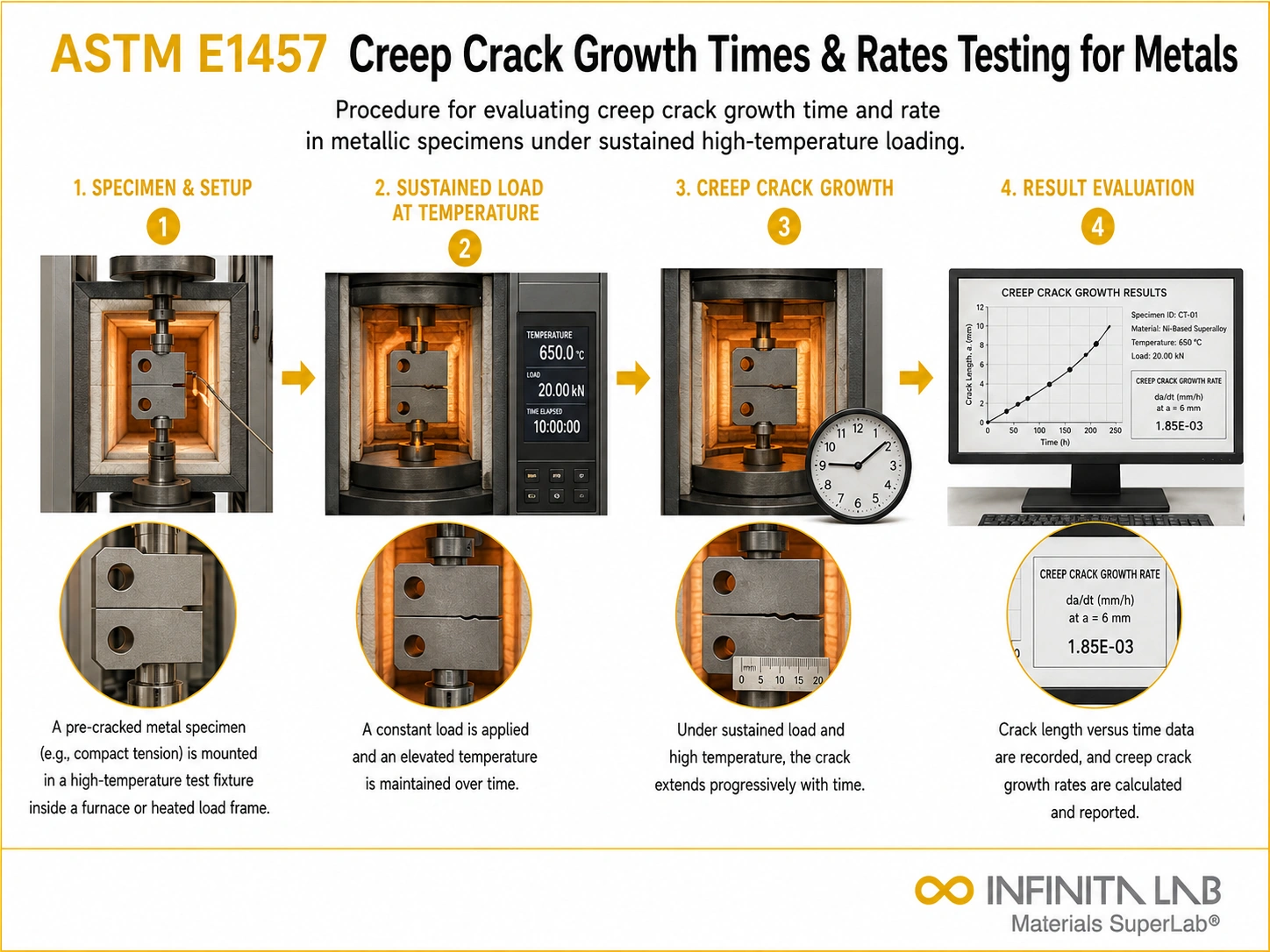
Our ASTM E1457 Testing Procedure
Specimen Preparation
Prepare notched or pre-cracked specimen with precise dimensions.
1High-Temperature Exposure
Heat specimen to required temperature and stabilize.
2Load Application
Apply constant load or stress to initiate creep conditions.
3Crack Monitoring
Measure crack growth over time until failure or specified limit.
4ASTM E1457 Test Parameters and Requirements
| Parameter | Details |
|---|---|
| Test Temperature | Elevated (material-specific, often above 0.4Tm) |
| Loading Type | Constant load or constant displacement |
| Material Type | Metallic materials |
| Crack Monitoring | Optical or compliance-based methods |
| Crack Length Measurement | Continuous or periodic |
| Stress Intensity Factor | Used for crack growth analysis |
| Specimen Type | Pre-cracked or notched specimens |
| Output | Crack growth rate vs. time or stress intensity |


- High-temperature creep testing machine
- Furnace with temperature control system
- Crack growth measurement system
- Extensometers or displacement sensors
- Load frame and control system
- Data acquisition system
- Optical or compliance measurement tools
Equipment and Instrumentation Used for ASTM E1457 Testing
What You Receive: Test Report, Data, and Certification
- Creep crack growth rate curves
- Time-to-failure data
- Stress intensity factor vs. crack growth
- Material creep resistance evaluation
- Test report with detailed analysis
- Life prediction data
ASTM E1457 Creep Crack Growth Times Rates FAQs
Creep crack growth refers to the gradual propagation of cracks in metals under constant stress at elevated temperatures. This phenomenon occurs due to time-dependent plastic deformation, which weakens the material over prolonged exposure to high temperatures and applied loads.
ASTM E1457 provides a standardized method to evaluate how materials behave under long-term stress and heat. It helps engineers predict failure, ensuring safe operation of critical components in industries like power generation and aerospace.
Creep is a time-dependent deformation under constant load at high temperature, whereas fatigue results from cyclic loading. Creep crack growth occurs slowly over time, while fatigue cracks grow due to repeated stress cycles.
Higher temperatures accelerate atomic diffusion and dislocation movement, increasing the rate of creep deformation and crack growth. Temperature is a critical factor in determining material performance under these conditions.
Crack initiation is the formation of a crack, while crack growth refers to its propagation over time. Both are critical in assessing material durability under creep conditions.
Why Choose Infinita Lab for Creep Crack Growth Times Rates Testing?
At the core of this breadth is our network of 2,000+ accredited laboratories across the USA, offering access to over 10,000 testing methods and analytical services. From advanced materials characterization (SEM, TEM, RBS, XPS) to mechanical, chemical, environmental, biological, and standardized ASTM/ISO-compliant testing, we deliver unmatched flexibility, specialization, and scale. You are never limited by geography, facility, or methodology — Infinita Lab connects you to the right expertise and testing solution, every time.

Looking for an Accredited Partner for ASTM E1457 Creep Crack Growth Times Rates Testing?
Send query us at hello@infinitalab.com or call us at (888) 878-3090 to learn more about our services and how we can support you.



Request a Quote
Submit your material details and receive testing procedures, pricing, and turnaround time within 24 hours.
 Quick Turnaround and Hasslefree process
 Confidentiality Guarantee
 Free, No-obligation Consultation
 100% Customer Satisfaction
