


ASTM D7291: Through Thickness Flatwise Tensile Strength And Elastic Modulus Testing Services
Accredited ASTM D7291 through thickness flatwise tensile strength and elastic modulus testing from Infinita Lab, performed to the exact standard requirements - accurate, reproducible results with full documentation for compliance, R&D, and quality control programs.
TRUSTED BY


Get ASTM D7291 compliant results - request your through thickness flatwise tensile strength and elastic modulus testing quote
- Overview
- Scope, Applications, and Benefits
- Test Process
- Specifications
- Instrumentation
- Results and Deliverables
What Is ASTM D7291 Through Thickness Flatwise Tensile Strength And Elastic Modulus?
ASTM D7291 is the standard test method engineers turn to when they need to understand a composite laminate’s through-thickness, or “flatwise,” tensile strength and elastic modulus. It answers a different question than conventional in-plane tensile testing does. Where in-plane testing pulls a laminate along the direction of its fibers, this method applies tensile force perpendicular to the laminate plane, in the Z-direction, to see how well the layers of a composite resist being pulled apart. Because composite laminates and sandwich structures are built up from stacked plies or bonded facesheet-core assemblies, their through-thickness properties tend to run far weaker than their in-plane properties, and they’re governed largely by the matrix resin and interlaminar bond quality rather than the reinforcing fibers themselves. That makes through-thickness tensile behavior a critical, and often overlooked, factor in structural design and failure analysis.
In the ASTM D7291 procedure, a cylindrical composite specimen is adhesively bonded between two loading blocks using a bonding fixture built to maintain axial alignment, since misalignment during bonding is a well-recognized source of test variability. The assembly is then pulled in tension along the specimen axis until it fails within the laminate, and force-versus-displacement data, along with strain data when instrumented, are recorded to calculate ultimate flatwise tensile strength and elastic modulus.
This data matters most to engineers working with thick-section laminates, bonded sandwich panels, and structures where delamination or core-to-facesheet debonding is a primary failure concern. Infinita Lab connects manufacturers, designers, and quality teams with accredited labs that run ASTM D7291 testing with proper fixture control, specimen alignment, and reporting rigor, delivering the data needed for structural design validation, quality assurance, and material qualification programs.

Applications and Benefits of ASTM D7291 Through Thickness Flatwise Tensile Strength And Elastic Modulus Testing
Scope
- This test method determines the flatwise, or through-thickness, tensile strength and elastic modulus of fiber-reinforced polymer matrix composite materials and sandwich constructions.
- Rather than pulling in the fiber direction, tensile force is applied perpendicular to the plane of the laminate, along the Z-axis.
- It covers composites reinforced with continuous fibers, including unidirectional tape or two-dimensional fabric layups.
- Discontinuous-fiber composites fall under its scope too, such as nonwoven mats or chopped fiber constructions.
- Before testing, cylindrical specimens, either straight-sided disks or reduced-gauge-section spools, are adhesively bonded between metal loading blocks.
- A dedicated bonding fixture keeps the specimen aligned to the blocks during that bonding step, which helps minimize off-axis loading once testing begins.
- For thicker specimens, a tapered or reduced-area gauge section is sometimes used to encourage failure away from the bonded end blocks.
- Because ASTM D7291 and ASTM D6415 generate different stress distributions and stressed volumes within the specimen, results reported under this standard aren’t directly comparable to those from D6415.
- A valid test result requires that failure occur within the composite material itself, not at the adhesive bond line or within the loading blocks.
- Administered under ASTM Committee D30 on Composite Materials, the standard applies to research, design, and quality assurance testing programs.
Applications
- Evaluating interlaminar tensile strength in thick-section composite laminates used in aerospace primary and secondary structures.
- In sandwich panel constructions for wind turbine blades and marine structures, it assesses core-to-facesheet bond integrity.
- Structural design and analysis teams rely on it wherever through-thickness stresses may develop, such as at ply drop-offs, bonded joints, or curved laminate sections.
- Validating adhesive bonding processes used to join composite facesheets to honeycomb or foam cores.
- Candidate resin systems and reinforcement architectures can be screened for their resistance to delamination-driven failure.
- It also supports material qualification and allowable development programs for aerospace and defense composite structures.
- For manufacturers producing composite panels, blades, and other layered structures, it provides quality assurance data wherever Z-direction integrity is a design concern.
Benefits
- It provides direct, quantitative Z-direction property data that in-plane tensile or flexure testing can’t generate.
- Weak interlaminar bonding or resin-rich regions can be caught before a component ever enters service.
- Through-thickness stiffness and strength inputs from this testing support more accurate finite element modeling.
- By informing design margins, it reduces the risk of in-service delamination failures in composite and sandwich structures.
- The data generated is suitable for structural design allowables, quality assurance records, and research and development programs.
- For engineering and quality teams, it offers a standardized, repeatable way to compare materials, processes, and suppliers.
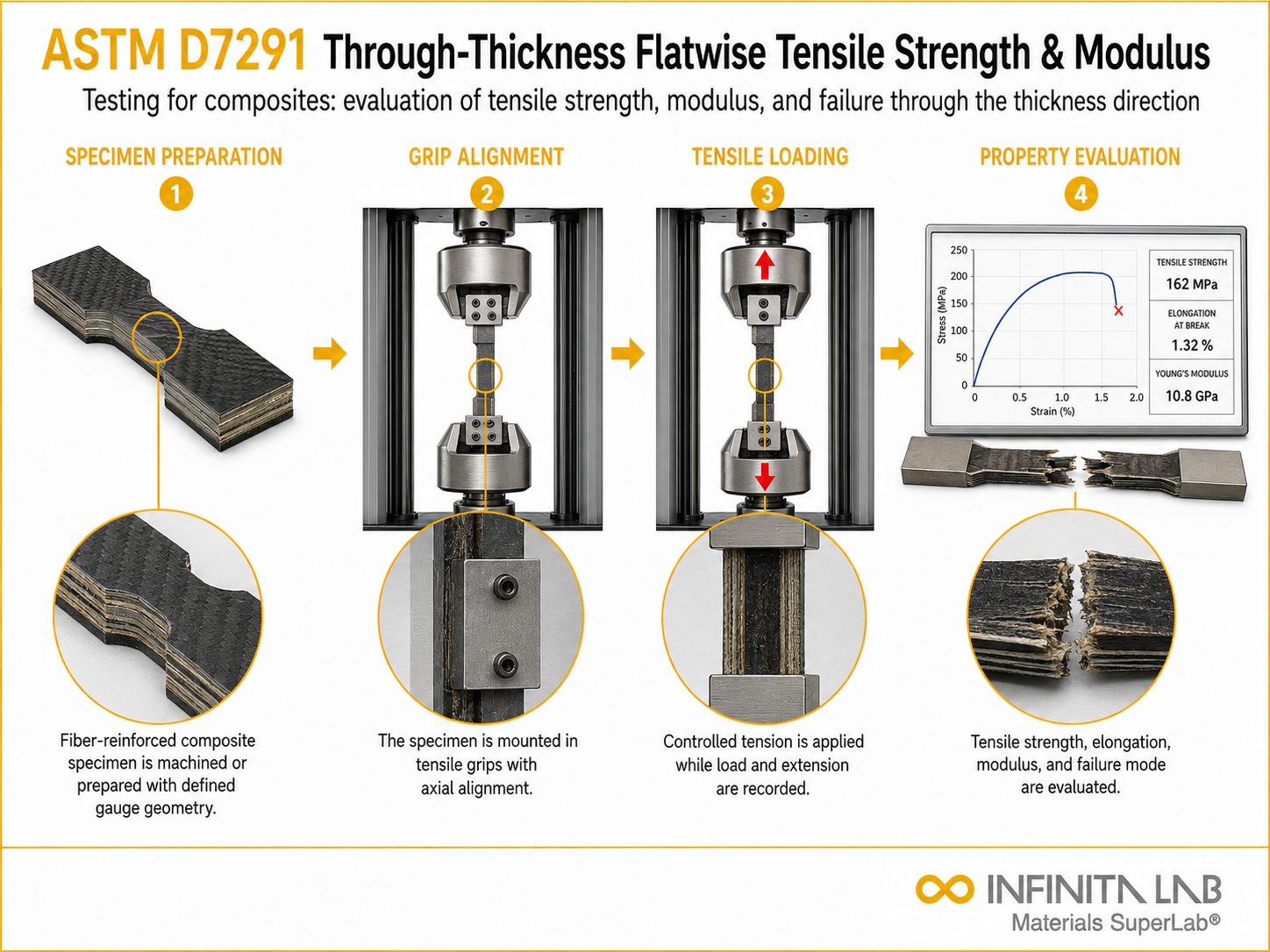
Our ASTM D7291 Testing Procedure
Specimen Preparation
Prepare a flat composite specimen to the specified dimensions and ensure that the bonding surfaces are parallel.
1Bonding to Fixtures
Bond the specimen between the loading blocks using a suitable adhesive and allow it to cure properly.
2Through-Thickness Loading
Apply tensile load perpendicular to the laminate plane until failure, while recording load and displacement
3Data Analysis & Reporting
Calculate through-thickness tensile strength and elastic modulus as per ASTM International.
4ASTM D7291 Test Parameters and Requirements
| Parameter | Details |
|---|---|
| Material Type | Polymer matrix composite laminates |
| Loading Direction | Perpendicular to the laminate plane |
| Specimen Types | Flat, parallel-sided coupon |
| Specimen dimensions | 25 mm × 25 mm square (flatwise cross-section) |
| Strain Measurement | Based on displacement over thickness |
| Adhesive bonding requirement | Structural adhesive; bonding adhesive strength must exceed the composite through-thickness tensile strength |
| Loading Mode | Uniaxial tensile loading |
| Failure Mode | Interlaminar fracture or adhesive failure |


- Universal Testing Machine – Applies a controlled tensile load to the bonded specimen assembly while recording force and crosshead displacement.
- Self-Aligning Load Fixtures – Help minimize off-axis loading during the tensile test, which preserves the accuracy of strength and modulus results.
- Bonding Alignment Fixture – Holds the specimen and loading blocks in precise axial alignment during the adhesive bonding step, before testing even begins.
- Extensometers or Strain Gauges – Measure axial deformation or strain across the specimen gauge section to support elastic modulus calculations.
- Precision Callipers and Measurement Tools – Record specimen diameter, thickness, and gauge dimensions ahead of testing so stress and strain calculations stay accurate.
- Environmental Conditioning Chambers – Come into play when specimens require conditioning to specific temperature or humidity conditions before or during testing.
- Data Acquisition System – Captures and logs load, displacement, and strain data throughout the test for subsequent analysis.
Equipment and Instrumentation Used for ASTM D7291 Testing
What You Receive: Test Report, Data, and Certification
- Ultimate through-thickness flatwise tensile strength values for the tested material or laminate configuration.
- Through-thickness elastic modulus, calculated from the recorded load and strain or displacement data.
- Load-versus-displacement curves documenting specimen behaviour throughout the test, right up to failure.
- Failure mode classification, along with photographic or written documentation of the fracture location within the specimen.
- A complete test report detailing specimen geometry, conditioning, test parameters, and results in accordance with ASTM D7291 requirements.
- Supporting data suitable for structural design allowable, material qualification files, and quality assurance records.
ASTM D7291 Through Thickness Flatwise Tensile Strength And Elastic Modulus FAQs
ASTM D7291 determines the flatwise tensile strength of a composite by pulling it in a direction perpendicular to its laminate layers, testing the bonding strength of the resin system that holds the layers of the composite material together.
Through-thickness strength is the criterion for delamination resistance during out-of-plane loading. Layer separation due to weak interlayer bonding can be a problem in composites subjected to pressure, bending, or more complex loading conditions.
ASTM D7291 is demanded in aerospace, marine, wind energy, and defense applications where thick laminates or sandwich structures are required to resist delamination and retain structural integrity under multidirectional service loads.
ASTM D7291 uses circular or square composite specimens bonded to metal loading blocks. Adhesive bonding ensures uniform load transfer, allowing accurate measurement of flatwise tensile properties without inducing edge-related failure modes.
Flatwise tensile strength is a measure of maximum stress before layer separation, while flatwise elastic modulus is a measure of stiffness. These properties can be used for structural modeling and finite element analysis of laminated composite components.
Why Choose Infinita Lab for Through Thickness Flatwise Tensile Strength And Elastic Modulus Testing
When your Through Thickness Flatwise Tensile Strength And Elastic Modulus results have to hold up - for compliance, a customer audit, or an engineering decision - ASTM D7291 accuracy and an unbiased third-party report matter more than price. Infinita Lab routes your ASTM D7291 through thickness flatwise tensile strength and elastic modulus testing to ISO/IEC 17025-accredited U.S. partner labs with hands-on method experience, so you get defensible data, transparent reporting, and turnaround times built around your project deadline - not ours.

Need ASTM D7291 Through Thickness Flatwise Tensile Strength And Elastic Modulus Testing You Can Rely On?
Send query us at hello@infinitalab.com or call us at (888) 878-3090 to learn more about our services and how we can support you.



Request a Quote
Submit your material details and receive testing procedures, pricing, and turnaround time within 24 hours.
 Quick Turnaround and Hasslefree process
 Confidentiality Guarantee
 Free, No-obligation Consultation
 100% Customer Satisfaction
