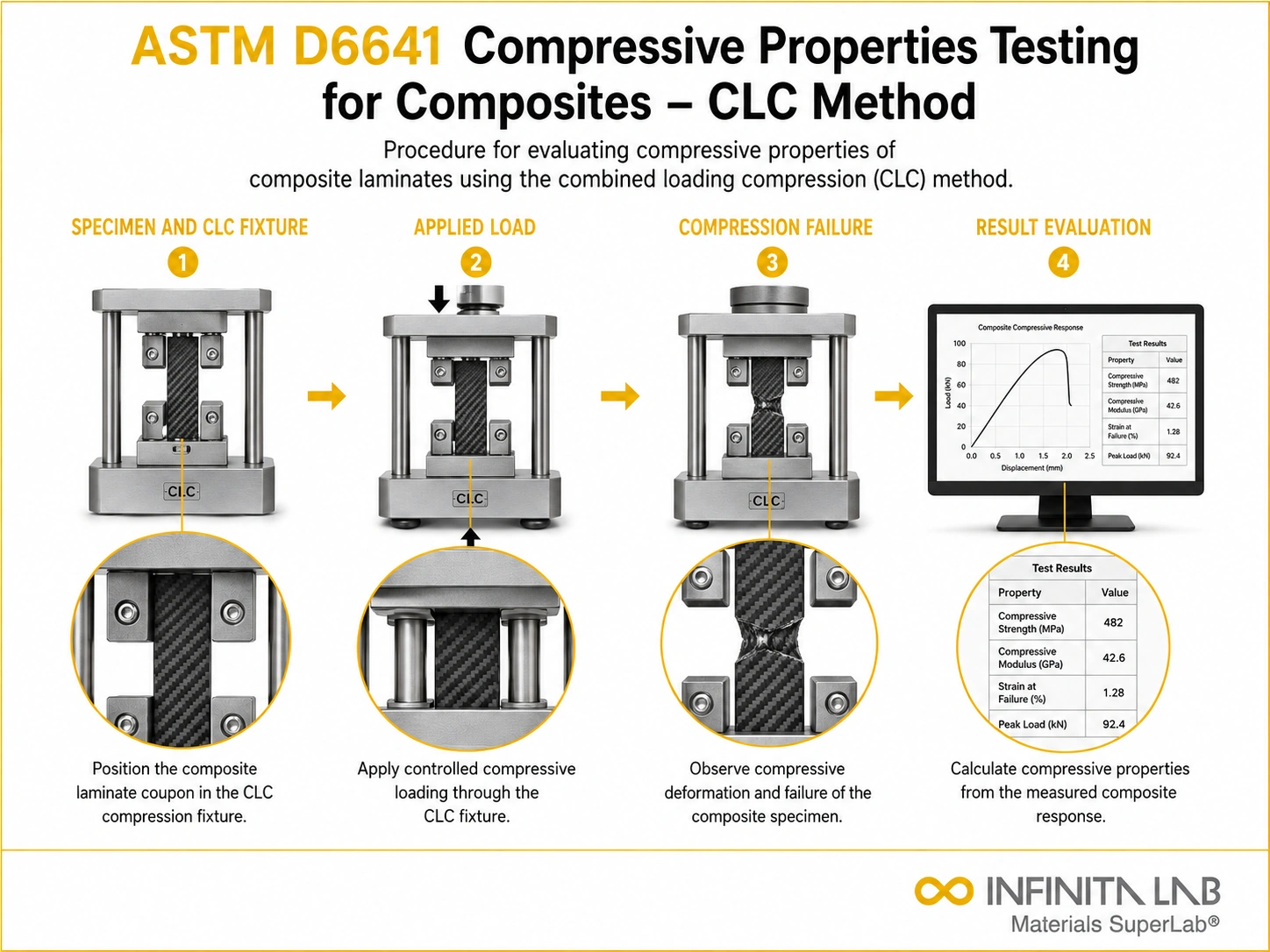


What Is ASTM D6641 Composite Compressive Properties CLC?
ASTM D6641 is a standard test method for determining the compressive properties of polymer matrix composite laminates using the Combined Loading Compression (CLC) fixture. It applies compressive load simultaneously through end-loading and shear-loading mechanisms, reducing premature end-brooming failures common in end-loaded-only compression tests.
This method is widely used in the aerospace, automotive, and wind energy industries to characterize the compressive strength and modulus of continuous fiber-reinforced polymer composites, which are essential design parameters for structural components.

Applications and Benefits of ASTM D6641 Composite Compressive Properties CLC Testing
Scope
ASTM D6641 evaluates:
- Compressive strength of polymer matrix composite laminates
- Compressive modulus of elasticity
- Strain-to-failure in compression
- Performance of both unidirectional and multidirectional laminates
Applications
- Aerospace structural composite components
- Automotive composite body panels and chassis
- Wind turbine blade structural laminate qualification
- Sporting goods and recreational composite products
- Research and development of new composite materials
Benefits
- Combined loading reduces premature specimen failure modes
- Applicable to a wide range of composite layups
- Compatible with standard servo-hydraulic test frames
- Provides accurate compressive strength and modulus data
- Supports material qualification and design allowables generation
Our ASTM D6641 Testing Procedure
Specimen Preparation
Flat composite specimens are machined to standard dimensions and strain gauges are bonded to both faces for alignment verification
1Fixture Assembly
Specimen is installed in the CLC fixture with controlled end-tab and side clamp torques to achieve combined shear and end loading.
2Compression Testing
A compressive load is applied at a controlled displacement rate while recording load, strain, and displacement until specimen failure.
3Reporting
Compressive strength, modulus, and failure mode are determined and reported per ASTM D6641 requirements.
4ASTM D6641 Test Parameters and Requirements
| Parameter | Details |
|---|---|
| Standard | ASTM D6641 |
| Test Principle | Combined loading compression (shear + end loading) |
| Applicable Materials | Polymer matrix composite laminates |
| Measured Outputs | Compressive strength (MPa), compressive modulus (GPa), failure strain |
| Specimen Geometry | Standard flat rectangular coupon |
| Loading Rate | Controlled displacement rate |


- Combined Loading Compression (CLC) test fixture
- Servo-hydraulic or electromechanical universal testing machine
- Strain gauges or extensometer for strain measurement
- Data acquisition system
- Torque wrench for fixture assembly
Equipment and Instrumentation Used for ASTM D6641 Testing
What You Receive: Test Report, Data, and Certification
- Compressive strength values (MPa)
- Compressive modulus of elasticity (GPa)
- Failure strain data
- Failure mode documentation (photographs)
- Statistical analysis and material allowables support data
ASTM D6641 Composite Compressive Properties CLC FAQs
Composite laminates tend to buckle or fail prematurely at the specimen ends during compression. The CLC fixture's combined loading approach minimizes these artifacts and promotes gauge-section failure.
Combined loading means that the compressive force is introduced both through the specimen end faces (end loading) and through shear from the side clamps, distributing the load more uniformly.
The method is applicable to unidirectional (0°), cross-ply, quasi-isotropic, and other balanced symmetric laminates commonly used in structural composite design.
Tabs are not always required for CLC testing, which is one advantage over other compression methods. However, tabs may be used for certain material types to prevent surface damage from the fixture clamps.
Compressive modulus is calculated from the linear portion of the stress-strain curve, typically between 1000 and 3000 microstrain, using data from at least two strain gauges on opposite faces.
Combined loading compression testing evaluates the compressive properties of fiber-reinforced composite materials by applying force through both the specimen ends and its clamped surfaces. The specimen is secured in a specialized fixture and compressed in a testing machine until failure. The results help determine compressive strength, modulus, and strain at failure, as applicable. ASTM D6641 covers this method.
Shear loading compression testing measures the compressive properties of composite materials by transferring force through the specimen’s clamped side surfaces. The specimen is secured in a specialized fixture, which applies compressive loading through shear forces while helping prevent buckling. The load and deformation are recorded to evaluate compressive strength and stress-strain behavior. ASTM D3410 and ISO 14126 Method 1 are commonly used for this approach.
End loading compression testing evaluates a material’s resistance to compressive forces applied directly to the flat ends of a specimen. The specimen is aligned between compression platens or within a suitable fixture, and the load is increased until the required measurement or failure occurs. The results help determine compressive strength and other relevant mechanical properties. ASTM D695 is commonly used for end-loading compression tests of plastics and certain composite specimens.
Why Choose Infinita Lab for Composite Compressive Properties CLC Testing
When your Composite Compressive Properties CLC results have to hold up - for compliance, a customer audit, or an engineering decision - ASTM D6641 accuracy and an unbiased third-party report matter more than price. Infinita Lab routes your ASTM D6641 composite compressive properties CLC testing to ISO/IEC 17025-accredited U.S. partner labs with hands-on method experience, so you get defensible data, transparent reporting, and turnaround times built around your project deadline - not ours.

Need ASTM D6641 Composite Compressive Properties CLC Testing You Can Rely On?
Send query us at hello@infinitalab.com or call us at (888) 878-3090 to learn more about our services and how we can support you.