


Vertical Compression Testing Services
Testing for vertical compression integrity determines a material or structure's ability to support a given load. It entails applying force, gauging deformation, and evaluating the outcomes. Load testing, non-destructive testing, finite element analysis, and computer modeling are examples of techniques. It checks for structural stability and finds holes.
TRUSTED BY


Get compliant results — request your vertical compression testing quote
- Overview
- Scope, Applications, and Benefits
- Test Process
- Specifications
- Instrumentation
- Results and Deliverables
What Is Vertical Compression?
Vertical compression testing measures the maximum compressive load that a shipping container, packaging component, or unit load can withstand before it fails or deforms beyond acceptable limits. In practical terms, it tells you how much stacking weight your box can handle -on a warehouse shelf, on a pallet, or in a distribution truck. That number directly impacts product protection, storage efficiency, and packaging material costs.
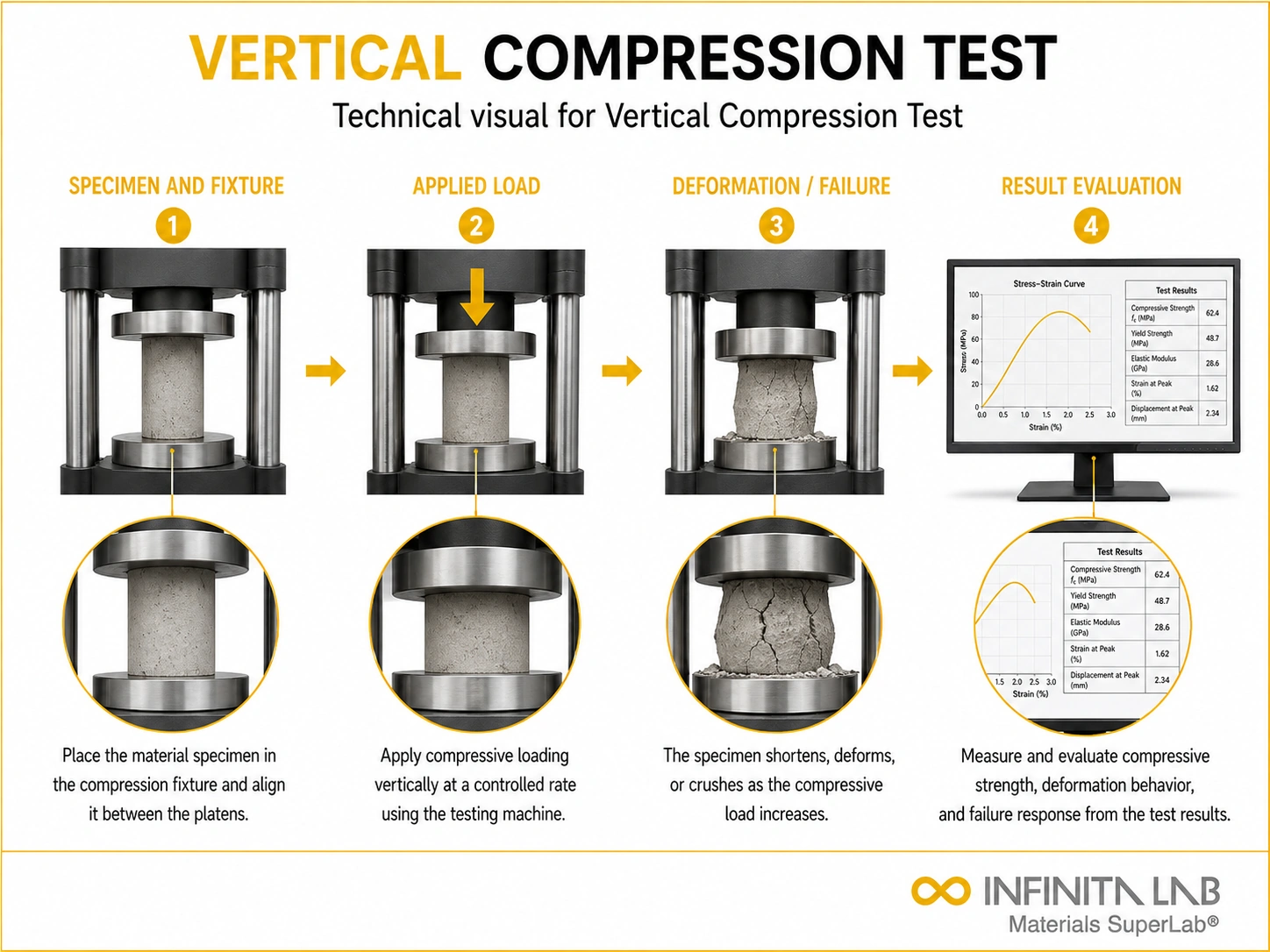
The primary standard governing this test is ASTM D642, which covers compressive resistance testing of shipping containers, components, and unit loads. The test is conducted using a compression machine with either fixed or swivel platens, applying a controlled vertical load at a constant rate while recording the load-displacement response. The peak load at failure is the Box Compression Strength (BCT), which is used alongside safety factors to set real-world stacking limits. ASTM D642 is related to TAPPI T804 and fulfills the requirements of ISO 12048.
Containers can be tested in multiple orientations -top to bottom, edge to edge, or corner to corner -and can be evaluated empty or filled, depending on whether the contents are expected to share the load. Specimen conditioning before testing is critical because corrugated board strength is highly sensitive to moisture content, and results from unconditioned samples are unreliable and not comparable across labs.

Applications and Benefits of Vertical Compression Testing
Scope
Vertical compression testing per ASTM D642 applies to shipping containers, including corrugated fiberboard boxes, paperboard boxes, drums, pails, and other rigid packaging, as well as unit loads assembled for distribution. Testing can be performed on containers in top-to-bottom, edge-to-edge, or corner-to-corner orientations. Fixed-platen machines are required for edge-to-edge and corner-to-corner orientations; swivel-platen machines are used for top-to-bottom testing and cause failure at the container’s weakest point. Unit loads are generally tested only in the top-to-bottom orientation. Containers may be tested empty or with contents and interior packaging in place when load sharing is expected. The standard, TAPPI T804, for fiberboard containers is equivalent to ISO 12048. For constant-load creep evaluation under sustained stacking conditions, ASTM D4577 is the relevant companion standard.
Applications
- Corrugated box and fiberboard container stacking strength qualification
- Warehouse pallet stacking limit determination
- Packaging design validation for new product launches
- Supplier packaging qualification and incoming material verification
- Distribution simulation and transit performance evaluation per ASTM D4169
- Packaging optimization to reduce material usage without compromising stack strength
- Drum, pail, and rigid container load-bearing capacity assessment
- E-commerce and retail-ready packaging structural performance testing
Benefits
- Provides a single, objective number -Box Compression Strength -that directly supports stacking design decisions
- Identifies the weakest load orientation of a container before it reaches the supply chain
- Supports cost reduction by defining the minimum structural requirement rather than over-engineering
- Results are directly applicable to McKee Formula stacking limit calculations for warehouse planning.
- Multiple orientations and fill states can be tested under one standard
- Comparable across labs when conditioning and test parameters are followed consistently
- Recognized by major retailers and logistics providers as a standard packaging performance metric
Vertical Compression Testing Process
Specimen Conditioning
Containers are conditioned at 23 ± 1 °C and 50 ± 2% relative humidity for a minimum of 24 hours before testing.
1Specimen Setup and Pre-load
The container is centered on the lower compression platen in the specified test orientation.
2Compression Loading
A constant crosshead displacement rate is applied, compressing the container between the platens.
3Data Analysis and Reporting
Peak load (Box Compression Strength), deformation at peak load, and the load-displacement curve are recorded and reported.
4Test parameters and requirements
| Parameter | Details |
|---|---|
| Primary Standard | ASTM D642 – Compressive Resistance of Shipping Containers, Components, and Unit Loads |
| Related Standards | TAPPI T804, ISO 12048, ASTM D4577 (constant load), ASTM D4169 (distribution simulation) |
| Test Orientations | Top to bottom, edge to edge, corner to corner |
| Platen Types | Fixed platen (required for edge/corner orientations), swivel platen (top-to-bottom) |
| Specimen Types | Corrugated boxes, paperboard containers, drums, pails, unit loads |
| Conditioning | 23 +/- 1 degrees C, 50 +/- 2% RH, minimum 24 hours per ASTM D4332 |


- Compression testing machine with fixed or swivel platens
- The load cell is calibrated across the expected force range
- Displacement transducer or crosshead position encoder
- Data acquisition system for continuous load-displacement recording
- Temperature and humidity-controlled conditioning chamber per ASTM D4332
- Calibrated thermometer and hygrometer for conditioning environment verification
Instrumentation Used for Vertical Compression Testing
What You Receive: Test Report, Data, and Certification
- Box Compression Strength (BCT) -peak load at failure in lbf or N
- Deformation at peak load in inches or mm
- Load-displacement curve showing the full compression response
- Failure mode description (e.g., panel buckling, corner failure, top panel collapse)
- Test orientation and container fill state (empty or filled)
- Conditioning temperature, humidity, and duration
- Container dimensions, construction, and identification details
- Test report with all recorded values formatted for packaging engineering and supply chain review
Vertical Compression FAQs
It measures the ability of shipping containers to withstand stacking loads without collapsing or permanently deforming. This helps assess structural integrity during storage and transport.
Compression strength determines how well packaging can survive stacking in warehouses and transit. Insufficient strength can lead to product damage due to box collapse.
Corrugated boxes, cartons, fiberboard containers, plastic crates, and other load-bearing packaging structures are commonly evaluated under vertical compression loads.
Failure is identified when the container buckles, reaches a peak load followed by a drop in force, or deforms beyond an acceptable limit under applied compression.
Material grade, corrugation structure, humidity exposure, box geometry, and closure method all significantly affect the load-bearing capacity of shipping containers.
Why Choose Infinita Lab for Vertical Compression Testing
At the core of this breadth is our network of 2,000+ accredited laboratories across the USA, offering access to over 10,000 testing methods and analytical services. From advanced materials characterization (SEM, TEM, RBS, XPS) to mechanical, chemical, environmental, biological, and standardized ASTM/ISO-compliant testing, we deliver unmatched flexibility, specialization, and scale. You are never limited by geography, facility, or methodology — Infinita Lab connects you to the right expertise and testing solution, every time.

Looking for an Accredited Partner for Vertical Compression Testing?
Send query us at hello@infinitalab.com or call us at (888) 878-3090 to learn more about our services and how we can support you.



Request a Quote
Submit your material details and receive testing procedures, pricing, and turnaround time within 24 hours.
 Quick Turnaround and Hasslefree process
 Confidentiality Guarantee
 Free, No-obligation Consultation
 100% Customer Satisfaction
