


MIL-STD-810 Method 503 Thermal Shock Testing Services
MIL-STD 810 is a set of standards for environmental engineering considerations and laboratory tests for military equipment. Method 503 is one of the methods outlined in the MIL-STD 810 standards and deals with high-temperature exposure. This method is used to evaluate the effects of high temperatures on the performance of military equipment and ensure that the equipment can function properly under high-temperature conditions.
TRUSTED BY


Precision Testing Solutions for Accurate, Reliable, and Standards-Compliant Results
- Overview
- Scope, Applications, and Benefits
- Test Process
- Specifications
- Instrumentation
- Results and Deliverables
MIL-STD-810 Method 503 Thermal Shock Testing Overview
MIL-STD-810 Method 503 evaluates the ability of military and commercial equipment to withstand sudden transitions between extreme hot and cold temperature environments. The test subjects, components, assemblies, and complete systems undergo rapid temperature changes that create severe thermal stresses due to differential thermal expansion between materials and interfaces. It is an accelerated environmental reliability test used to identify structural weaknesses, seal failures, coating delamination, solder joint fatigue, connector degradation, and electronic performance instability under rapid thermal exposure conditions.
Unlike conventional temperature cycling, thermal shock testing uses extremely rapid temperature transitions between extremes, generating significantly higher stress at bonded interfaces and in multi-material assemblies. MIL-STD-810 Method 503 is widely used for aerospace systems, military electronics, avionics modules, ruggedized communication equipment, PCB assemblies, batteries, connectors, sealed enclosures, and mission-critical defense hardware exposed to harsh environmental transitions during storage, transportation, deployment, and operational service. The method includes both Procedure I (air-to-air thermal shock) and Procedure II (liquid-to-liquid thermal shock), depending on the product type and procurement requirements.

Scope, Applications, and Benefits
Scope
MIL-STD-810 Method 503 applies to electronic assemblies, aerospace hardware, military systems, ruggedized enclosures, connectors, batteries, seals, and mission-critical components exposed to rapid transitions between extreme temperature environments. The test evaluates the effects of thermal expansion, thermal contraction, material incompatibility, and abrupt environmental changes on structural integrity, environmental sealing performance, and functional reliability.
Typical assemblies and materials evaluated include:
- Military electronic systems
- Aerospace avionics modules
- PCB assemblies and soldered interconnects
- Ruggedized communication equipment
- Battery systems and energy storage modules
- Military connectors and cable assemblies
- Optical systems and sensor housings
- Sealed enclosures and electro-mechanical assemblies
- Radar and surveillance equipment
- Navigation and guidance systems
Applications
- Thermal shock qualification of military and aerospace electronic assemblies
- PCB solder joint reliability testing under rapid temperature transitions
- Seal and gasket integrity validation for ruggedized enclosures
- Avionics system environmental qualification for defense aircraft applications
- Connector and cable assembly durability testing under thermal stress conditions
- Battery enclosure and energy storage system thermal shock evaluation
- Optical equipment and sensor housing qualification for extreme environments
- Material compatibility assessment for multi-material assemblies
- Failure analysis of cracked coatings, fractured materials, and delaminated interfaces
Benefits
- Simulates severe, rapid temperature transition environments encountered during military operations
- Identifies latent manufacturing defects before field deployment
- Detects solder joint fatigue, cracking, and electronic interconnect failures
- Evaluates seal integrity and enclosure leakage resistance under thermal stress
- Supports MIL-STD-810 environmental qualification and defense procurement compliance
- Helps improve the long-term reliability of aerospace and military systems
- Reduces risk of mission-critical equipment failure in extreme environments
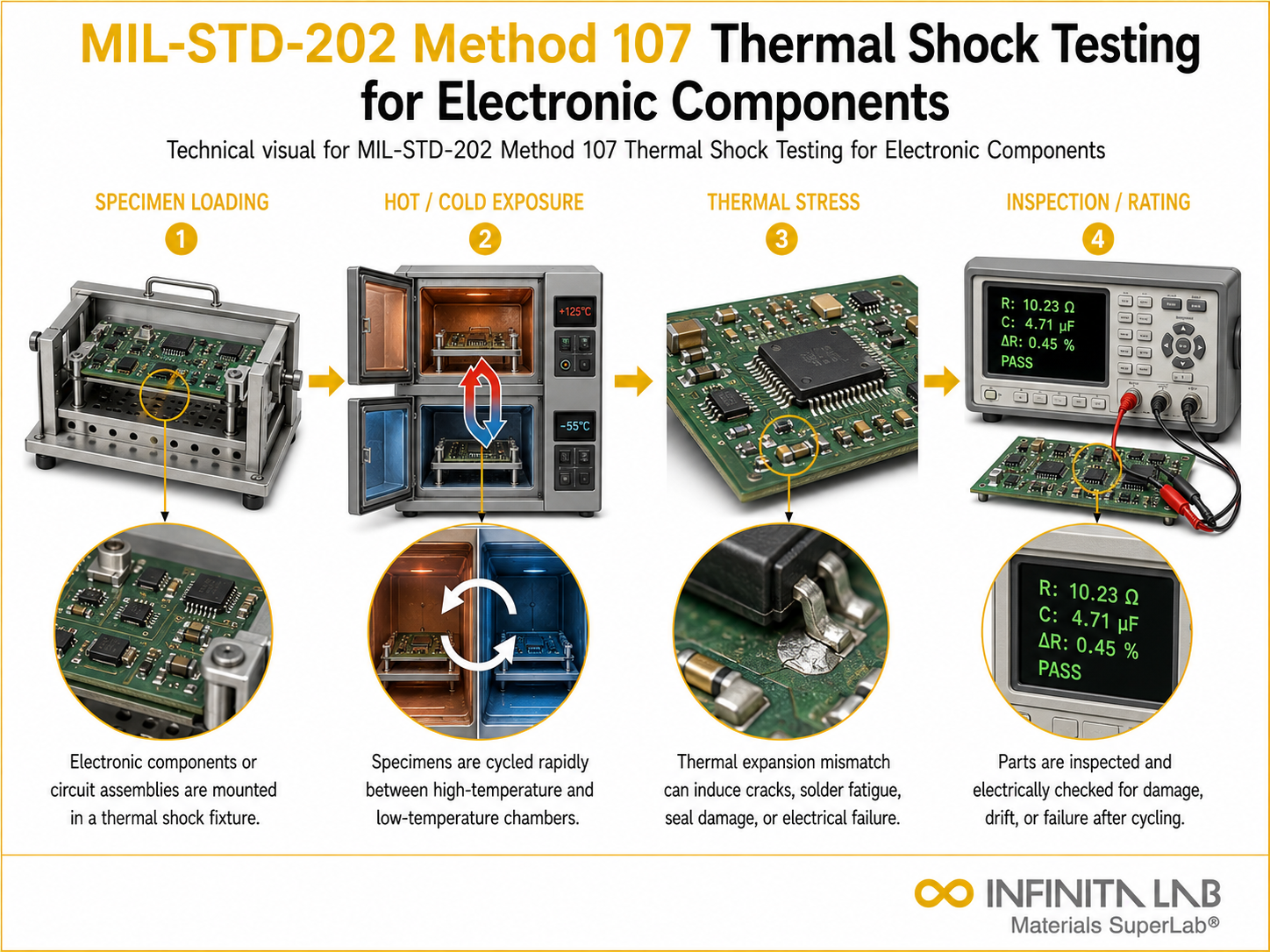
MIL-STD-810 Method 503 Test Process
Sample Preparation
Test items are configured and conditioned based on operational requirements.
1Thermal Shock Exposure
Samples are exposed to extreme high and low temperatures (e.g., -55°C to +125°C).
2Rapid Transfer
Specimens are transferred between temperature zones rapidly to create thermal shock (≥10°C/min change).
3Data Analysis
Physical damage, performance degradation, and functional integrity are evaluated.
4MIL-STD-810 Method 503 Technical Specifications
| Parameter | Details |
|---|---|
| Applicable Equipment | Military systems, defense electronics, aerospace components, UAVs, and commercial products requiring MIL-STD-810 thermal shock qualification |
| Procedure I | Air-to-air thermal shock |
| Procedure II | Liquid-to-liquid thermal shock |
| Typical Temperature Range | −55 °C to +125 °C |
| Temperature Change Rate | ≥10°C per minute |
| Transfer Time Between Chambers | Usually less than 1 minute |
| Dwell Time at Temperature Extremes | 30 minutes to 2 hours |
| Number of Cycles | Defined by mission profile or procurement requirement |
| Test Specimens | Components, PCBs, assemblies, enclosures, connectors |
| Failure Criteria | Cracking, delamination, leakage, functional degradation |
| Monitoring | Functional testing before, during, or after cycling |
| Environmental Chambers | Dual-chamber or liquid immersion systems |
| Measured Outputs | Thermal stress observations, functional data, structural assessment, and test compliance result |


Instrumentation Used for Testing
- Dual-chamber thermal shock testing system
- High-temperature environmental chamber
- Low-temperature environmental chamber
- Liquid immersion thermal shock system for Procedure II testing
- Automated specimen transfer mechanism
- Thermocouple temperature monitoring system
- Functional electrical monitoring equipment
- Data acquisition and chamber control software
- Leak detection and seal integrity testing instruments
- Optical inspection and crack detection systems
Results and Deliverables
- Thermal shock exposure records, including temperature extremes and cycle data
- Pre- and post-exposure functional performance comparison data
- Structural integrity and physical inspection observations
- Test compliance result per MIL-STD-810 Method 503 acceptance criteria
- MIL-STD-810 Method 503 Compliance Report
Frequently Asked Questions
MIL-STD-810 Method 503, thermal shock, is a test for determining if military and commercial equipment is capable of withstanding extreme temperature changes without sustaining structural or functional degradation under actual field deployment conditions.
Thermal shock testing involves rapid transitions between extreme temperature extremes, inducing severe thermal stress at all material interfaces. Temperature cycling uses a slower rate of change, making thermal shock a far more extreme and accelerated test method.
Military ground vehicles, aerospace parts, airborne avionics, UAV systems, soldier-worn electronics, and commercial defense products intended for use in arctic, desert, airborne, or space environments with sudden extreme temperature changes must be qualified using Method 503.
Method 503 thermal shock testing measures the occurrence of solder joint cracking, material fracture, seal failures, gasket failures, coating delamination, connector degradation, and electronic performance degradation due to rapid thermal expansion and contraction stresses.
MIL-STD-810 Method 503 qualification is often specified by U.S. DoD procurement programs and defense prime contractors for equipment destined for thermally challenging deployment environments. Always check with your program contract and statement of work for specific test program requirements.
Why Choose Infinita Lab for Advanced Materials Testing and Characterization?
At the core of this breadth is our network of 2,000+ accredited laboratories across the USA, offering access to over 10,000 testing methods and analytical services. From advanced materials characterization (SEM, TEM, RBS, XPS) to mechanical, chemical, environmental, biological, and standardized ASTM/ISO-compliant testing, we deliver unmatched flexibility, specialization, and scale. You are never limited by geography, facility, or methodology — Infinita Lab connects you to the right expertise and testing solution, every time.

Looking for a Trusted Partner for Accurate and Reliable Testing Services?
Send query us at hello@infinitlab.com or call us at (888) 878-3090 to learn more about our services and how we can support you.



Request a Quote
Submit your material details and receive testing procedures, pricing, and turnaround time within 24 hours.
 Quick Turnaround and Hasslefree process
 Confidentiality Guarantee
 Free, No-obligation Consultation
 100% Customer Satisfaction
