


Water Quenching Thermal Shock Ceramics Guide Testing Services
Water quenching is a rapid cooling process in which heated metals are immersed in water to achieve high cooling rates, forming hard microstructures such as martensite. It enhances strength and hardness but can introduce stresses causing distortion or cracking if not controlled properly.
TRUSTED BY


Get compliant results — request your water quenching thermal shock ceramics guide testing quote
- Overview
- Scope, Applications, and Benefits
- Test Process
- Specifications
- Instrumentation
- Results and Deliverables
What Is Water Quenching Thermal Shock Ceramics Guide?
Water quenching is a rapid cooling process used in heat treatment where heated materials, typically metals, are immersed in water to achieve high cooling rates. This sudden temperature drop alters the microstructure, increasing hardness and strength by transforming phases such as austenite into martensite in steels. The process is widely applied where enhanced mechanical properties are required.
However, due to its high cooling severity, water quenching can introduce internal stresses, distortion, and cracking if not properly controlled. The effectiveness of quenching depends on factors such as water temperature, agitation, material composition, and geometry, making process control critical for achieving desired metallurgical properties.

Applications and Benefits of Water Quenching Thermal Shock Ceramics Guide Testing
Scope
Water quenching involves rapid cooling of heated materials to modify microstructure and mechanical properties through controlled heat extraction.
- Used for steels and certain alloys after heat treatment
- Produces high cooling rates for phase transformation
- Influences hardness, strength, and residual stress
- Applicable to components with specific mechanical requirements
- Evaluates quench severity and cooling behavior
- Supports metallurgical process optimization
Applications
- Heat treatment of steel components
- Automotive and aerospace parts hardening
- Tool and die manufacturing
- Gear and shaft processing
- Structural component strengthening
- Metallurgical research and development
Benefits
- Achieves high hardness and strength
- Rapid and efficient cooling process
- Enhances wear resistance
- Simple and cost-effective method
- Suitable for mass production
- Improves mechanical performance
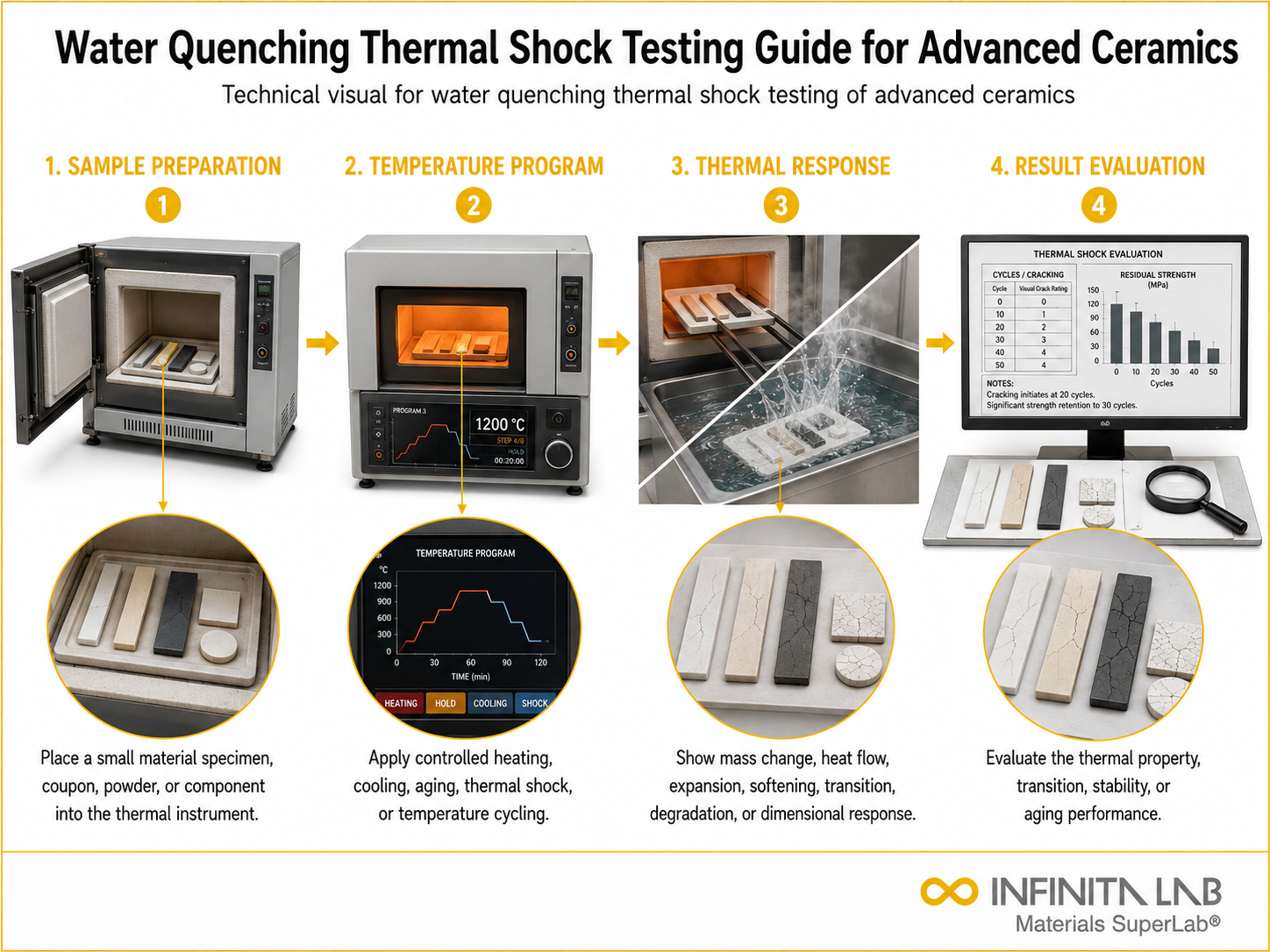
Our Testing Procedure
Heating of Material
The material is heated to a specified temperature, typically in the austenitic range for steels.
1Immersion in Water
The heated specimen is rapidly immersed in water to initiate fast cooling.
2Cooling and Phase Transformation
Rapid heat extraction transforms the microstructure, increasing hardness and strength.
3Post-Quench Evaluation
The material is analyzed for hardness, distortion, and possible defects.
4Water Quenching – Technical Specifications
| Parameter | Details |
|---|---|
| Process Type | Rapid liquid quenching |
| Material Type | Steels and heat-treatable alloys |
| Cooling Medium | Water (with or without additives) |
| Cooling Rate | High (severity dependent) |
| Temperature Range | Austenitizing to ambient |
| Quench Severity | High compared to oil or air |
| Agitation Control | Static or forced circulation |


- Heat treatment furnace
- Quenching tank
- Temperature monitoring system
- Agitation system (if applicable)
- Hardness testing machine
- Metallographic analysis tools
Equipment and Instrumentation Used for Testing
What You Receive: Test Report, Data, and Certification
- Hardness measurement report
- Microstructure evaluation
- Distortion and dimensional analysis
- Crack inspection results
- Heat treatment validation report
- Process performance documentation
Water Quenching Thermal Shock Ceramics Guide FAQs
Rapid cooling suppresses diffusion-controlled transformations and forces the formation of hard phases like martensite, resulting in significantly increased hardness.
The transformation of austenite into martensite occurs due to rapid cooling, preventing equilibrium phase formation and locking carbon atoms in a distorted lattice.
The dominant transformation is austenite to martensite, a diffusionless process where carbon atoms are trapped in a distorted lattice, producing high internal strain and hardness without allowing equilibrium phases like ferrite or pearlite to form.
Water exhibits high thermal conductivity and heat capacity, combined with rapid vapor film breakdown, resulting in very high cooling rates that generate steep thermal gradients and intense phase transformation kinetics within the material.
Cracking results from combined thermal stresses due to rapid cooling gradients and transformation stresses from volume expansion during martensite formation, exceeding the material’s fracture strength, especially in high-carbon or complex-shaped components.
Why Choose Infinita Lab for Water Quenching Thermal Shock Ceramics Guide Testing
At the core of this breadth is our network of 2,000+ accredited laboratories across the USA, offering access to over 10,000 testing methods and analytical services. From advanced materials characterization (SEM, TEM, RBS, XPS) to mechanical, chemical, environmental, biological, and standardized ASTM/ISO-compliant testing, we deliver unmatched flexibility, specialization, and scale. You are never limited by geography, facility, or methodology — Infinita Lab connects you to the right expertise and testing solution, every time.

Looking for an Accredited Partner for Water Quenching Thermal Shock Ceramics Guide Testing?
Send query us at hello@infinitalab.com or call us at (888) 878-3090 to learn more about our services and how we can support you.



Request a Quote
Submit your material details and receive testing procedures, pricing, and turnaround time within 24 hours.
 Quick Turnaround and Hasslefree process
 Confidentiality Guarantee
 Free, No-obligation Consultation
 100% Customer Satisfaction
