


ASTM D2343: Reinforced Plastic Fiber Tensile Testing Services
Accredited ASTM D2343 reinforced plastic fiber tensile testing from Infinita Lab, performed to the exact standard requirements - accurate, reproducible results with full documentation for compliance, R&D, and quality control programs.
TRUSTED BY


Get ASTM D2343 compliant results - request your reinforced plastic fiber tensile testing quote
- Overview
- Scope, Applications, and Benefits
- Test Process
- Specifications
- Instrumentation
- Results and Deliverables
What Is ASTM D2343 Reinforced Plastic Fiber Tensile?
ASTM D2343 is a standardized test method for determining the tensile properties of glass fiber strands, yarns, and rovings, typically tested as impregnated rods. It evaluates the intrinsic tensile strength and modulus of the reinforcement fibers rather than finished composite structures.
This method is specifically intended for fiber-level characterization, and should not be confused with laminate testing standards such as ASTM D3039, which evaluate complete composite materials. In laboratory practice, ASTM D2343 is primarily used for quality control of reinforcement fibers and validation of supplier consistency.

Applications and Benefits of ASTM D2343 Reinforced Plastic Fiber Tensile Testing
Scope
ASTM D2343 applies to glass fiber-reinforced plastics, including reinforced thermoplastics and thermosetting plastics, as well as glass fiber yarns, strands, and rovings that are resin-impregnated. It may also apply to carbon-reinforced plastics if appropriate.
ASTM D2343 evaluates:
- Tensile strength of glass fiber strands and rovings
- Tensile modulus of reinforcement fibers
- Fiber performance after resin impregnation
- Variability in fiber manufacturing quality
- Reinforcement consistency for composite production
Applications
- Boat hulls and marine structures
- Pipes and pressure vessels
- Automotive components
- Aerospace components
- Sports equipment
- Wind turbine blades
- Electrical insulators
- Brake pads
- Electrical connectors and circuit boards
Benefits
- Ensures resin and glass fibre compatibility
- Prevents premature material failure
- Provides accurate tensile strength data
- Supports material selection and comparison
- Improves composite design optimisation
- Enhances production quality control
- Ensures repeatable and reliable testing
- Supports engineering decision-making
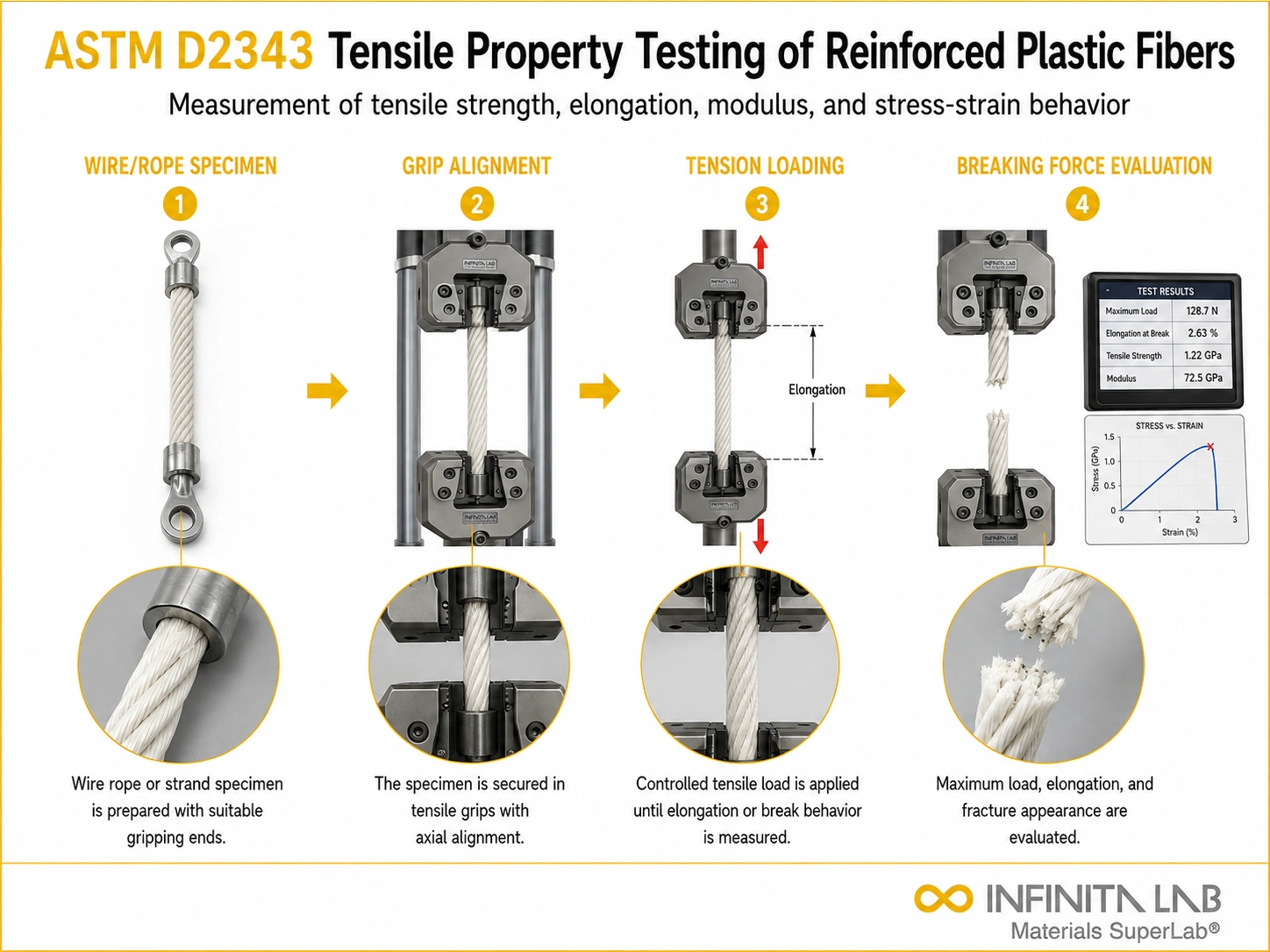
Our ASTM D2343 Testing Procedure
Impregnation & Specimen Preparation
Impregnate glass fiber skeins with resin under controlled ratio, alignment, winding tension, and curing conditions.
1Specimen Mounting
Align and mount cured specimens in the tensile testing machine for uniform loading.
2Tensile Loading & Measurement
Apply controlled tensile force until failure; record breaking load and elongation.
3Data Analysis
Calculate tensile strength and modulus; average results from at least five specimens.
4ASTM D2343 Test Parameters and Requirements
| Parameter | Details |
|---|---|
| Applicable Materials | Glass fibre reinforced thermoplastics and thermosets |
| Loading Type | Uniaxial tensile loading |
| Specimen Type | Glass fiber strands, yarns, rovings (impregnated rods) |
| Key Controlled Variables | Resin content, gage length, grip type, testing speed, curing conditions |
| Cross-head Speed | Controlled rate (per standard requirements) |
| Typical Resin-to-Glass Ratio | Approximately 70% (controlled) |
| Comparison Standard | ASTM D3039 (for composite laminates) |
| Measured Properties | Tensile strength, modulus of elasticity, breaking load |
| Output Units | MPa or psi (strength), GPa (modulus) |


- Universal testing machine (UTM)
- Precision grips and fixtures
- Resin impregnation bath
- Winding fixture
- Curing oven
- Analytical balance
- Extensometer (if required)
- Data acquisition and analysis software
Equipment and Instrumentation Used for ASTM D2343 Testing
What You Receive: Test Report, Data, and Certification
- Ultimate tensile strength values
- Modulus of elasticity calculations
- Breaking load measurements
- Average results from multiple specimens
- Material comparison data
- Resin compatibility assessment
- Test report as per ASTM D2343
ASTM D2343 Reinforced Plastic Fiber Tensile FAQs
ASTM D2343 is a standard test method for determining the tensile strength, tensile modulus, and elongation of glass fiber strands, yarns, and rovings used as reinforcement in composite materials.
The method applies to glass fiber reinforcements, including continuous filament strands, yarns, and rovings intended for use in reinforced plastic and composite manufacturing applications.
Tensile testing ensures consistent mechanical performance of reinforcing fibers, directly influencing the strength, stiffness, and reliability of finished composite products.
The test measures tensile strength, elongation at break, and tensile modulus by subjecting fiber specimens to uniaxial tensile loading until failure.
Results depend on fiber diameter, surface treatment (sizing), specimen preparation, alignment, gauge length, environmental conditions, and loading rate during testing.
Why Choose Infinita Lab for Reinforced Plastic Fiber Tensile Testing
When your Reinforced Plastic Fiber Tensile results have to hold up - for compliance, a customer audit, or an engineering decision - ASTM D2343 accuracy and an unbiased third-party report matter more than price. Infinita Lab routes your ASTM D2343 reinforced plastic fiber tensile testing to ISO/IEC 17025-accredited U.S. partner labs with hands-on method experience, so you get defensible data, transparent reporting, and turnaround times built around your project deadline - not ours.

Need ASTM D2343 Reinforced Plastic Fiber Tensile Testing You Can Rely On?
Send query us at hello@infinitalab.com or call us at (888) 878-3090 to learn more about our services and how we can support you.



Request a Quote
Submit your material details and receive testing procedures, pricing, and turnaround time within 24 hours.
 Quick Turnaround and Hasslefree process
 Confidentiality Guarantee
 Free, No-obligation Consultation
 100% Customer Satisfaction
