

What Is ASTM D4065 Dynamic Mechanical Analysis DMA?
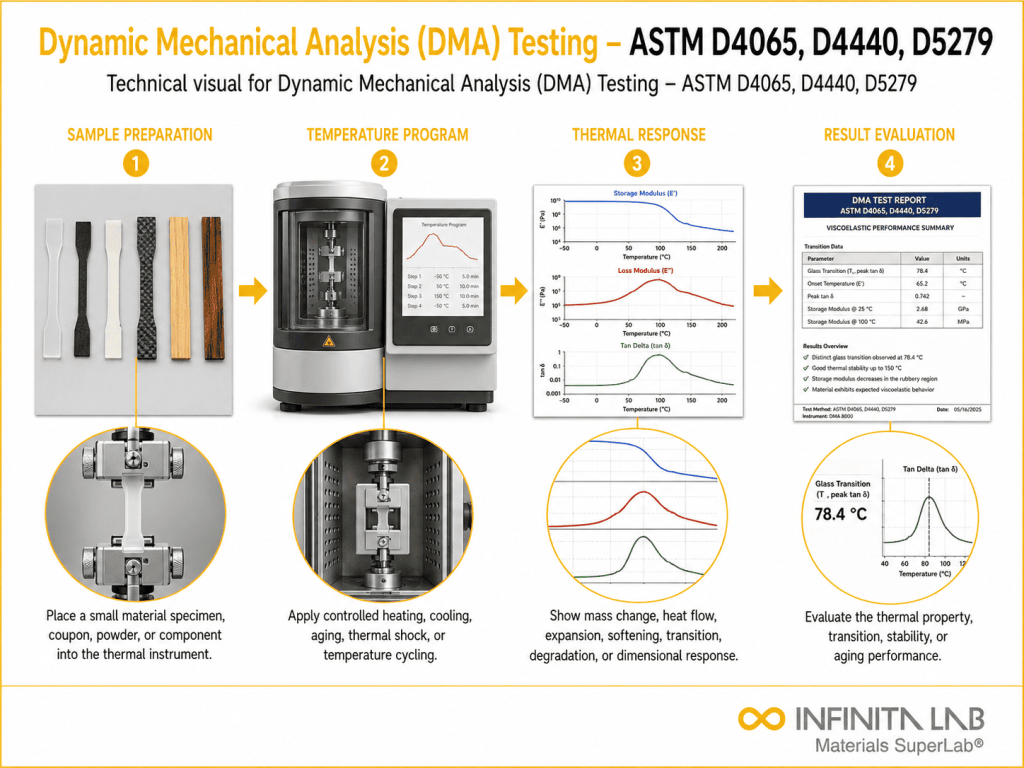
The ASTM D4065, D4440, and D5279 standards describe DMA test procedures to investigate the dynamic mechanical properties of polymers. By Dynamic Mechanical Analysis, they determine the elastic (storage) modulus G’ and the viscous (loss) modulus G” of a material, as well as the damping factor Tan δ, and follow their behavior as a function of temperature, frequency, or time.
The strength of DMA is in its ability to detect transition points in plastics, particularly the glass transition temperature Tg. It is generally more sensitive than DSC to transitions in materials. The results are typically plots of G’, G”, and Tan δ vs. temperature or frequency.
Applications and Benefits of ASTM D4065 Dynamic Mechanical Analysis DMA Testing
Scope
ASTM D4065, D4440, and D5279 are standard test methods used to evaluate the dynamic mechanical properties of polymeric materials, including rigid and semi-rigid plastics, thermoplastics, and thermosets. These tests measure key viscoelastic parameters such as Storage Modulus (G’), Loss Modulus (G”), Damping Coefficient (Tan δ), and Glass Transition Temperature (Tg).
The measurements are performed as functions of temperature, frequency, and strain or time, helping determine material behavior under different mechanical and environmental conditions.
Applications
- Determination of glass transition temperature (Tg)
- Evaluation of viscoelastic behavior
- Quality control of polymer materials
- Product development and material comparison
- Assessment of curing behavior
- Performance evaluation under dynamic loading
- Research and development of advanced polymer systems
- Failure analysis and material selection
Benefits
- High sensitivity to small transition regions
- More precise Tg detection than DSC in many cases
- Simultaneous measurement of elastic and viscous behavior
- Evaluation of damping characteristics
- Useful for thermal and frequency-dependent analysis
- Supports material design and performance optimization
- Standardized and reproducible testing method
Our ASTM D4065 Testing Procedure
Sample Preparation & Mounting
A standard specimen is mounted in the DMA instrument.
1Test Setup
The specimen is placed in a temperature-controlled chamber, and test parameters are set.
2Dynamic Loading & Measurement
Oscillatory deformation is applied during temperature ramping, and G’, G”, and Tan δ are recorded.
3Tg Determination
Tg is determined from the Tan δ peak or modulus change.
4ASTM D4065 Test Parameters and Requirements
| Parameter | Details |
|---|---|
| Measured Properties | Storage Modulus (G’), Loss Modulus (G”), Tan δ |
| Modes of Testing | Torsional (commonly), bending or tension (instrument dependent) |
| Temperature Control | Programmable thermal chamber |
| Data Output | Modulus and damping vs temperature/frequency/strain |
| Tg Reporting | Method of Tg determination must be specified |
| Specimen Dimensions | 56 mm × 13 mm × 3 mm |


- Dynamic Mechanical Analyzer (DMA)
- Oscillatory drive system
- Torsional or bending fixtures
- Temperature-controlled thermal chamber
- Displacement and force sensors
- Data acquisition and analysis software
Equipment and Instrumentation Used for ASTM D4065 Testing
What You Receive: Test Report, Data, and Certification
- Storage Modulus (G’) vs Temperature/Frequency/Strain curves
- Loss Modulus (G”) vs Temperature/Frequency/Strain curves
- Tan δ vs Temperature/Frequency/Strain curves
- Glass Transition Temperature (Tg) with method specified
- Damping behaviour evaluation
- Comparative viscoelastic performance analysis
ASTM D4065 Dynamic Mechanical Analysis DMA FAQs
DMA testing measures the storage modulus (G′), loss modulus (G″), and damping factor (tan δ) of polymeric materials as a function of temperature, frequency, or time. These properties characterize how a material stores and dissipates mechanical energy.
These standards are primarily used for plastics, thermoplastic and thermosetting resins, and composite systems. ASTM D5279 specifically evaluates torsional dynamic mechanical properties of rectangular plastic specimens.
Yes. DMA can identify glass transition and other molecular transition regions by monitoring changes in modulus and peaks in loss modulus or tan δ. The reported Tg can vary depending on the criterion used, so the method of determining Tg should be specified.
A DMA report typically includes storage modulus, loss modulus, tan δ, transition temperatures, and corresponding plots versus temperature, frequency, or time. Test conditions such as frequency, deformation mode, temperature range, and specimen information are also important for interpreting and comparing results.
DMA provides sensitive information about stiffness, damping, viscoelastic behaviour, transitions, formulation effects, and temperature-dependent performance. It is useful for material development, quality control, process optimization, specification acceptance, and engineering design.
Dynamic mechanical analysis (DMA) testing evaluates the viscoelastic properties of composite materials under controlled mechanical loading and temperature conditions. A composite specimen is subjected to small oscillating forces while its temperature is varied. The test measures storage modulus, loss modulus, and damping behavior to determine glass transition temperature (Tg), stiffness, and temperature-dependent performance. ASTM D7028 specifically covers DMA measurement of the glass transition temperature of polymer matrix composites reinforced with continuous, high-modulus fibers.
A dynamic mechanical analyzer applies controlled oscillating force or deformation to a specimen and measures its mechanical response. The instrument records force, displacement, and the phase difference between applied force and resulting deformation to calculate storage modulus, loss modulus, and damping factor. When temperature is varied, these measurements reveal changes in material stiffness and viscoelastic behavior.
DMA testing services evaluate how materials respond to mechanical forces across a specified temperature or frequency range. The laboratory prepares the specimen, selects the appropriate testing mode, and measures viscoelastic properties using a calibrated dynamic mechanical analyzer. Results typically include storage modulus, loss modulus, damping factor, and glass transition temperature where applicable, helping assess material performance, thermal stability, and suitability for specific applications.
Why Choose Infinita Lab for Dynamic Mechanical Analysis DMA Testing
When your Dynamic Mechanical Analysis DMA results have to hold up - for compliance, a customer audit, or an engineering decision - ASTM D4065 accuracy and an unbiased third-party report matter more than price. Infinita Lab routes your ASTM D4065 dynamic mechanical analysis DMA testing to ISO/IEC 17025-accredited U.S. partner labs with hands-on method experience, so you get defensible data, transparent reporting, and turnaround times built around your project deadline - not ours.

Looking for an Accredited Partner for ASTM D4065 Dynamic Mechanical Analysis DMA Testing?
Send query us at hello@infinitalab.com or call us at (888) 878-3090 to learn more about our services and how we can support you.



