


ASTM D7028: Epoxy Glass Transition DMA Testing Services
Accredited ASTM D7028 epoxy glass transition DMA testing from Infinita Lab, performed to the exact standard requirements - accurate, reproducible results with full documentation for compliance, R&D, and quality control programs.
TRUSTED BY


Get ASTM D7028 compliant results - request your epoxy glass transition DMA testing quote
- Overview
- Scope, Applications, and Benefits
- Test Process
- Specifications
- Instrumentation
- Results and Deliverables
What Is ASTM D7028 Epoxy Glass Transition DMA?
ASTM D7028, Standard Test Method for Glass Transition Temperature (DMA Tg) of Polymer Matrix Composites by Dynamic Mechanical Analysis (DMA), defines a standardised procedure for determining the glass transition temperature of fibre-reinforced polymer matrix composites using a dynamic mechanical analyser. The method is widely used across aerospace, automotive, wind energy, and general composite manufacturing to characterize the thermal performance of thermoset and thermoplastic matrix systems, including epoxy, bismaleimide, polyester, vinyl ester, and other resin formulations reinforced with continuous, high-modulus fibres.
Dynamic mechanical analysis works by clamping a rectangular composite specimen into a temperature-controlled fixture and subjecting it to a small oscillating (sinusoidal) mechanical stress or strain while the temperature is ramped at a controlled rate. As the specimen is deformed under this cyclical flexural load, the DMA instrument continuously measures the storage modulus (the elastic, energy-storing component of the material’s response), the loss modulus (the viscous, energy-dissipating component), and tan delta, the ratio of loss modulus to storage modulus. As the specimen passes through its glass transition region, the polymer matrix softens, producing characteristic changes in all three curves that can be used to identify the glass transition temperature.
Tg is a critical design and qualification parameter because it marks the point at which a polymer matrix converts from a rigid, glassy state to a much softer, rubbery state, accompanied by a dramatic loss of stiffness and load-bearing capability. For this reason, Tg effectively defines the practical upper-temperature service limit of a polymer composite. ASTM D7028 testing supports material selection, process and cure verification, quality control, and qualification programs for structural composites intended for elevated-temperature service.

Applications and Benefits of ASTM D7028 Epoxy Glass Transition DMA Testing
Scope
- ASTM D7028 covers the determination of the glass transition temperature of polymer matrix composites reinforced with continuous, oriented, high-modulus fibres using dynamic mechanical analysis.
- The method applies an oscillating flexural stress or strain to a specimen while temperature is increased at a controlled, constant rate, generating continuous storage modulus, loss modulus, and tan delta data as functions of temperature.
- Tg can be defined using more than one criterion derived from the same DMA curves, including the onset of the drop in storage modulus, the peak of the loss modulus curve, and the peak of the tan delta curve, and these criteria typically yield somewhat different Tg values for the same specimen.
- Because the different criteria correspond to different physical events in the softening transition, the standard requires the reporting method to be clearly stated alongside the resulting Tg value.
- Test fixtures are selected based on specimen geometry and stiffness, with dual cantilever, single cantilever, and three-point bend configurations all recognised for use under this method.
- The standard applies to thermoset and thermoplastic matrix composite systems, including epoxy, bismaleimide, polyester, vinyl ester, and other resin chemistries used in structural laminates.
- Specimens are typically prepared as flat rectangular strips cut or machined from cured composite laminate, with a fibre direction oriented parallel to the specimen’s long axis.
- Testing is used to characterise both fully cured production material and specimens taken during process or cure-cycle development, allowing degree-of-cure and post-cure effects to be evaluated.
- The method is applied across aerospace, automotive, wind energy, marine, and general industrial composite manufacturing wherever the upper-temperature service limit of a resin matrix must be verified.
- Results from D7028 testing support engineering qualification, incoming material acceptance, manufacturing process control, and root-cause investigation of thermal or cure-related performance issues.
Applications
- Qualification and acceptance testing of composite laminates for aerospace primary and secondary structures.
- Verification of resin cure state and post-cure adequacy for epoxy and other thermoset matrix systems.
- Evaluation of wind turbine blade composite materials for elevated-temperature service performance.
- Characterisation of automotive structural and semi-structural composite components subjected to thermal loading.
- Screening and comparison of candidate matrix resins during new material or process development.
- Quality control testing of production composite parts to confirm consistency between manufacturing batches.
- Investigation of field or manufacturing issues where suspected under-cure, moisture uptake, or thermal degradation may have altered matrix performance.
Benefits
- Directly measures a viscoelastic transition rather than relying solely on thermal expansion, making DMA sensitive to subtle changes in matrix stiffness and damping behaviour.
- Requires only a small, simply prepared specimen, allowing efficient use of limited or expensive composite material.
- Produces a continuous data record across the transition region rather than a single point value, supporting multiple Tg determination criteria from one test run.
- Provides an objective, standardised basis for comparing matrix performance across different material batches, suppliers, or process conditions.
- Supports both material qualification and ongoing production quality control from a single, well-established test method.
- Generates data that is broadly recognized and accepted across aerospace, automotive, and wind energy industry specifications.
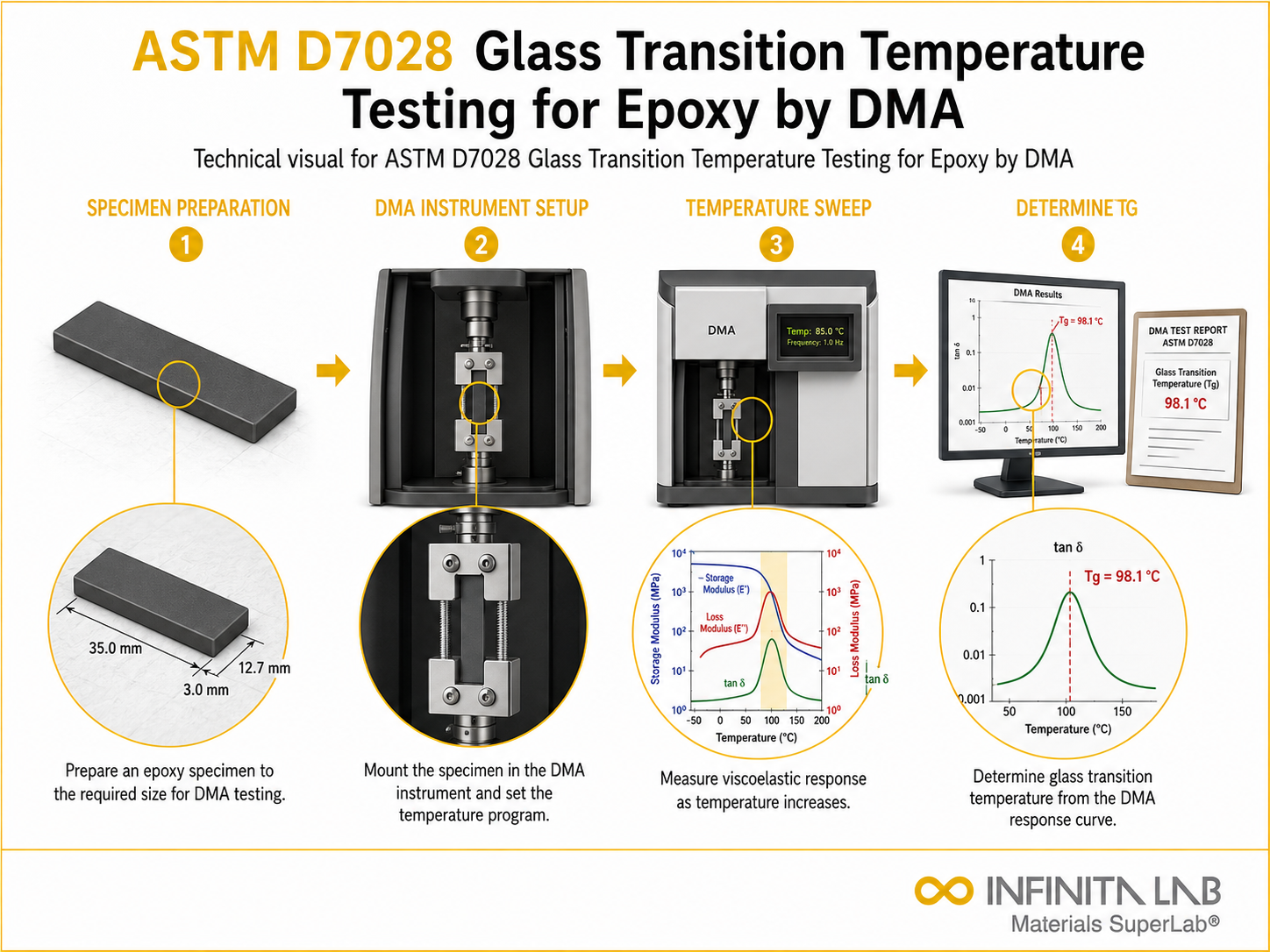
Our ASTM D7028 Testing Procedure
Specimen Preparation
Rectangular composite specimens are cut to defined dimensions and conditioned per test requirements (dry or wet).
1DMA Setup
Specimens are clamped in the appropriate fixture (single-cantilever, dual-cantilever, or 3-point bend) and loaded into the DMA furnace.
2Temperature Ramp
A dynamic oscillatory force is applied while temperature is increased at a controlled rate (typically 3–5°C/min); E', E'', and tan δ are continuously recorded.
3Tg Determination
Tg is identified from the onset of E' reduction, E'' peak, and tan δ peak; all three values are reported.
4ASTM D7028 Test Parameters and Requirements
| Parameter | Details |
|---|---|
| Test Principle | Dynamic mechanical analysis (DMA) |
| Applicable Materials | Continuous fiber-reinforced polymer matrix composites |
| Heating Rate | 1–5°C/min |
| Frequency | 1 Hz (default) |
| Measured Outputs | E' onset Tg, E'' peak Tg, tan δ peak Tg |


- Dynamic mechanical analyser (DMA) – Applies oscillating mechanical stress or strain to the specimen and measures the resulting storage modulus, loss modulus, and tan delta response.
- Temperature-controlled furnace/chamber – Ramps and precisely controls specimen temperature through the glass transition region during the test.
- Specimen clamping fixtures (dual cantilever, single cantilever, three-point bend) – Hold the specimen in the required geometry and transmit the oscillating flexural load uniformly during testing.
- Precision cutting and machining equipment – Prepares composite laminate specimens to the required dimensions with smooth, uniform edges.
- Environmental conditioning chamber – Stabilises specimen temperature and moisture content before testing.
- Data acquisition and analysis software – Records modulus and tan delta data continuously and applies the applicable Tg determination criteria to the resulting curves.
- Calibration reference standards – Verify instrument temperature accuracy and modulus measurement performance before testing.
Equipment and Instrumentation Used for ASTM D7028 Testing
What You Receive: Test Report, Data, and Certification
- Glass transition temperature (Tg) reported in °C, clearly identified by the determination method used (onset of storage modulus drop, peak loss modulus, or peak tan delta).
- Full storage modulus, loss modulus, and tan delta curves plotted as functions of temperature across the tested range.
- Documentation of specimen geometry, fixture configuration, conditioning, and test parameters used during the run.
- A formal test report referencing ASTM D7028, suitable for submission to customers, regulatory bodies, or internal quality records.
- Comparative data across multiple specimens or batches when testing is performed for material screening or quality control purposes.
- Raw data files available on request to support further engineering analysis or archival requirements.
ASTM D7028 Epoxy Glass Transition DMA FAQs
Aerospace specifications typically use the E' onset or E'' peak, which are more conservative than tan δ peak; the appropriate value depends on the governing specification or OEM requirement.
Absorbed moisture plasticizes the polymer matrix, reducing Tg — this is why aerospace composites are often tested in both dry and conditioned (hot-wet) states.
The method applies to thermoset (epoxy, bismaleimide, PEEK) and thermoplastic matrix composites with continuous fiber reinforcement.
Typical specimens are 50–60 mm long, 10–15 mm wide, and 2–4 mm thick; exact dimensions depend on the DMA fixture selected.
Yes — the measured Tg can be compared to the theoretical fully cured Tg to estimate degree of cure; under-cured laminates show a lower Tg than fully cured material.
ASTM D7028-07(2024) is the Standard Test Method for Glass Transition Temperature (DMA Tg) of Polymer Matrix Composites by Dynamic Mechanical Analysis (DMA). It determines the glass transition temperature of dry or moisture-conditioned polymer matrix composites containing continuous, high-modulus fibers using DMA under flexural oscillation. The resulting DMA Tg can indicate the composite’s upper use temperature and support quality control.
Why Choose Infinita Lab for Epoxy Glass Transition DMA Testing
When your Epoxy Glass Transition DMA results have to hold up - for compliance, a customer audit, or an engineering decision - ASTM D7028 accuracy and an unbiased third-party report matter more than price. Infinita Lab routes your ASTM D7028 epoxy glass transition DMA testing to ISO/IEC 17025-accredited U.S. partner labs with hands-on method experience, so you get defensible data, transparent reporting, and turnaround times built around your project deadline - not ours.

Need ASTM D7028 Epoxy Glass Transition DMA Testing You Can Rely On?
Send query us at hello@infinitalab.com or call us at (888) 878-3090 to learn more about our services and how we can support you.



Request a Quote
Submit your material details and receive testing procedures, pricing, and turnaround time within 24 hours.
 Quick Turnaround and Hasslefree process
 Confidentiality Guarantee
 Free, No-obligation Consultation
 100% Customer Satisfaction
