

What Is ASTM D6272 Composite Four Point Flexural?
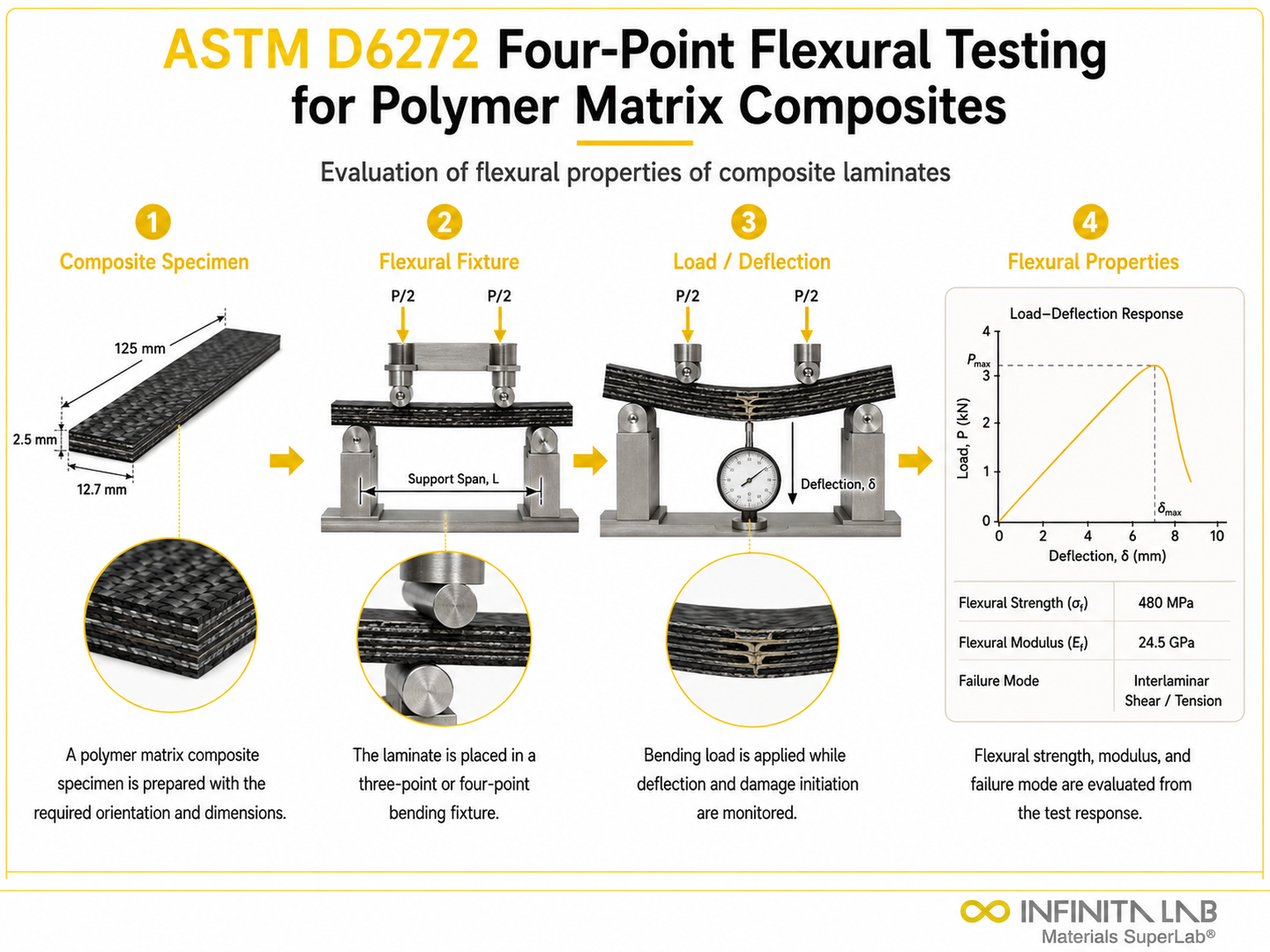
ASTM D6272 describes the four-point bending flexural test method for fibre-reinforced polymer composite materials. Unlike three-point bending (ASTM D790), the four-point configuration applies a uniform bending moment over a defined gauge section, minimising stress concentrations at loading points and providing more accurate flexural modulus and strength data for composites.
This test is essential for structural composite characterisation in aerospace, automotive, wind energy, and marine applications, where accurate flexural property data is required for component design and material qualification.

Applications and Benefits of ASTM D6272 Composite Four Point Flexural Testing
Scope
ASTM D6272 is used to evaluate the flexural performance of materials under a controlled bending load, providing key insights into their stiffness, strength, and deformation behaviour. It is especially useful for comparing how different laminate configurations perform under flexural stress.
The test typically evaluates:
- Flexural strength at the outer fibre – the maximum stress experienced at the specimen’s outer surface during bending
- Flexural modulus – includes both chord modulus and tangent modulus to assess material stiffness
- Strain at failure in bending – the amount of deformation the material undergoes before fracture
- Comparative flexural properties – enables performance comparison across different laminate structures and layups
Applications
- Aerospace structural composite qualification
- Wind turbine blade composite testing
- Automotive composite panel and structural part testing
- Marine and infrastructure composite materials
- Research and development of new composite systems
Benefits
- Uniform moment zone eliminates stress concentrations of 3-point bending
- More accurate modulus measurement for stiff composites
- Compatible with woven, UD, and multidirectional laminates
- Supports qualification and design allowable
- Applicable to both coupon and sub-component scale testing
Our ASTM D6272 Testing Procedure
Specimen Preparation
Composite coupons are machined to ASTM D6272 dimensions and documented.
1Fixture Setup
The specimen is mounted on support and loading rollers as per the required span configuration.
2Load Application
Bending load is applied at a controlled rate while load and deflection are recorded.
3Data Processing
Flexural stress, strain, and modulus are calculated and reported with failure mode.
4ASTM D6272 Test Parameters and Requirements
| Parameter | Details |
|---|---|
| Loading Configuration | Four-point (1/3 point or 1/4 point loading) |
| Applicable Materials | FRP composites, thermoplastics, laminates |
| Support Span | Typically 16:1 span-to-depth ratio |
| Crosshead Rate | 1–2 mm/min (displacement controlled) |
| Measured Outputs | Flexural strength, modulus, strain at failure |


- Universal testing machine (UTM) with load cell
- Four-point bending fixture with adjustable spans
- Contact or video extensometer for deflection measurement
- Specimen measurement tools (micrometre, callipers)
- Data acquisition and test control software
Equipment and Instrumentation Used for ASTM D6272 Testing
What You Receive: Test Report, Data, and Certification
- Flexural stress–strain curves
- Flexural strength and strain at failure
- Flexural modulus (chord and tangent)
- Failure mode classification and photographs
- Statistical summary and full test report per ASTM D6272
ASTM D6272 Composite Four Point Flexural FAQs
Four-point bending produces a uniform bending moment between the inner loading rollers, eliminating the shear stress present in the gauge zone of three-point bending. This is particularly important for composites where transverse shear failure can prematurely reduce measured flexural strength.
ASTM D6272 recommends a support span-to-depth ratio of 16:1 as a starting point, but this may be increased to 32:1 or more for materials prone to interlaminar shear failure under standard spans.
ASTM D6272 is intended for reinforced plastics and composites. ASTM D790 is the preferred standard for unreinforced and lightly filled plastics in three-point bending.
Common failure modes include tensile fracture on the tensile face, compressive buckling/delamination on the compressive face, interlaminar shear in the specimen core, and combined failure modes. Failure mode is documented per ASTM D6272 notation.
ASTM D6272 requires a minimum of 5 specimens per test condition. For design allowable or statistical data, 10–20 specimens per condition may be needed.
A four-point bending test evaluates a metal's resistance to bending under an applied load. The specimen is placed on two supports, and two loading points apply force from above, creating a region of constant bending moment between them. The load and deflection are measured to assess flexural behavior, stiffness, and failure strength, where applicable. The appropriate test standard depends on the material; ASTM E855 covers bending testing of metallic flat materials, while ASTM C651 applies specifically to manufactured carbon and graphite articles.
Why Choose Infinita Lab for Composite Four Point Flexural Testing
When your Composite Four Point Flexural results have to hold up - for compliance, a customer audit, or an engineering decision - ASTM D6272 accuracy and an unbiased third-party report matter more than price. Infinita Lab routes your ASTM D6272 composite four point flexural testing to ISO/IEC 17025-accredited U.S. partner labs with hands-on method experience, so you get defensible data, transparent reporting, and turnaround times built around your project deadline - not ours.

Need ASTM D6272 Composite Four Point Flexural Testing You Can Rely On?
Send query us at hello@infinitalab.com or call us at (888) 878-3090 to learn more about our services and how we can support you.





