


ASTM C1341: Ceramic Matrix Composite Flexural Testing Services
The test method in ASTM C1341 is used for material development, material flexural specifications, and quality control of ceramic composite specimens. The specimens in the form of rectangular bars are assumed to have continuous fiber-reinforced, homogenous and linearly elastic ceramic composites.
TRUSTED BY


Get ASTM C1341 compliant results — request your ceramic matrix composite flexural testing quote
- Overview
- Scope, Applications, and Benefits
- Test Process
- Specifications
- Instrumentation
- Results and Deliverables
What Is ASTM C1341 Ceramic Matrix Composite Flexural?
ASTM C1341 specifies a test method for determining the flexural properties of continuous fiber-reinforced advanced ceramic composites under bending loads. The test evaluates material behavior such as flexural strength, modulus, and deformation characteristics essential for structural performance.
This standard is widely used in aerospace, defense, and high-temperature engineering applications where ceramic composites are subjected to bending stresses. ASTM C1341 ensures reliable and repeatable measurement, supporting material development, quality control, and design validation.

Applications and Benefits of ASTM C1341 Ceramic Matrix Composite Flexural Testing
Scope
ASTM C1341 covers the determination of flexural properties of continuous fiber-reinforced ceramic composites using standardized bending test methods. It includes specimen preparation, loading configurations, and calculation procedures for accurate evaluation.
Includes:
- Measurement of flexural strength and modulus
- Evaluation of bending behavior of composites
- Standardized specimen geometry and preparation
- Controlled loading and test conditions
- Data analysis and reporting
Applications
- Aerospace structural components
- Defense and military systems
- High-temperature composite materials
- Turbine and engine components
- Advanced material research
- Structural design validation
Benefits
- Provides critical flexural performance data
- Supports composite material design
- Evaluates fiber-matrix interaction under bending
- Ensures reliability in structural applications
- Standardized and repeatable testing method
- Suitable for high-performance materials
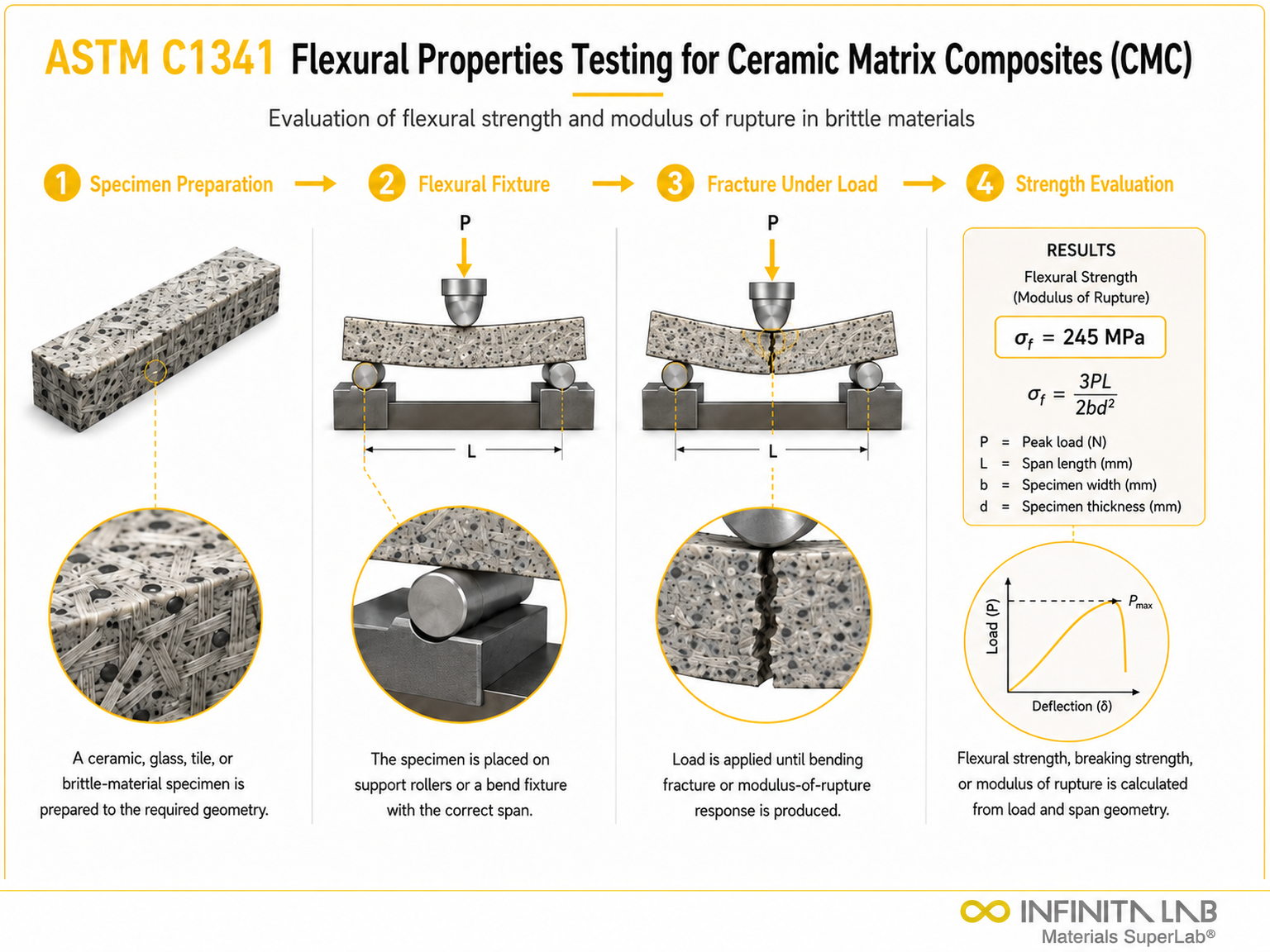
Our ASTM C1341 Testing Procedure
Specimen Preparation
Composite specimens are machined with precise dimensions and controlled fiber orientation.
1Test Setup
Specimen is placed on supports in a bending fixture within a testing machine.
2Load Application
Load is applied at a controlled rate until failure or specified deformation occurs.
3Result Calculation
Flexural properties are calculated using load, span length, and specimen dimensions.
4ASTM C1341 Test Parameters and Requirements
| Parameter | Details |
|---|---|
| Material Type | Continuous fiber-reinforced ceramic composites |
| Loading Configuration | Three-point or four-point bending |
| Specimen Geometry | Rectangular bars with defined dimensions |
| Measurement Parameters | Flexural strength, modulus, strain |
| Test Environment | Typically ambient conditions |
| Failure Mode | Matrix cracking, fiber breakage, or delamination |
| Output | Load-deflection curves and flexural properties |


- Universal Testing Machine (UTM)
- Flexural test fixture (3-point or 4-point)
- Vernier calipers or micrometers
- Extensometer or deflection measuring device
- Data acquisition system
- Optical microscope
Equipment and Instrumentation Used for ASTM C1341 Testing
What You Receive: Test Report, Data, and Certification
- Flexural strength and modulus report
- Load versus deflection curves
- Failure mode analysis
- Specimen dimension records
- Compliance certification as per ASTM C1341
- Test summary and evaluation report
ASTM C1341 Ceramic Matrix Composite Flexural FAQs
ASTM C1341 is used to determine the flexural properties of continuous fiber-reinforced ceramic composites, providing essential data on strength, stiffness, and deformation behavior for evaluating performance in structural and high-temperature engineering applications.
Flexural testing evaluates how materials behave under bending loads, which is essential for components subjected to structural stresses in aerospace, automotive, and industrial applications.
Three-point bending applies load at a single central point, while four-point bending distributes load across two points, providing a more uniform stress distribution and reducing localized stress concentration.
The test provides reliable flexural data, supports material development, and ensures performance and safety of composite materials in demanding applications.
The method requires precise specimen preparation and alignment, and results may vary depending on fiber orientation and material uniformity, requiring careful testing and interpretation.
Why Choose Infinita Lab for Ceramic Matrix Composite Flexural Testing
At the core of this breadth is our network of 2,000+ accredited laboratories across the USA, offering access to over 10,000 testing methods and analytical services. From advanced materials characterization (SEM, TEM, RBS, XPS) to mechanical, chemical, environmental, biological, and standardized ASTM/ISO-compliant testing, we deliver unmatched flexibility, specialization, and scale. You are never limited by geography, facility, or methodology — Infinita Lab connects you to the right expertise and testing solution, every time.

Looking for an Accredited Partner for ASTM C1341 Ceramic Matrix Composite Flexural Testing?
Send query us at hello@infinitalab.com or call us at (888) 878-3090 to learn more about our services and how we can support you.



Request a Quote
Submit your material details and receive testing procedures, pricing, and turnaround time within 24 hours.
 Quick Turnaround and Hasslefree process
 Confidentiality Guarantee
 Free, No-obligation Consultation
 100% Customer Satisfaction
