


ASTM D7264: Composite Flexural Properties Testing Services
ASTM D7264: Testing of Flexural properties for various polymer matrix composites is done by the ASTM D7264 method. Flexural properties of materials are combined effects of a material's core compressive, tensile, and shear properties, and it varies according to different temperatures, strain rate, and sample thickness. Read more about ASTM D7264 Flexural Properties of Composites below.
TRUSTED BY


Get ASTM D7264 compliant results — request your composite flexural properties testing quote
- Overview
- Scope, Applications, and Benefits
- Test Process
- Specifications
- Instrumentation
- Results and Deliverables
What Is ASTM D7264 Composite Flexural Properties?
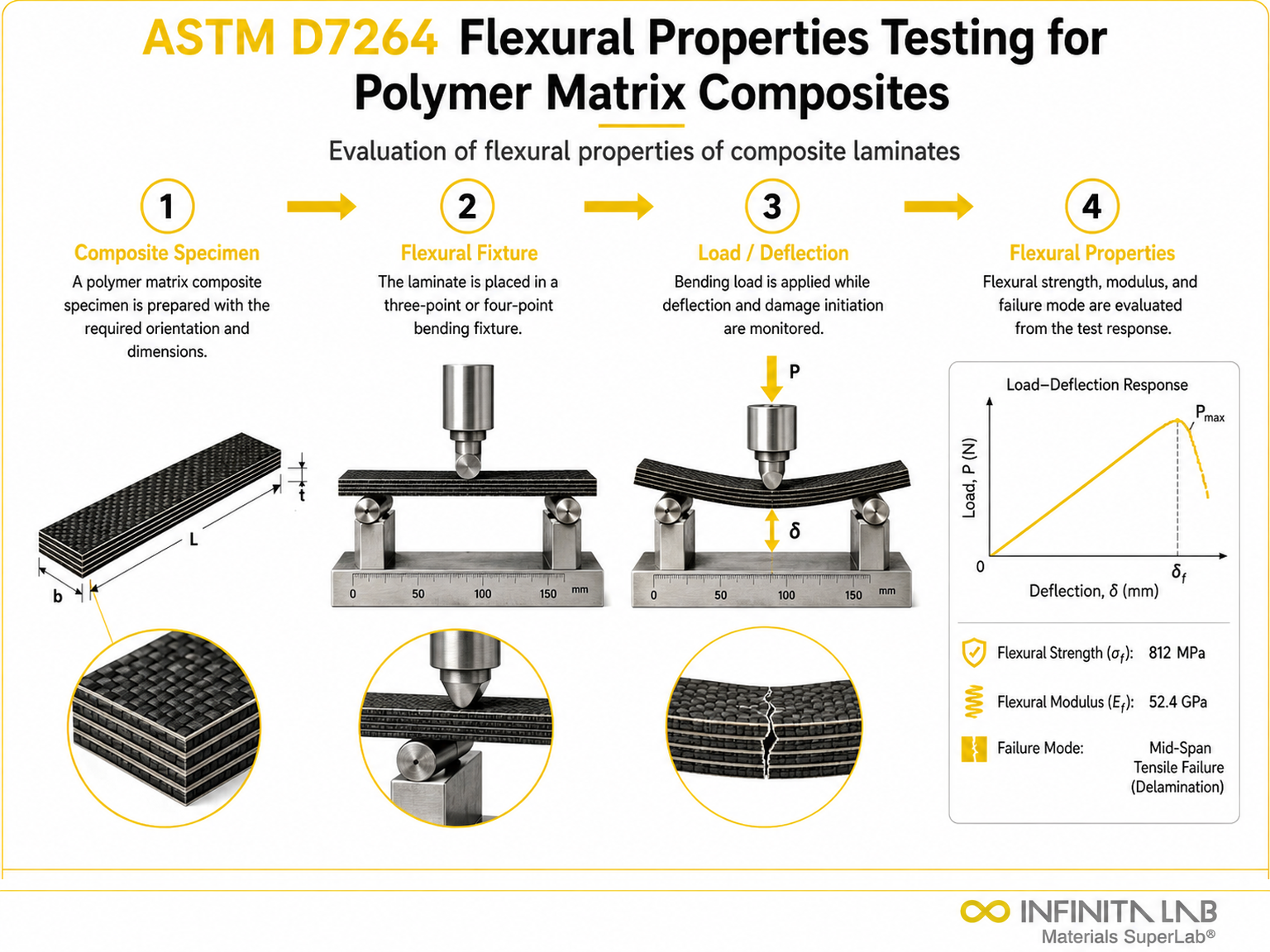
ASTM D7264 provides standard test methods for determining the flexural properties of polymer matrix composite materials in both three-point and four-point bending configurations. Flexural strength and modulus are fundamental mechanical properties needed for composite structural design and material qualification.
This standard is one of the primary ASTM methods for composite flexural characterization, widely used across aerospace, automotive, marine, and sporting goods industries.

Applications and Benefits of ASTM D7264 Composite Flexural Properties Testing
Scope
ASTM D7264 covers continuous and chopped fiber-reinforced polymer matrix composites and determines:
- Flexural strength (ultimate fiber stress at failure)
- Flexural modulus (chord modulus from load-deflection data)
- Load-deflection behavior and failure mode
- Both three-point (Procedure A) and four-point 1/3-span (Procedure B) bending
Applications
- Composite laminate structural design property generation
- Batch release and quality control for composite panels
- Comparison of resin systems, fiber architectures, and manufacturing processes
- Environmental conditioning effects on flexural performance
- Repair material qualification for composite structures
Benefits
- Simple, low-cost test providing fundamental design property data
- Applicable to a broad range of fiber/matrix combinations
- Standard geometry readily accommodated in any universal testing machine
- Allows comparison between three-point and four-point loading modes
- Essential for regulatory and customer specification compliance
Our ASTM D7264 Testing Procedure
Specimen Preparation
Rectangular composite specimens are machined from panels to defined width and thickness with smooth, parallel edges.
1Fixture Setup
Specimens are centered on the support span in either three-point (Procedure A) or four-point 1/3-span (Procedure B) configuration.
2Flexural Loading
Load is applied at the midpoint (3-pt) or at the 1/3 span points (4-pt) at a controlled crosshead rate; load and deflection are recorded.Load is applied at the midpoint (3-pt) or at the 1/3 span points (4-pt) at a controlled crosshead rate; load and deflection are recorded.
3Property Calculation
Flexural strength and modulus are calculated from the maximum load and the initial slope of the load-deflection curve.
4ASTM D7264 Test Parameters and Requirements
| Parameter | Details |
|---|---|
| Standard | ASTM D7264 |
| Test Principle | Three-point or four-point bending |
| Applicable Materials | Continuous fiber and chopped fiber PMC laminates |
| Span-to-Depth Ratio | 32:1 (Procedure A); 40:1 (Procedure B) |
| Loading Rate | Per calculated formula based on span and depth |
| Measured Outputs | Flexural strength (MPa), flexural modulus (GPa), failure mode |


- Universal testing machine with appropriate load cell
- Three-point or four-point bending fixtures with cylindrical loading noses
- Crosshead displacement or extensometer for deflection measurement
- Precision calipers for specimen dimension measurement
- Data acquisition system
Equipment and Instrumentation Used for ASTM D7264 Testing
What You Receive: Test Report, Data, and Certification
- Flexural strength (MPa) and statistical summary
- Flexural modulus (GPa)
- Load-deflection curve for each specimen
- Failure mode documentation (tension, compression, interlaminar shear)
- Complete test report for design, qualification, or specification compliance
ASTM D7264 Composite Flexural Properties FAQs
ASTM D790 is the standard for unreinforced and reinforced plastics, while D7264 is specifically developed for fiber-reinforced polymer matrix composites with specific span-to-depth ratios and loading nose geometries optimized for composite laminates.
Three-point bending (Procedure A) is simpler and more common for screening tests; four-point bending (Procedure B) provides a uniform bending moment in the test zone and is preferred when comparing materials for damage tolerance or large-area testing.
Tension or compression failure in the outer fiber is the desired mode; interlaminar shear failure (splitting at the mid-plane) indicates the span-to-depth ratio is too low and the result should be considered invalid.
Specimens tested with fibers oriented along the specimen axis (0°) produce maximum flexural strength; off-axis or woven laminates show lower flexural strength depending on fiber architecture.
Yes — with appropriate environmental chamber equipment, D7264 testing can be conducted across a range of temperatures to characterize temperature-dependent flexural properties.
Why Choose Infinita Lab for Composite Flexural Properties Testing?
At the core of this breadth is our network of 2,000+ accredited laboratories across the USA, offering access to over 10,000 testing methods and analytical services. From advanced materials characterization (SEM, TEM, RBS, XPS) to mechanical, chemical, environmental, biological, and standardized ASTM/ISO-compliant testing, we deliver unmatched flexibility, specialization, and scale. You are never limited by geography, facility, or methodology — Infinita Lab connects you to the right expertise and testing solution, every time.

Need ASTM D7264 Composite Flexural Properties Testing You Can Rely On?
Send query us at hello@infinitalab.com or call us at (888) 878-3090 to learn more about our services and how we can support you.



Request a Quote
Submit your material details and receive testing procedures, pricing, and turnaround time within 24 hours.
 Quick Turnaround and Hasslefree process
 Confidentiality Guarantee
 Free, No-obligation Consultation
 100% Customer Satisfaction
