


ASTM D790: 3 Point Flexure Plastics Testing Services
Flexural modulus of elasticity (i.e., flexural modulus), stress-strain behavior, and bending tensile strengths can be achieved using the simple sample geometry of a 3-point bending test.
TRUSTED BY


Get ASTM D790 compliant results — request your 3 point flexure plastics testing quote
- Overview
- Scope, Applications, and Benefits
- Test Process
- Specifications
- Instrumentation
- Results and Deliverables
What Is ASTM D790 3 Point Flexure Plastics?
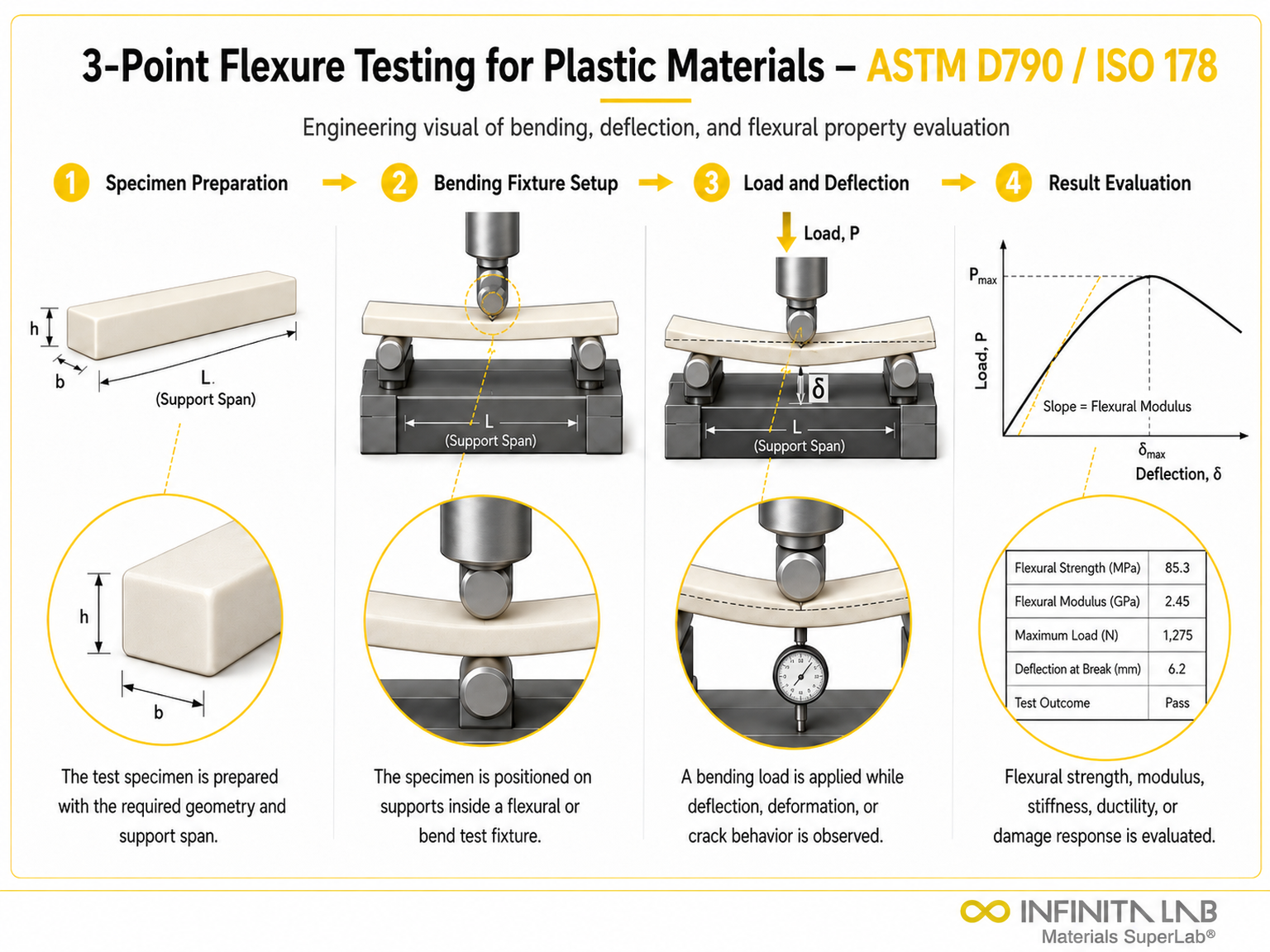
The 3-point flexure test is used to determine the flexural properties of plastic materials by applying a load at the center of a supported specimen. The test evaluates how a material behaves under bending, including its flexural strength, modulus, and deformation characteristics.
This test is widely used for plastics, composites, and polymer-based materials in product design and quality control. It helps assess stiffness and load-bearing capability, which are critical for applications involving structural or semi-structural components.

Applications and Benefits of ASTM D790 3 Point Flexure Plastics Testing
Scope
The 3-point flexure test evaluates the bending performance of plastic materials by applying a controlled load at the midpoint of a specimen supported at two ends. The test determines flexural strength, modulus, and strain behavior.
The test evaluates:
- Flexural strength of plastic materials
- Flexural modulus (stiffness)
- Deflection under load
- Stress-strain behavior in bending
- Material performance under transverse loading
Applications
- Plastic and polymer components
- Composite materials
- Structural plastic parts
- Automotive and aerospace components
- Consumer product materials
- Material research and development
Benefits
- Provides a standardized evaluation of bending properties
- Helps assess stiffness and load-bearing capacity
- Supports material selection and product design
- Assists in quality control of plastic components
- Enables comparison of flexural performance
Our ASTM D790 Testing Procedure
Sample Preparation
Rectangular specimens are prepared with specified dimensions and surface finish.
1Fixture Setup
The specimen is placed on two supports with a defined span length.
2Load Application
A central load is applied at a constant rate until failure or specified deflection.
3Data Recording & Evaluation
Load and deflection data are recorded to calculate flexural strength and modulus.
4ASTM D790 Test Parameters and Requirements
| Parameter | Details |
|---|---|
| Applicable Materials | Plastics and polymer composites |
| Span Length | Typically 16× specimen thickness |
| Specimen Dimensions | ~127 mm × 12.7 mm × 3.2 mm (typical) |
| Crosshead Speed | 1 to 10 mm/min |
| Load Range | Up to 10 kN (depending on material) |
| Measured Outputs | Flexural strength (MPa), modulus (GPa), deflection (mm) |


- Universal testing machine (up to ~10 kN capacity)
- 3-point bending fixture
- Load cell and displacement sensor
- Specimen support rollers
- Extensometer (optional)
- Data acquisition software
Equipment and Instrumentation Used for ASTM D790 Testing
What You Receive: Test Report, Data, and Certification
- Flexural strength values (MPa)
- Flexural modulus results (GPa)
- Load vs. deflection curves
- Maximum strain and deformation data
- Test condition summary
- ASTM compliance report
ASTM D790 3 Point Flexure Plastics FAQs
3-point flexure testing includes span length, loading rate, specimen thickness, width, and support geometry, evaluating flexural strength, modulus, and deformation behavior of plastic materials under controlled bending conditions.
3-point flexure testing determines flexural strength, flexural modulus, strain at break, and load-deflection behavior, providing insight into stiffness and resistance of plastics to bending forces.
3-point flexure testing is commonly applied to thermoplastics, thermosets, reinforced plastics, and composite materials used in structural, automotive, and consumer product applications.
3-point flexure testing requires a universal testing machine, support fixtures, loading nose, and displacement measurement system to apply controlled bending loads and record material response.
3-point flexure testing evaluates bending behavior under controlled conditions and may not represent complex loading scenarios where combined stresses, temperature variations, or long-term use affect plastic performance.
Why Choose Infinita Lab for 3 Point Flexure Plastics Testing
At the core of this breadth is our network of 2,000+ accredited laboratories across the USA, offering access to over 10,000 testing methods and analytical services. From advanced materials characterization (SEM, TEM, RBS, XPS) to mechanical, chemical, environmental, biological, and standardized ASTM/ISO-compliant testing, we deliver unmatched flexibility, specialization, and scale. You are never limited by geography, facility, or methodology — Infinita Lab connects you to the right expertise and testing solution, every time.

Looking for an Accredited Partner for ASTM D790 3 Point Flexure Plastics Testing?
Send query us at hello@infinitalab.com or call us at (888) 878-3090 to learn more about our services and how we can support you.



Request a Quote
Submit your material details and receive testing procedures, pricing, and turnaround time within 24 hours.
 Quick Turnaround and Hasslefree process
 Confidentiality Guarantee
 Free, No-obligation Consultation
 100% Customer Satisfaction
