

What Is Thermal Physical Analysis?
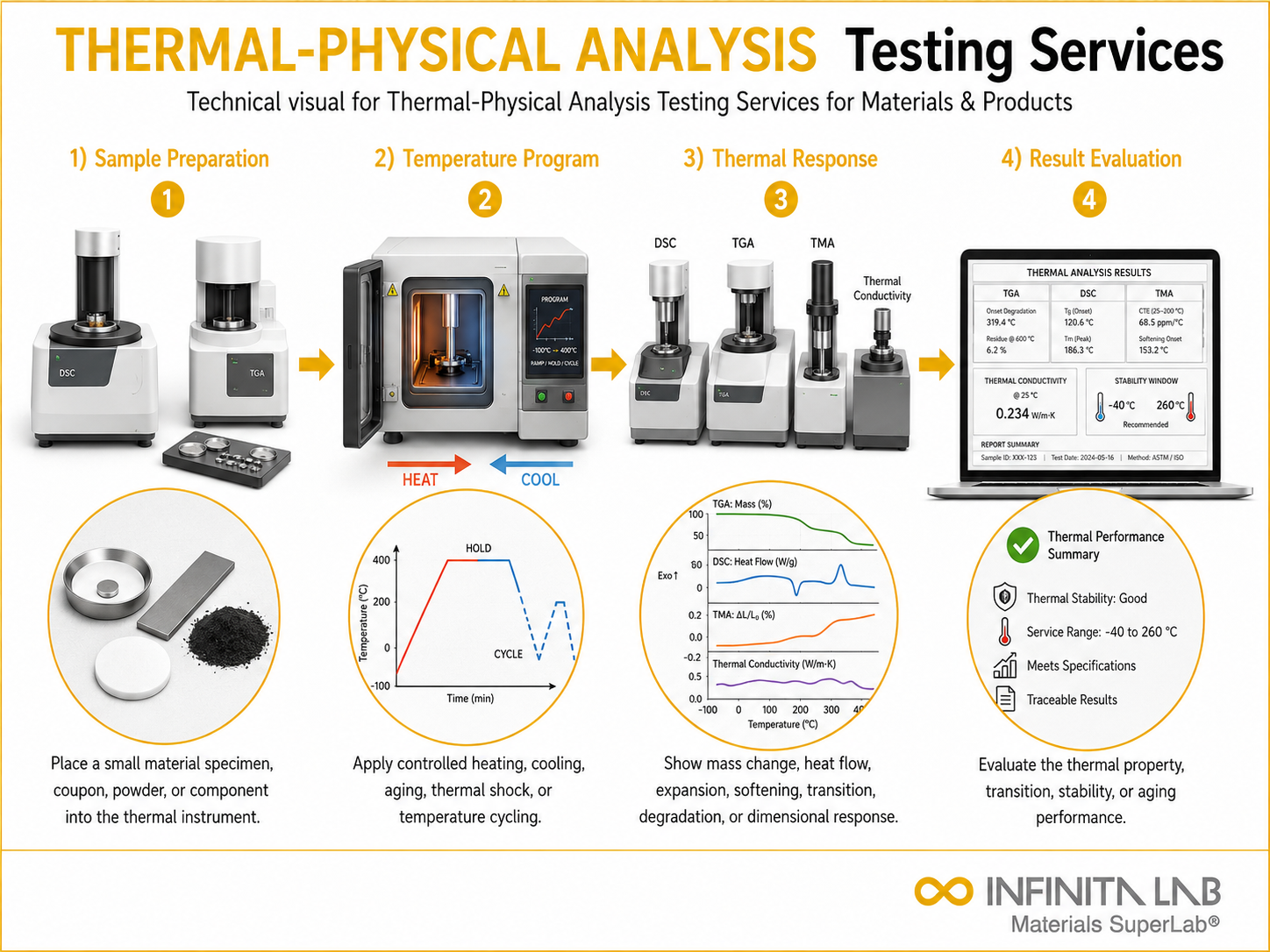
Thermal Physical Analysis is a comprehensive characterization approach used to study the thermophysical behavior of materials under controlled temperature conditions. It evaluates multiple thermal properties such as thermal conductivity, diffusivity, expansion, specific heat, and phase transition behavior to understand how materials respond to thermal energy input. This analysis is essential for predicting performance in real-world thermal environments where materials undergo heating, cooling, and cyclic temperature variations.
The technique integrates advanced instrumentation such as DSC, TGA, TMA, and laser-based systems to generate accurate thermal response data. It is widely used in material development, quality control, and engineering design to ensure stability, reliability, and performance of materials in demanding thermal applications across industries.

Applications and Benefits of Thermal Physical Analysis Testing
Scope
Thermal Physical Analysis evaluates comprehensive thermophysical behavior of materials under controlled thermal environments.
- Assesses multiple thermal properties including expansion, conductivity, and phase behavior
- Applicable to metals, polymers, ceramics, composites, and advanced materials
- Evaluates temperature-dependent physical and structural changes
- Supports both steady-state and transient thermal studies
- Used for material development, validation, and failure analysis
- Helps understand phase transitions, decomposition, and stability
- Provides multi-property thermal characterization in a single study
Applications
- Advanced material research and development
- Aerospace thermal performance evaluation
- Automotive component thermal validation
- Electronics thermal reliability analysis
- Energy storage and battery material studies
- Polymer and composite optimization
Benefits
- Provides complete thermophysical understanding of materials
- Reduces material failure risk under thermal stress
- Supports accurate engineering design and simulation
- Improves product reliability and performance
- Enables early detection of material instability
- Optimizes material selection for thermal applications
Our Testing Procedure
Sample Conditioning
Material samples are prepared, cleaned, and stabilized to ensure uniform thermal response during analysis.
1Instrument Calibration
Thermal analysis instruments are calibrated using certified reference standards for accurate measurement across thermal properties.
2Controlled Thermal Scanning
The sample is subjected to programmed heating or cooling cycles while multiple thermal responses are recorded simultaneously.
3Data Interpretation
Thermal behavior data is analyzed to determine property relationships, phase transitions, and stability characteristics.
4Test parameters and requirements
| Parameter | Details |
|---|---|
| Measurement Principle | Multi-parameter thermal response analysis |
| Temperature Range | 150°C to 1600°C depending on instrument system |
| Property Coverage | Conductivity, diffusivity, expansion, phase transitions |
| Sample Types | Solids, polymers, composites, ceramics, metals |
| Heating Rate | 0.1 to 50°C/min programmable |
| Atmosphere Control | Inert, oxidative, or vacuum environments |
| Data Output | Multi-property thermal response profiles |


- Differential Scanning Calorimeter (DSC)
- Thermogravimetric Analyzer (TGA)
- Thermomechanical Analyzer (TMA)
- Laser Flash Analysis (LFA) system
- Thermal conductivity measurement system
- Controlled atmosphere furnace
Equipment and Instrumentation Used for Testing
What You Receive: Test Report, Data, and Certification
- Multi-property thermal behavior report
- Phase transition and stability analysis
- Thermal expansion and conductivity profiles
- Material degradation and decomposition data
- Calibration and validation certificates
- Engineering-grade thermal characterization report
Thermal Physical Analysis FAQs
Thermal Physical Analysis is a combined approach used to study how materials respond to heat by evaluating multiple thermophysical properties such as conductivity, expansion, phase changes, and stability under controlled thermal conditions.
It provides a complete understanding of how materials behave under thermal stress, helping engineers design reliable systems, prevent failure, and select materials suitable for high-temperature or cyclic thermal environments.
Unlike single-property tests, Thermal Physical Analysis provides a multi-parameter evaluation, offering a holistic understanding of material behavior instead of isolated thermal characteristics.
Grain size, porosity, and phase distribution affect heat flow pathways and expansion behavior. Irregular microstructures lead to anisotropic and non-uniform thermal responses.
It identifies early indicators such as softening, decomposition onset, or expansion instability, which are precursors to mechanical or thermal failure in service conditions.
Why Choose Infinita Lab for Thermal Physical Analysis Testing?
At the core of this breadth is our network of 2,000+ accredited laboratories across the USA, offering access to over 10,000 testing methods and analytical services. From advanced materials characterization (SEM, TEM, RBS, XPS) to mechanical, chemical, environmental, biological, and standardized ASTM/ISO-compliant testing, we deliver unmatched flexibility, specialization, and scale. You are never limited by geography, facility, or methodology — Infinita Lab connects you to the right expertise and testing solution, every time.

Looking for an Accredited Partner for Thermal Physical Analysis Testing?
Send query us at hello@infinitalab.com or call us at (888) 878-3090 to learn more about our services and how we can support you.





