


ASTM D1184: Adhesive Laminate Flexural Strength Testing Services
Accredited ASTM D1184 adhesive laminate flexural strength testing from Infinita Lab, performed to the exact standard requirements - accurate, reproducible results with full documentation for compliance, R&D, and quality control programs.
TRUSTED BY


Get ASTM D1184 compliant results - request your adhesive laminate flexural strength testing quote
- Overview
- Scope, Applications, and Benefits
- Test Process
- Specifications
- Instrumentation
- Results and Deliverables
What Is ASTM D1184 Adhesive Laminate Flexural Strength?
ASTM D1184, formally titled “Standard Test Method for Flexural Strength of Adhesive Bonded Laminated Assemblies,” gives manufacturers and adhesive formulators a standardised way to compare how well a bonded laminate holds up under bending loads. ASTM Committee D14 maintains the method on Adhesives and remains active today, currently published as D1184-98(2020) following its most recent reapproval. It applies specifically to laminated assemblies composed of rigid adherends, typically metal or wood, joined with a structural or semi-structural adhesive.
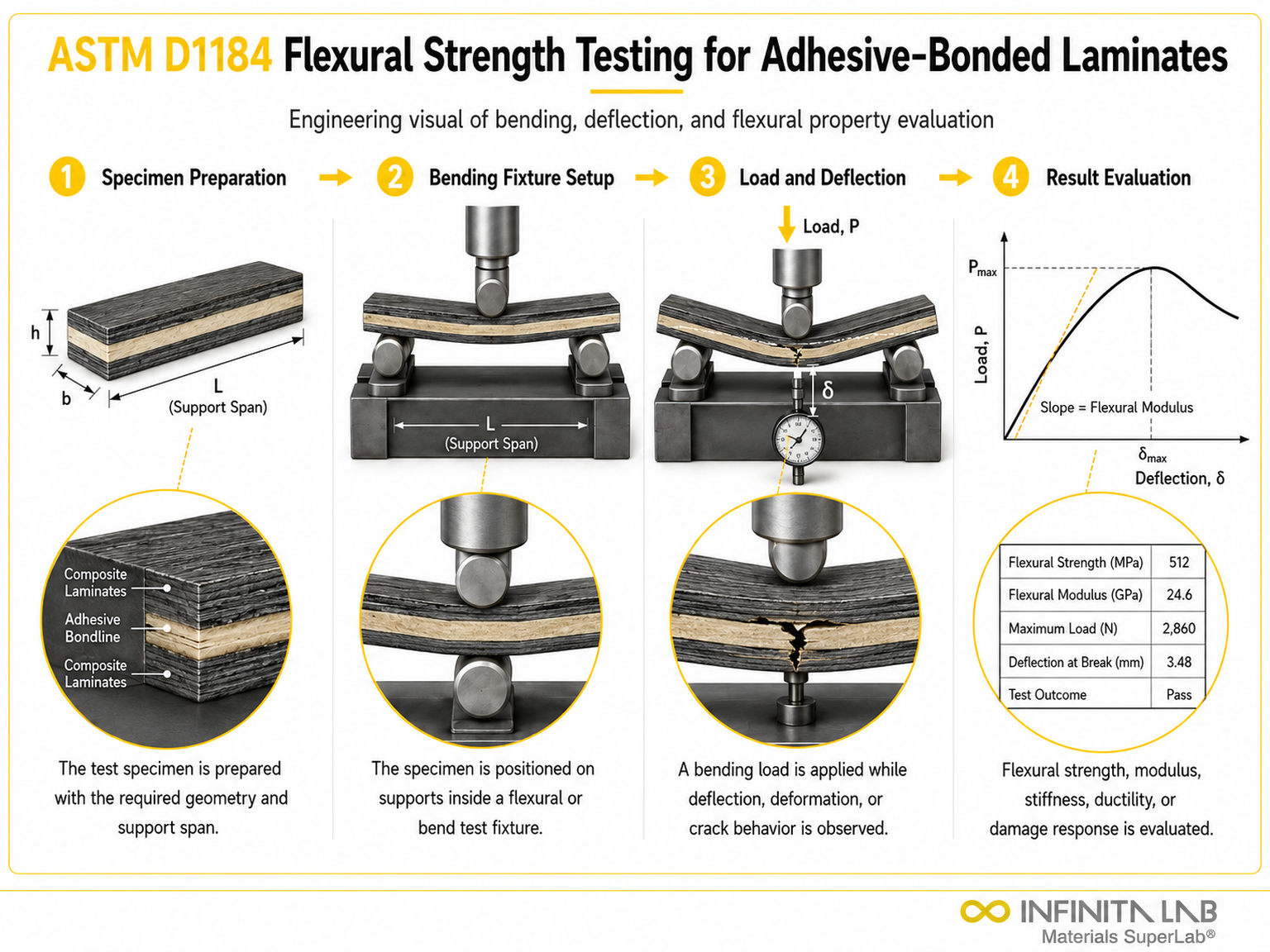
The test itself uses a three-point bending setup, where a laminated specimen is supported near its ends and loaded at the centre until it fails. What sets D1184 apart from other flexural standards is that the specimen geometry and loading arrangement are deliberately chosen to generate significant interlaminar shear stress at the bond line, not just simple bending stress in the substrate. That makes the method especially useful for evaluating how the adhesive bond itself performs, rather than just the base material. Engineers running this test typically want to know whether a given adhesive formulation, surface preparation, or cure schedule produces a bond line that resists delamination and shear-driven failure under flexural loading.
It’s worth noting that ASTM explicitly states the data generated by this method are meant for comparative evaluation, not for structural design calculations. That distinction matters for how the results get used downstream, whether in adhesive qualification, quality control, or R&D screening. At Infinita Lab, we route D1184 testing through accredited partner laboratories that run the method to the letter, so you get consistent, defensible data whether you’re comparing adhesive candidates, validating a new laminate construction, or supporting a broader qualification package.

Applications and Benefits of ASTM D1184 Adhesive Laminate Flexural Strength Testing
Scope
- Establishes a standardised three-point bend procedure for adhesive-bonded laminated assemblies made from rigid adherends.
- Covers laminated specimens constructed from metal, wood, or combinations of the two joined with adhesive.
- Does not apply to assemblies built with nonrigid or flexible adherends.
- Generates measurable interlaminar shear stress at the bond line in addition to conventional bending stress.
- Produces comparative flexural strength values rather than design allowable.
- Requires specimens to be conditioned under controlled temperature and humidity before testing.
- Falls under the jurisdiction of ASTM Committee D14 on Adhesives.
- Allows testing at ambient or elevated temperature depending on the fixture and program requirements.
- Records maximum load, flexural strength, and observed failure mode for each specimen.
- Supports side-by-side comparison of different adhesive systems, surface treatments, or laminate constructions.
Applications
- Adhesive manufacturers use the method to screen new formulations before advancing them to full qualification testing.
- Laminated wood product producers rely on it to verify bond quality in structural and semi-structural assemblies.
- Aerospace and industrial suppliers apply it to bonded metal laminates where interlaminar strength is a design concern.
- Quality control labs use it as a routine check on production consistency for bonded laminate assemblies.
- Research teams reference it when comparing surface preparation techniques or cure cycles.
- Composite and construction material developers use it to benchmark new adhesive-bonded panel systems.
- Failure investigators apply it to reproduce and characterise delamination or bond-line failures observed in service.
Benefits
- Delivers a repeatable, industry-recognised method for comparing adhesive bond performance across suppliers.
- Highlights weaknesses at the bond line that might not show up in simpler flexural tests of the substrate alone.
- Supports data-driven decisions during adhesive selection and formulation development.
- Provides documented evidence for quality assurance and customer or regulatory reporting.
- Helps manufacturers catch process drift in bonding operations before it becomes a field failure.
- Gives R&D teams a fast, cost-effective screening tool ahead of more extensive structural testing.
Our ASTM D1184 Testing Procedure
Specimen Preparation
Laminated assemblies are prepared with bonded layers according to specified dimensions.
1Fixture Setup
The specimen is placed in a flexural testing fixture, typically in a three-point or four-point bending setup.
2Flexural Loading
A controlled load is applied at the midpoint of the specimen at a constant rate until failure or maximum deflection occurs.
3Failure Observation & Data Recording
Maximum load, bending stress, and failure mode are recorded to determine flexural strength and bond performance.
4ASTM D1184 Test Parameters and Requirements
| Parameter | Details |
|---|---|
| Test Type | Flexural (bending) test |
| Specimen Geometry | Rectangular laminated strips |
| Loading Configuration | Three-point bending |
| Measured Outputs | Maximum load, flexural strength, failure mode |
| Failure Criteria | Adhesive, cohesive, or substrate failure |
| Specimen Type | Adhesive-bonded laminated assembly |
| Test Speed | Controlled crosshead speed |
| Failure Mode | Delamination or fracture |
| Units | Strength reported in MPa or psi |


- Universal Testing Machine – Applies the controlled centre-point load and records the load-deflection response throughout the test.
- Three-Point Bend Fixture – Supports the specimen at the specified span and directs load to the centre of the laminate.
- Environmental Chamber – Enables testing at elevated temperature when the program calls for it.
- Conditioning Chamber – Maintains controlled temperature and humidity during specimen pre-test conditioning.
- Calibrated Load Cell – Measures applied force with the accuracy needed for reliable flexural strength calculations.
- Extensometer or Deflection Sensor – Tracks specimen deflection under load for the load-deflection curve.
- Digital Imaging Equipment – Documents specimen condition and failure mode after test completion.
Equipment and Instrumentation Used for ASTM D1184 Testing
What You Receive: Test Report, Data, and Certification
- A detailed test report documenting maximum load, calculated flexural strength, and failure mode for each specimen.
- Load-versus-deflection data suitable for comparing performance across adhesive systems or laminate constructions.
- Photographic documentation of failure surfaces to support root-cause and bond-quality assessment.
- Specimen preparation and conditioning records to confirm the test was run under the specified conditions.
- A summary comparison table when multiple adhesive or laminate variants are tested side by side.
- Raw data files available on request for further statistical analysis or internal engineering review.
ASTM D1184 Adhesive Laminate Flexural Strength FAQs
Flexural strength determines whether a laminated structure can sustain loads, resist bending, and maintain structural integrity during real-world applications such as construction, aerospace, and automotive components.
Deflection measurement helps understand the flexibility and stiffness of the laminated assembly. It provides insight into how the structure behaves under load before failure occurs.
Three-point bending applies load at a single central point, while four-point bending distributes load over two points. This affects stress distribution and can influence failure behavior.
It ensures that adhesive bonds can withstand bending forces during service. This helps prevent structural failure, improves durability, and enhances the overall reliability of laminated assemblies.
Common failure modes include adhesive bond failure, delamination between layers, or fracture of the substrate material. These observations help evaluate bonding effectiveness and structural performance.
ASTM C1184 evaluates structural silicone sealants through tests for hardness, tensile adhesion, heat aging, extrudability, and tack-free time to verify their performance and suitability for structural glazing applications.
Why Choose Infinita Lab for Adhesive Laminate Flexural Strength Testing
When your Adhesive Laminate Flexural Strength results have to hold up - for compliance, a customer audit, or an engineering decision - ASTM D1184 accuracy and an unbiased third-party report matter more than price. Infinita Lab routes your ASTM D1184 adhesive laminate flexural strength testing to ISO/IEC 17025-accredited U.S. partner labs with hands-on method experience, so you get defensible data, transparent reporting, and turnaround times built around your project deadline - not ours.

Need ASTM D1184 Adhesive Laminate Flexural Strength Testing You Can Rely On?
Send query us at hello@infinitalab.com or call us at (888) 878-3090 to learn more about our services and how we can support you.



Request a Quote
Submit your material details and receive testing procedures, pricing, and turnaround time within 24 hours.
 Quick Turnaround and Hasslefree process
 Confidentiality Guarantee
 Free, No-obligation Consultation
 100% Customer Satisfaction
