


ASTM C1684: Ceramic Cylindrical Rod Flexural Strength Testing Services
Accredited ASTM C1684 ceramic cylindrical rod flexural strength testing from Infinita Lab, performed to the exact standard requirements - accurate, reproducible results with full documentation for compliance, R&D, and quality control programs.
TRUSTED BY


Get ASTM C1684 compliant results - request your ceramic cylindrical rod flexural strength testing quote
- Overview
- Scope, Applications, and Benefits
- Test Process
- Specifications
- Instrumentation
- Results and Deliverables
What Is ASTM C1684 Ceramic Cylindrical Rod Flexural Strength?
ASTM C1684-18(2023), Standard Test Method for Flexural Strength of Advanced Ceramics at Ambient Temperature – Cylindrical Rod Strength, defines how to measure the bending strength of rod-shaped ceramic specimens at room temperature. It’s a test method, not a specification. ASTM Committee C28 on Advanced Ceramics maintains it. The document covers apparatus, specimen requirements and procedure, then calculations and reporting. Round specimens are favored over rectangular bend bars when a material is manufactured as a rod. No one has to cut a bar from it, since the rod can be tested as machined, drawn, or as-fired. Recommended diameters run from 1.5 to 8 mm, with lengths from 25 to 85 mm. Other sizes are permitted. Four-point loading at the quarter points is preferred; three-point loading is allowed as a simpler alternative. The method applies to monolithic ceramics and to particulate- or whisker-reinforced ceramics, and it may also be used for glasses. Continuous fiber-reinforced ceramic composites? Outside its scope. The intended range is ceramics with a strength of roughly 50 MPa or higher. In practice, the rod rests on two lower supports. Upper contacts load it until it breaks, and the peak load, specimen diameter, and fixture spans then give the flexural strength through a beam-bending calculation. Ceramic fracture depends on flaw size and severity, as well as the material’s fracture resistance. So the result describes a specimen population and its surface condition, not a single fixed constant. Material development, quality control, characterization, and design all draw on the data. The 2023 designation reapproves the 2018 revision. That revision followed earlier editions from 2008 and 2013.

Applications and Benefits of ASTM C1684 Ceramic Cylindrical Rod Flexural Strength Testing
Scope
ASTM C1684 applies to monolithic ceramics as well as particulate- or whisker-reinforced ceramic materials tested in cylindrical rod form.
It evaluates:
- The method determines the flexural strength of rod-shaped advanced ceramic specimens at ambient temperature.
- Apparatus, specimen requirements, test procedure, calculations, and reporting are all covered.
- Rods may be machined, drawn, or as-fired. Some variation in size and cross-sectional uniformity is allowed.
- Diameters of 1.5 to 8 mm and lengths of 25 to 85 mm are recommended.
- Other specimen sizes may be used when the material or the application calls for them.
- Four-point loading at the quarter points is the preferred test configuration.
- Three-point loading is permitted as an alternative.
- Monolithic ceramics and particulate- or whisker-reinforced ceramics fall within the method, and it may be used for glasses.
- This standard does not cover continuous fiber-reinforced ceramic composites.
- Intended strength is about 50 MPa or greater, and testing is limited to ambient temperature.
Applications
- Material development, where candidate compositions or processing routes are compared by strength.
- Quality control on ceramic rod stock taken from production lots.
- Characterizing the strength of as-fired, drawn, or machined rod surfaces.
- Strength data that feeds into ceramic component design.
- Comparing surface finishing or machining practices on round ceramic parts.
- Ceramic pins, rods, and similar round components supplied in rod form can be evaluated too.
- Glass rods, where the method may be used, for strength screening.
Benefits
- No rectangular bars need to be cut from the stock because rod specimens can be tested directly.
- As-fired and drawn surfaces can be evaluated in the condition in which the material is used.
- Corner and edge chipping, a concern with rectangular bend bars, is avoided by a round cross section.
- Four-point loading stresses a longer length of the rod between the inner contacts.
- When the full four-point arrangement isn’t needed, three-point loading offers a simpler setup.
- Customers, regulators, and suppliers can compare results from a recognized ASTM method.
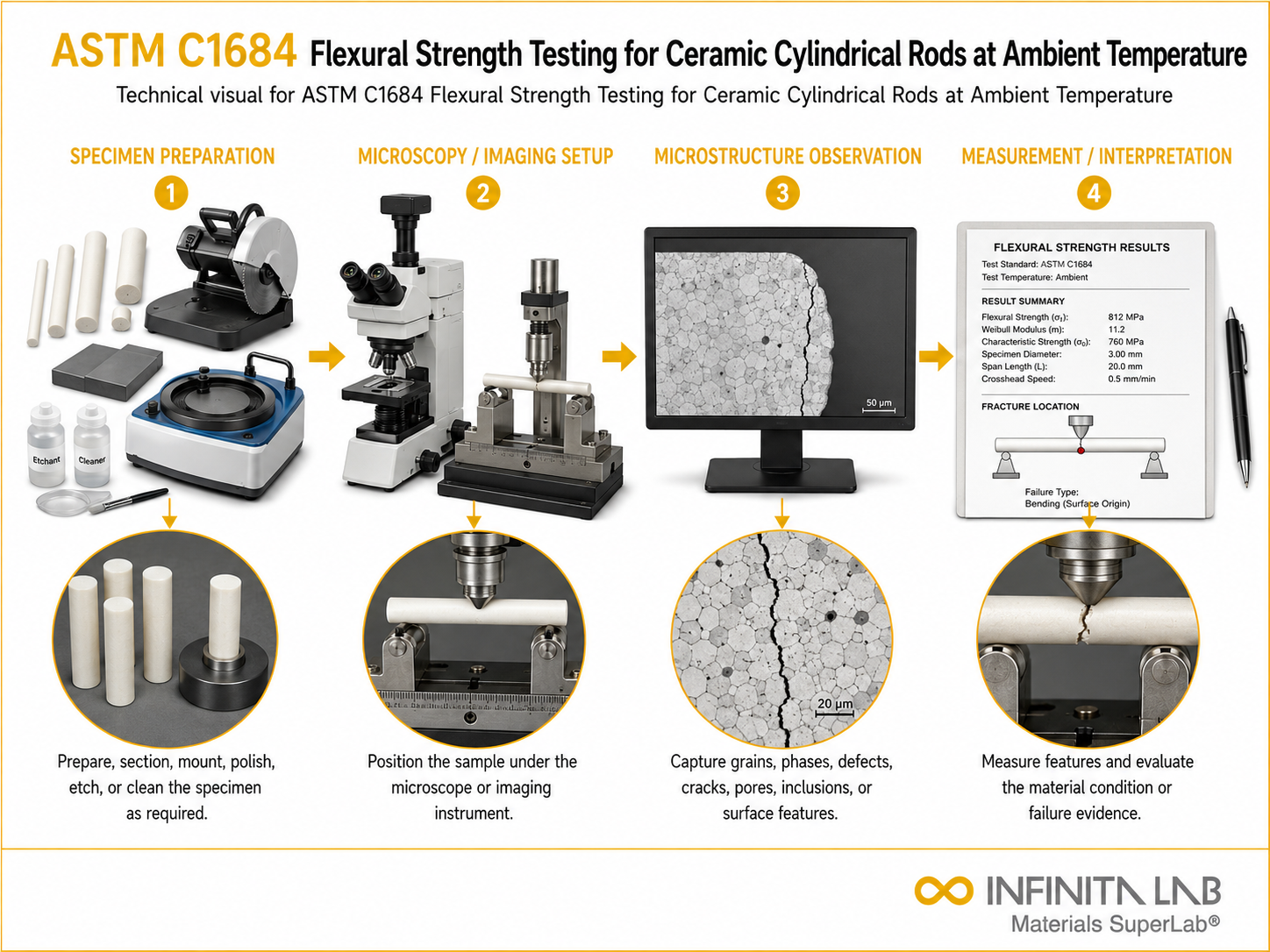
Our ASTM C1684 Testing Procedure
Specimen Preparation
Ceramic rods are prepared with controlled dimensions and surface finish, and their diameter and length are measured.
1Test Setup
Specimens are placed on bending fixtures with the specified span-to-diameter ratio.
2Flexural Loading
Load is applied at a controlled rate until fracture, using either single-point or two-point loading.
3Fracture & Data Recording
The maximum load at fracture is recorded and used to calculate flexural strength based on the selected test configuration.
4ASTM C1684 Test Parameters and Requirements
| Parameter | Details |
|---|---|
| Test Configurations | Three-point and four-point flexure |
| Applicable Materials | Monolithic and particulate- or whisker-reinforced ceramics |
| Minimum Strength Range | ≥ 50 MPa |
| Specimen Diameter | 1.5 to 8 mm (recommended) |
| Specimen Length | 25 to 85 mm (recommended) |
| Span-to-Diameter Ratio | Greater than 3 |
| Measured Output | Flexural strength at fracture |


- Universal testing machine – Applies a controlled load to the rod and records the force up to fracture.
- Four-point flexure fixture – Supports the rod and loads it at the quarter points, the preferred test configuration.
- Three-point flexure fixture – The alternative loading arrangement, used when three-point testing is specified.
- Load cell – Measures applied force, so peak load at fracture is recorded accurately.
- Micrometer or caliper – Used before testing to measure rod diameter and length.
- Data acquisition system – Records each specimen’s load history and supports the strength calculation.
- Optical or stereo microscope – Used to examine fracture surfaces and note where each rod failed.
Equipment and Instrumentation Used for ASTM C1684 Testing
What You Receive: Test Report, Data, and Certification
- Flexural strength values obtained from three-point or four-point testing
- Comparison of strength results between test configurations
- Identification of fracture behavior and failure modes
- Statistical analysis for reliability and Weibull parameters (if required)
- Material performance data for design and quality control purposes
- Documentation supporting material selection and engineering validation
ASTM C1684 Ceramic Cylindrical Rod Flexural Strength FAQs
Bending strength, or flexural strength, of ceramics, is usually obtained by performing either 3-point or 4-point bending tests on test bars of either rectangular or circular cross sections.
Alumina-Zirconia (ATZ) - CeramAlloy ATZ™ 1800 MPa. Zirconia (ZrO2) - CeramaZirc™ Nano HIP. 1400 MPa. Zirconia (ZrO2) - CeramaZirc™ 3YZ. 1200 MPa.
IPS Empress CAD has the lowest flexural strength values among the other tested materials (137.37 MPa). The material is leucite-reinforced glass ceramics, which other studies reported to have lower mechanical properties than LD-glass ceramics.
The flexural strength is higher than the tensile one. Indeed, for two samples of the same size, only one half is stressed in bending while the whole is in tension, so fewer defects are involved in bending. Nevertheless, the Weibull law often underestimates the flexural strength.
Why Choose Infinita Lab for Ceramic Cylindrical Rod Flexural Strength Testing
When your Ceramic Cylindrical Rod Flexural Strength results have to hold up - for compliance, a customer audit, or an engineering decision - ASTM C1684 accuracy and an unbiased third-party report matter more than price. Infinita Lab routes your ASTM C1684 ceramic cylindrical rod flexural strength testing to ISO/IEC 17025-accredited U.S. partner labs with hands-on method experience, so you get defensible data, transparent reporting, and turnaround times built around your project deadline - not ours.

Need ASTM C1684 Ceramic Cylindrical Rod Flexural Strength Testing You Can Rely On?
Send query us at hello@infinitalab.com or call us at (888) 878-3090 to learn more about our services and how we can support you.



Request a Quote
Submit your material details and receive testing procedures, pricing, and turnaround time within 24 hours.
 Quick Turnaround and Hasslefree process
 Confidentiality Guarantee
 Free, No-obligation Consultation
 100% Customer Satisfaction
