

What Is ASTM C1495 Surface Grinding Effect Ceramic Flexure?
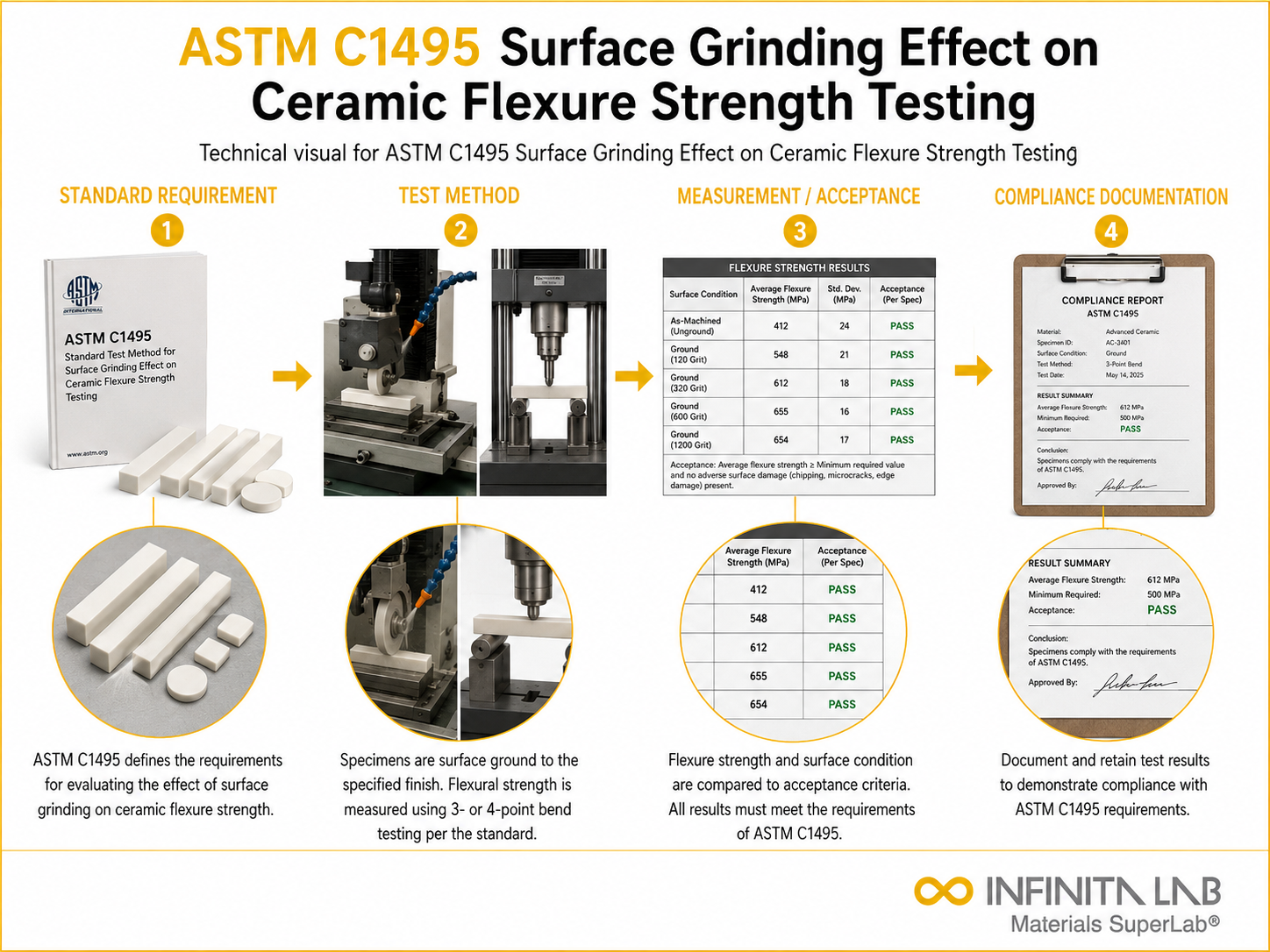
ASTM C1495-16(2023), Standard Test Method for Effect of Surface Grinding on Flexure Strength of Advanced Ceramics, answers a specific question: what did this grinding operation do to the ceramic part’s strength? Nothing more, nothing less. The method works by grinding one set of flexure specimens under a baseline procedure spelled out in the standard itself, then grinding a second set under the process conditions actually in question, and comparing the resulting flexure strengths of the two populations. That baseline grind – a controlled, two-stage rough-then-finish diamond-wheel operation with tightly specified wheel speed, feed rate, grit size, and coolant application – exists. Hence, the comparison reflects the ceramic’s inherent capability, not whatever damage prior machining left behind. The scope stays narrow on one point. C1495 applies only to planar grinding modes: horizontal and vertical spindle surface grinders, double disk grinders, tool-and-cutter grinders. It doesn’t directly apply to cylindrical or centreless grinding, which generate curved surfaces instead. Specimens have to meet the rectangular, flat-surface requirements of companion flexure standards ASTM C1161 (ambient temperature) or C1211 (elevated temperature). Grinding gets evaluated in both the longitudinal and transverse directions relative to the bar’s long axis, since direction materially affects the flaw population a grind leaves behind. Strength testing itself happens in four-point bending, with the resulting data reduced statistically – typically with Weibull analysis per ASTM C1239 – to compare baseline and user-condition strength populations in a way that holds up to scrutiny.

Applications and Benefits of ASTM C1495 Surface Grinding Effect Ceramic Flexure Testing
Scope
ASTM C1495 outlines procedures for determining the influence of controlled surface grinding operations on the flexural strength of monolithic advanced ceramics and ceramic composites.
It evaluates:
- ASTM C1495 covers one thing: how a user-specified surface grinding process affects the flexural strength of advanced ceramics.
- Flexure strength after the grinding condition of interest gets compared against a baseline, obtained from a standardized rough-and-finish grinding procedure the standard itself defines.
- Only planar grinding processes are in scope – horizontal and vertical spindle reciprocating or rotary surface grinders, double disk grinders, tool-and-cutter grinders.
- Cylindrical or centreless grinding, which produce non-planar surfaces, fall outside it.
- Specimens take the form of rectangular flexure bars with flat ground surfaces, meeting the geometric and material requirements of ASTM C1161 or ASTM C1211.
- Grinding is characterized in two directions relative to the specimen’s long axis – longitudinal and transverse – since each can leave behind a different population of surface flaws.
- Procedure A, the full characterization approach, evaluates multiple specimen sets and grinding directions for a rigorous statistical comparison. Procedure B is the abbreviated version, built for routine production quality control.
- Baseline specimen preparation relies on closely controlled wheel speed, table speed, down-feed, cross-feed, grit size, and coolant delivery, so machine-to-machine variability doesn’t confound the comparison.
- Flexure strength itself is measured with the four-point bend test procedures and fixtures described in ASTM C1161 or ASTM C1211, depending on test temperature.
- Terminology throughout follows ASTM C1145, and strength data are typically reduced statistically per ASTM C1239.
Applications
- Qualifying machining damage that a specific grinding process introduced before the ceramic component goes into service.
- Selecting and optimizing grinding parameters – wheel grit, feed rate, depth of cut – to minimize strength loss during manufacturing.
- Grinding consistency monitoring and control, as part of an ongoing production quality program.
- How different advanced ceramic material grades respond to the same grinding process, compared side by side.
- Supporting reliability and design-allowable work for load-bearing or safety-critical components.
- Investigating suspected grinding-related strength loss during a failure analysis or root-cause investigation.
- New grinding processes or ceramic formulations developed to be more tolerant of machining damage.
Benefits
- An objective, repeatable way to connect a specific grinding recipe to a measurable change in strength.
- Catches damaging grinding practices before parts ever reach service, cutting the risk of premature field failure.
- Statistically defensible data, suitable for engineering records and supplier qualification files.
- Helps manufacturers balance production speed against strength retention when they’re setting grinding parameters.
- Complements fractographic and baseline flexure strength standards, rounding out the picture of component integrity.
- Informs decisions when comparing or qualifying alternate grinding equipment, wheels, or vendors.
Our ASTM C1495 Testing Procedure
Specimen Preparation
Ceramic specimens are prepared and categorized into ground and unground (as-fired/as-processed) groups.
1Surface Grinding & Verification
Specimens are ground under controlled conditions and checked for thickness, flatness, and surface finish.
2Flexural Strength Testing
Both ground and unground specimens are tested for fracture strength using a 4-point bending configuration.
3Strength Analysis
Test results are statistically analyzed to evaluate the effect of grinding on flexural strength.
4ASTM C1495 Test Parameters and Requirements
| Parameter | Details |
|---|---|
| Test Principle | Flexural strength comparison of ground vs. unground ceramics |
| Material Types | Monolithic advanced ceramics (alumina, zirconia, silicon nitride, composites) |
| Specimen Geometry | Rectangular bars or standard flexure test specimens |
| Surface Condition | Ground and unground comparison |
| Measured Output | Flexural strength and statistical variation |


- Precision Surface Grinder – handles controlled planar grinding passes, whether horizontal/vertical spindle, double disk, or tool-and-cutter type, for both baseline and user-specified conditioning.
- Diamond Grinding Wheels – the abrasive action comes from these; grit size, concentration, and dressing conditions are selected and documented for both the baseline and evaluation procedures.
- Wheel Truing and Dressing Equipment – keeps wheel geometry and cutting condition consistent, since wear and dressing cycle directly affect the resulting flexure strength.
- Four-Point Flexure Test Fixture – applies the bending load to each ground specimen per ASTM C1161 or C1211, generating fracture strength data.
- Universal Testing Machine – drives the flexure fixture at a controlled loading rate, recording load to failure for every specimen tested.
- Optical or Scanning Electron Microscope – used for fractographic examination, confirming whether failures originated from grinding damage or pre-existing flaws.
- Coolant Filtration and Delivery System – keeps flood-coolant flow clean and consistent during grinding, controlling the thermal and mechanical damage the grinding process itself introduces.
Equipment and Instrumentation Used for ASTM C1495 Testing
What You Receive: Test Report, Data, and Certification
- A complete data set of individual fracture stresses for both the baseline and user-specified grinding conditions.
- Statistical comparison of the two strength populations – commonly the Weibull modulus and characteristic strength.
- Full documentation of the grinding parameters used: wheel specification, feed rates, grinding direction, machine settings.
- Fractographic observations, identifying whether failures originated from grinding damage or from pre-existing volume flaws.
- A final test report, suitable for engineering records, process qualification files, or supplier quality documentation.
- Practical recommendations, where requested, on grinding parameter adjustments that could reduce strength degradation in the future.
ASTM C1495 Surface Grinding Effect Ceramic Flexure FAQs
Grinding can introduce microcracks, residual stresses, and surface defects that may weaken the material. This test ensures machining does not compromise durability.
It applies to monolithic advanced ceramics such as alumina, zirconia, silicon nitride, and other high-performance ceramic materials.
Flexural strength is determined using standardized bending methods like 3-point or 4-point bend testing on ground and unground specimens.
Why Choose Infinita Lab for Surface Grinding Effect Ceramic Flexure Testing
When your Surface Grinding Effect Ceramic Flexure results have to hold up - for compliance, a customer audit, or an engineering decision - ASTM C1495 accuracy and an unbiased third-party report matter more than price. Infinita Lab routes your ASTM C1495 surface grinding effect ceramic flexure testing to ISO/IEC 17025-accredited U.S. partner labs with hands-on method experience, so you get defensible data, transparent reporting, and turnaround times built around your project deadline - not ours.

Need ASTM C1495 Surface Grinding Effect Ceramic Flexure Testing You Can Rely On?
Send query us at hello@infinitalab.com or call us at (888) 878-3090 to learn more about our services and how we can support you.





