


ASTM C1161: Advanced Ceramic Ambient Flexural Strength Testing Services
ASTM C1161 is a testing standard that calculates the flexural strength of advanced ceramic materials at ambient temperature. This test method helps evaluate monolithic or particulate- or whisker-reinforced ceramics. The strength of every sample is reported in megapascals (pounds per square inch) up to three significant figures.
TRUSTED BY


Get ASTM C1161 compliant results — request your advanced ceramic ambient flexural strength testing quote
- Overview
- Scope, Applications, and Benefits
- Test Process
- Specifications
- Instrumentation
- Results and Deliverables
What Is ASTM C1161 Advanced Ceramic Ambient Flexural Strength?
ASTM C1161 gives engineers a reliable, reproducible way to measure the bending strength of ceramic materials under ambient conditions. The standard covers everything from how specimens must be dimensioned and surface-finished to how loads are applied and how results are calculated and reported.
Three specimen configurations are defined — A, B, and C — each with specific dimensions suited to different material forms and available sample sizes. Configuration B (3 × 4 × 45 mm) is the most commonly used in industrial and research settings. Four-point loading is generally preferred over three-point because it subjects a larger gauge volume to maximum stress, producing more statistically representative results — especially important when performing Weibull analysis on brittle materials.
The test is widely used across aerospace, electronics, biomedical, and structural ceramics, where component reliability is non-negotiable, and strength variability must be quantified, not assumed.

Applications and Benefits of ASTM C1161 Advanced Ceramic Ambient Flexural Strength Testing
Scope
ASTM C1161 covers the measurement of flexural strength in advanced ceramics at ambient temperature using three-point and four-point bending fixtures. The standard defines three specimen configurations (A, B, C) with precise dimensional tolerances, surface finish requirements, and chamfer specifications to minimise stress concentrations at edges. It also specifies fixture design criteria — including articulation to ensure uniform load distribution, loading rate, and the statistical treatment of results.
The standard applies to:
- Monolithic ceramics (Al₂O₃, SiC, Si₃N₄, ZrO₂, and similar)
- Particulate-reinforced ceramic composites
- Whisker-reinforced ceramics
- Ceramics with a minimum strength of approximately 50 MPa (~7 ksi)
It does not cover continuous fibre-reinforced ceramic matrix composites (see ASTM C1341 for those) or testing at elevated temperatures (see ASTM C1211).
Applications
ASTM C1161 is used wherever ceramic components carry structural, thermal, or electrical loads and failure is not an option:
- Aerospace & defense — qualification of SiC and Si₃N₄ components for turbine shrouds, nose cones, and radomes where high strength-to-weight ratio and thermal stability are critical
- Semiconductor & electronics — flexural strength testing of Al₂O₃ and AlN substrates used in power electronics, where fracture during thermal cycling is a real failure mode
- Biomedical implants — characterization of zirconia (ZrO₂) and alumina components used in dental prosthetics and orthopedic implants, where regulatory submissions require documented mechanical properties
- Automotive & industrial — testing of ceramic liners, wear-resistant components, and cutting tool inserts for mechanical reliability under operational stress
- Refractory & high-temperature materials — pre-qualification of ceramics intended for use in kilns, furnaces, or heat exchangers, tested at ambient to establish baseline strength before thermal aging studies
- R&D and material development — comparative flexural strength data across ceramic formulations, sintering conditions, or processing variables during new material development
Benefits
- Captures the failure mode that matters most — ceramics almost always fail in tension. Four-point bending in ASTM C1161 creates a controlled tensile stress field that reflects real-world fracture behavior better than compression or hardness tests.
- Enables Weibull statistical analysis — because ceramic strength is probabilistic, not a fixed number. ASTM C1161 data fed into Weibull analysis gives you characteristic strength and a Weibull modulus — the two numbers designers actually use for component reliability calculations.
- Standardized geometry eliminates lab-to-lab variability — specimen dimensions, surface finish, chamfer requirements, and fixture articulation are all defined, so your results are comparable across suppliers, facilities, and time.
- Supports design validation and material qualification — documented ASTM C1161 results are accepted by aerospace primes, medical device regulatory bodies, and industrial OEMs as evidence of material performance.
- Early-stage QC — flags batch-to-batch strength variation before a weak ceramic lot makes it into production.
Our ASTM C1161 Testing Procedure
Specimen Preparation
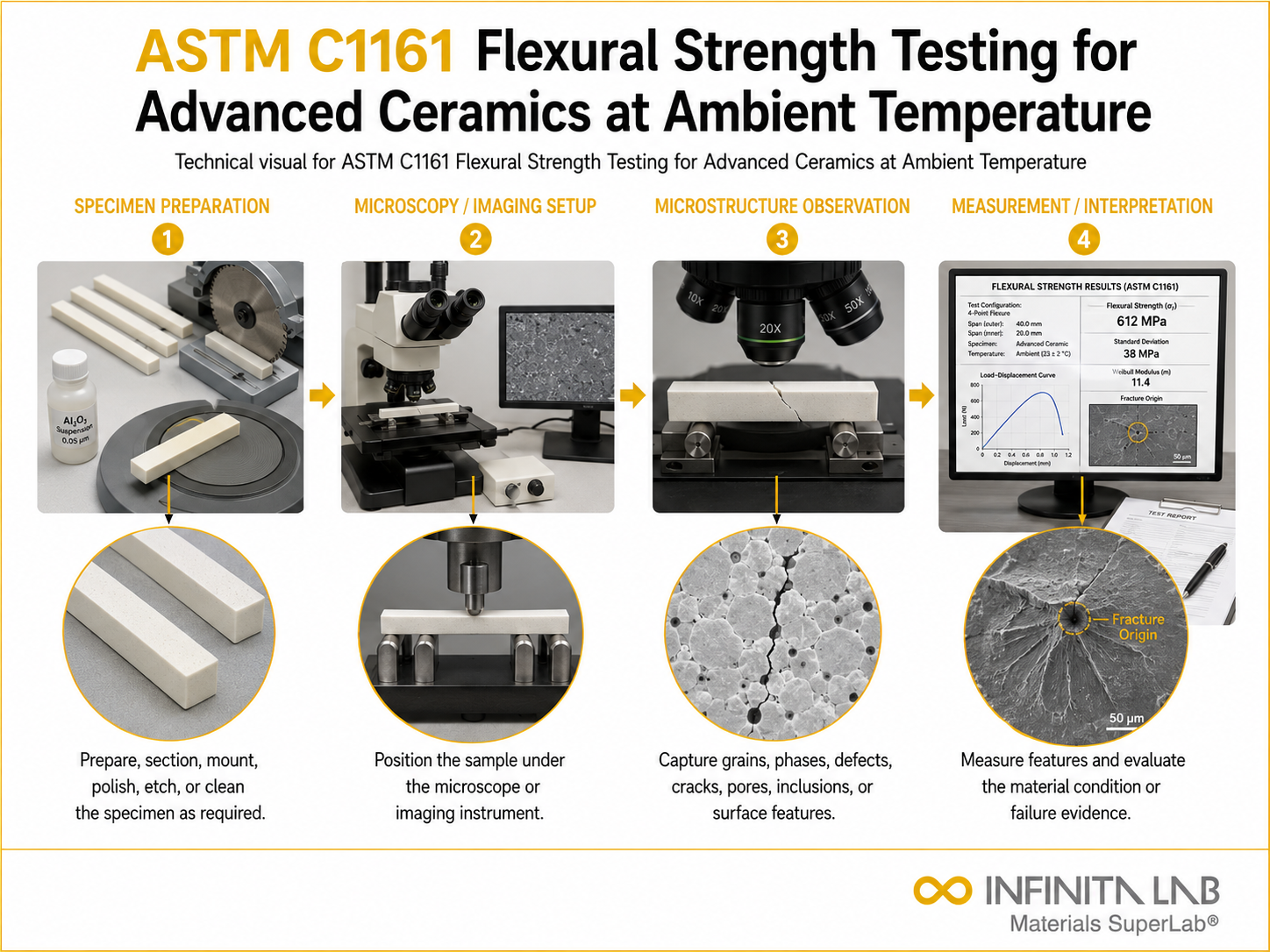
Ceramic specimens are machined to standardized dimensions and surface-finished to minimize flaws.
1Fixture Setup
Specimens are placed on a three-point or four-point flexural fixture with equal overhang beyond the outer supports.
2Load Application
A controlled load is applied until fracture occurs, recording maximum load at failure.
3Strength Calculation
Flexural strength is calculated using load, span length, and specimen dimensions.
4ASTM C1161 Test Parameters and Requirements
| Parameter | Details |
|---|---|
| Test Method | ASTM C1161 – Standard Test Method for Flexural Strength of Advanced Ceramics at Ambient Temperature |
| Specimen Configurations | A: 1.5 × 2 × 25 mm / B: 3 × 4 × 45 mm / C: 4 × 3 × 45 mm |
| Loading Modes | Three-point bending; Four-point bending (quarter-point or third-point) |
| Material Types | Monolithic ceramics, particulate-reinforced and whisker-reinforced ceramics |
| Applicable Materials | Al₂O₃, SiC, Si₃N₄, ZrO₂, and similar advanced ceramics (≥ 50 MPa) |
| Surface Finish | Tensile surface ground and polished; edges chamfered per standard requirements |
| Loading Rate | Crosshead speed set to produce fracture in 10–60 seconds |
| Reported Output | Flexural strength (MPa), mean, standard deviation; Weibull modulus (m) and characteristic strength (σ₀) on request |
| Test Temperature | Ambient (for elevated temperature, see ASTM C1211) |
| Minimum Specimen Count | 10 (30+ recommended for Weibull analysis) |


- Universal Testing Machine (UTM)
- Flexural test fixtures (three-point and four-point)
- Vernier calipers or micrometers
- Surface grinding and polishing equipment
- Data acquisition system
- Optical microscope
Equipment and Instrumentation Used for ASTM C1161 Testing
What You Receive: Test Report, Data, and Certification
- Test report — individual specimen dimensions, failure loads, and calculated flexural strength values for all specimens
- Statistical summary — mean flexural strength, standard deviation, and coefficient of variation
- Weibull analysis (on request) — Weibull modulus (m) and characteristic strength (σ₀) with probability of failure plot
- Load-displacement curves — raw data for each specimen
- Fracture origin analysis — optical or SEM fractography identifying failure initiation site (surface flaw, pore, inclusion, or machining damage)
- Specimen dimension records — pre-test cross-section measurements confirming conformance to configuration geometry
ASTM C1161 Advanced Ceramic Ambient Flexural Strength FAQs
ASTM C1161 is used to measure the flexural strength of advanced ceramics, providing critical data on their ability to withstand bending forces, which is essential for evaluating performance in structural, electronic, and high-temperature applications.
Ceramics don't behave like metals. They don't yield or deform plastically before fracture — they break suddenly and without warning. That makes consistent, standardized strength measurement critical. Without a common standard, results from different labs, fixtures, or specimen geometries can't be meaningfully compared. ASTM C1161 eliminates those variables by specifying exactly how specimens must be prepared, how loads must be applied, and how results must be calculated — so that a strength value from one lab means the same thing as a strength value from another. For procurement, design validation, and regulatory submissions, that consistency is essential.
Flexural strength, also called modulus of rupture (MOR), is the maximum stress a ceramic beam sustains at its tensile surface before fracture under bending load. It's calculated from the failure load, specimen dimensions, and support span geometry. Because ceramic strength is statistically distributed — not a single fixed value — ASTM C1161 results are often analyzed using Weibull statistics, which give you a characteristic strength (σ₀, the strength at 63.2% failure probability) and a Weibull modulus (m), which describes how consistent the material's strength is. A high Weibull modulus means tight, predictable strength distribution — exactly what designers need for reliable component sizing.
Three different configurations are specified: Depending on the test requirements, these included 3-point bend, 4-point bend (1/4 point loading) and 4-point bend (1/2 point loading) tests.
Ceramics with a strength of 50 MPa (~7 ksi) or above are suitable.
Why Choose Infinita Lab for Advanced Ceramic Ambient Flexural Strength Testing
At the core of this breadth is our network of 2,000+ accredited laboratories across the USA, offering access to over 10,000 testing methods and analytical services. From advanced materials characterization (SEM, TEM, RBS, XPS) to mechanical, chemical, environmental, biological, and standardized ASTM/ISO-compliant testing, we deliver unmatched flexibility, specialization, and scale. You are never limited by geography, facility, or methodology — Infinita Lab connects you to the right expertise and testing solution, every time.

Need ASTM C1161 Advanced Ceramic Ambient Flexural Strength Testing You Can Rely On?
Send query us at hello@infinitalab.com or call us at (888) 878-3090 to learn more about our services and how we can support you.



Request a Quote
Submit your material details and receive testing procedures, pricing, and turnaround time within 24 hours.
 Quick Turnaround and Hasslefree process
 Confidentiality Guarantee
 Free, No-obligation Consultation
 100% Customer Satisfaction
