


ASTM C1211: Advanced Ceramic Elevated Temperature Flexural Strength Testing Services
The ASTM C1211 test technique includes the assessment of advanced ceramics’ flexural strength at elevated temperatures. The ultimate strength of a particular beam in bending is measured by flexural strength. Three-point or four-point bending can be used to perform flexure tests.
TRUSTED BY


Get ASTM C1211 compliant results — request your advanced ceramic elevated temperature flexural strength testing quote
- Overview
- Scope, Applications, and Benefits
- Test Process
- Specifications
- Instrumentation
- Results and Deliverables
OverviewWhat Is ASTM C1211 Advanced Ceramic Elevated Temperature Flexural Strength?
ASTM C1211 describes the determination of flexural strength and modulus of rupture of advanced ceramic materials at elevated temperatures. This test characterizes the mechanical performance of ceramics under high-temperature conditions that simulate real service environments.
The method measures the maximum bending stress a ceramic specimen can withstand before fracture under controlled thermal exposure. ASTMC1211 is widely applied to evaluate the reliability, strength retention, and thermal performance of ceramics for aerospace, energy, electronics, and structural applications.

Applications and Benefits of ASTM C1211 Advanced Ceramic Elevated Temperature Flexural Strength Testing
Scope
ASTM C1211 applies to dense monolithic ceramics and similar materials that maintain structural integrity at high temperatures.
It evaluates:
- Flexural strength (modulus of rupture) at elevated temperatures
- Effect of temperature on mechanical performance
- Material reliability under thermal and mechanical loading
- Influence of microstructure and surface finish
- Strength degradation mechanisms
- Performance under three-point and four-point bending
The standard applies to rectangular bar specimens tested inside a high-temperature furnace.
Applications
- Turbine and engine components
- Thermal barrier coatings
- Aerospace structural ceramics
- Electronic substrates
- Energy generation systems
- High-temperature industrial equipment
- Research and development of ceramic materials
- Quality control testing
Benefits
- Provides standardized high-temperature strength data
- Assists in material selection for extreme environments
- Evaluates thermal reliability and fracture resistance
- Supports product design and safety margins
- Enables comparison of ceramic materials
- Improves component life prediction
- Enhances process optimization
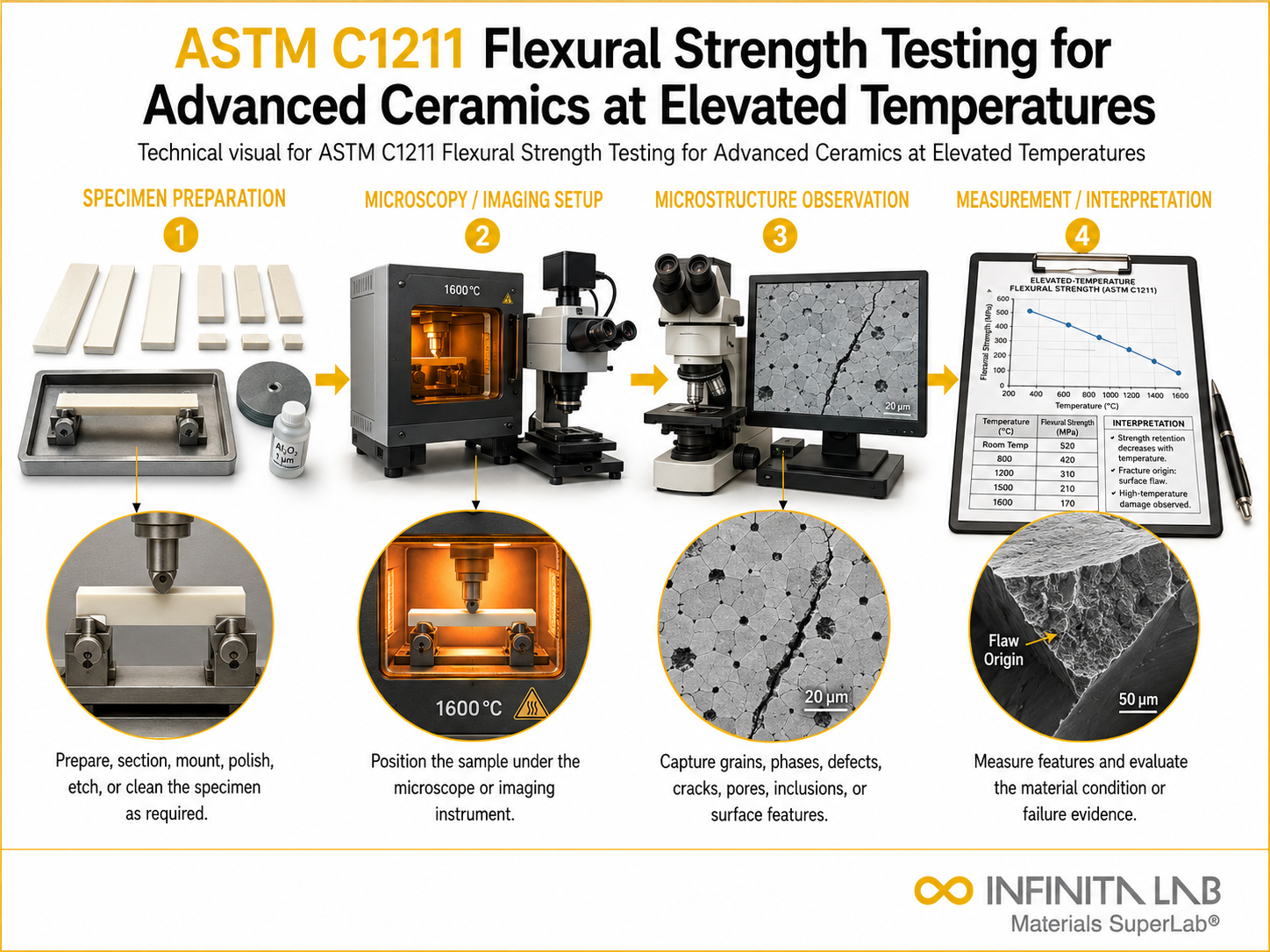
Our ASTM C1211 Testing Procedure
Specimen Preparation & Inspection
Ceramic bars are machined, polished, cleaned, and inspected for surface defects.
1Temperature Stabilization
The furnace is heated to the target temperature and held until thermal equilibrium is reached.
2Flexural Loading
Specimens are tested under three-point or four-point bending configurations.
3Data Collection & Calculation
Fracture load is recorded, and modulus of rupture is calculated.
4ASTM C1211 Test Parameters and Requirements
| Parameter | Details |
|---|---|
| Applicable Materials | Advanced monolithic ceramics |
| Specimen Type | Rectangular bars |
| Typical Dimensions | 3 mm × 4 mm × 45 mm |
| Test Temperature Range | Room temperature to 1500°C or higher |
| Loading Configuration | Three-point or four-point bending |
| Output Units | MPa |


- High-temperature furnace
- Universal testing machine
- Ceramic bending fixture
- Precision load cell
- Thermocouples
- Temperature controller
- Data acquisition system
Equipment and Instrumentation Used for ASTM C1211 Testing
What You Receive: Test Report, Data, and Certification
- Flexural strength values at various temperatures
- Load-to-failure data
- Strength–temperature relationship curves
- Fracture behavior analysis
- Comparative material performance reports
- Quality control documentation
- Design validation data
ASTM C1211 Advanced Ceramic Elevated Temperature Flexural Strength FAQs
Flexural strength provides insight into a ceramic’s ability to resist bending stresses before fracture. Since ceramics are brittle, understanding their strength under flexural loading helps predict failure behavior in real-world conditions like engines, turbines, and furnaces.
This test applies to dense, monolithic, and advanced ceramics such as alumina, silicon carbide, silicon nitride, and zirconia—materials commonly used where high strength and thermal stability are required.
Testing can be conducted from room temperature up to 1500°C or higher, depending on the material’s application range and the furnace’s capability. The temperature selected reflects the intended service environment of the ceramic.
ASTM C1211 uses either three-point or four-point bending configurations. The four-point method provides a larger constant stress region, giving more consistent results for materials with surface flaws or microstructural variations.
Why Choose Infinita Lab for Advanced Ceramic Elevated Temperature Flexural Strength Testing?
At the core of this breadth is our network of 2,000+ accredited laboratories across the USA, offering access to over 10,000 testing methods and analytical services. From advanced materials characterization (SEM, TEM, RBS, XPS) to mechanical, chemical, environmental, biological, and standardized ASTM/ISO-compliant testing, we deliver unmatched flexibility, specialization, and scale. You are never limited by geography, facility, or methodology — Infinita Lab connects you to the right expertise and testing solution, every time.

Need ASTM C1211 Advanced Ceramic Elevated Temperature Flexural Strength Testing You Can Rely On?
Send query us at hello@infinitalab.com or call us at (888) 878-3090 to learn more about our services and how we can support you.



Request a Quote
Submit your material details and receive testing procedures, pricing, and turnaround time within 24 hours.
 Quick Turnaround and Hasslefree process
 Confidentiality Guarantee
 Free, No-obligation Consultation
 100% Customer Satisfaction
