


ASTM D3039: Composite Tensile Testing Services
ASTM D3039 is used for evaluating tensile strength, tensile modulus, and Poisson's ratio for reinforced composites materials. Align-pro, strain gauges, or extensometers are used at ambient, high, or low temperatures with or without moisture conditioning for data generation.
TRUSTED BY


Get ASTM D3039 compliant results — request your composite tensile testing quote
- Overview
- Scope, Applications, and Benefits
- Test Process
- Specifications
- Instrumentation
- Results and Deliverables
What Is ASTM D3039 Composite Tensile?
ASTM D3039 defines the standard test method for determining the tensile properties of polymer matrix composite materials reinforced with high-modulus fibers such as carbon, glass, and aramid. The test yields critical mechanical property data, including tensile strength, tensile modulus, Poisson’s ratio, and elongation at failure under controlled laboratory conditions.
It can be applied to both unidirectional and multidirectional composite laminates. The ASTM D3039 method is widely used to develop data for design, substantiate manufacturing quality, and compare material systems in aerospace, automotive, marine, wind energy, and other high-performance industries.

Applications and Benefits of ASTM D3039 Composite Tensile Testing
Scope
ASTM D3039 outlines procedures for measuring the tensile properties of continuous-fiber-reinforced polymer-matrix composites.
It evaluates:
- Ultimate tensile strength
- Tensile modulus of elasticity
- Poisson’s ratio
- Strain at failure
- Stress–strain behavior
The method applies to unidirectional, cross-ply, angle-ply, and woven-fabric laminates, as well as to molded composite specimens.
Applications
- Aerospace structural components
- Automotive lightweight structures
- Wind turbine blades
- Marine composite structures
- Sporting goods and recreational equipment
- Research and development of advanced composites
Benefits
- Provides accurate tensile property data
- Supports structural design and analysis
- Enables comparison of composite systems
- Validates manufacturing processes
- Assists in optimizing fiber orientation and layup
- Enhances quality assurance and certification
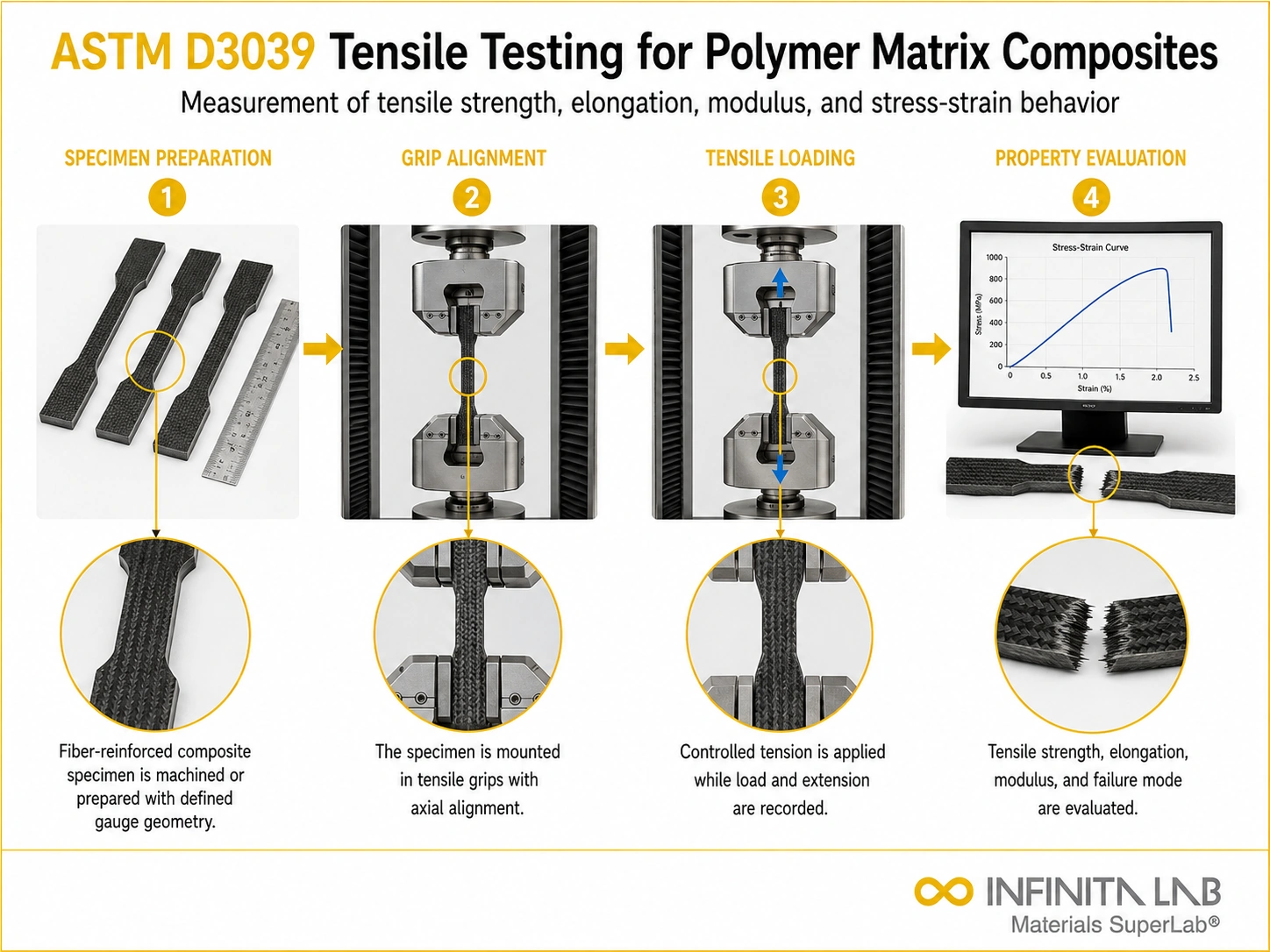
Our ASTM D3039 Testing Procedure
Specimen Preparation & Tabbing
Specimens are cut to size from cured laminates, with tabs bonded at the ends to prevent grip damage and ensure even load transfer.
1Conditioning
Prepared specimens are conditioned at standard laboratory conditions (≈23 °C, 50% RH).
2Mounting & Tensile Loading
Specimens are aligned in the grips to minimize bending, and a constant crosshead speed is applied until failure.
3Data Analysis
Stress–strain curves are generated to calculate tensile strength, modulus, Poisson’s ratio, and strain at break.
4ASTM D3039 Test Parameters and Requirements
| Parameter | Details |
|---|---|
| Applicable Materials | Fiber-reinforced polymer matrix composites |
| Fiber Types | Carbon, glass, aramid |
| Specimen Shape | Flat rectangular laminate |
| Typical Dimensions | 250 × 25 × 2 mm |
| Gauge Length | ~150 mm |
| Conditioning Environment | ~23 °C, 50% RH |
| Output Units | MPa or psi |


- Universal testing machine (UTM)
- Wedge or hydraulic grips
- Strain gauges or extensometers
- Precision alignment fixtures
- Data acquisition system
- Environmental chamber (optional)
Equipment and Instrumentation Used for ASTM D3039 Testing
What You Receive: Test Report, Data, and Certification
- Ultimate tensile strength values
- Tensile modulus of elasticity
- Poisson’s ratio
- Strain at failure (%)
- Stress–strain curves
- Comparative performance analysis
- Material qualification documentation
ASTM D3039 Composite Tensile FAQs
ASTM D3039 is a standard test method used to determine the tensile properties—such as tensile strength, modulus of elasticity, Poisson’s ratio, and strain at failure—of polymer matrix composite materials reinforced with continuous fibers.
Tensile testing provides critical data about a composite’s load-bearing capability, stiffness, and ductility. It helps predict how materials will perform under real-world service conditions, ensuring reliability in aerospace, automotive, and structural applications.
This test applies to polymer matrix composites reinforced with continuous fibers such as carbon, glass, aramid, or basalt. Both unidirectional and multidirectional laminates, as well as woven fabric composites, can be evaluated.
The specimen is typically a flat rectangular coupon with a constant cross-section, often fitted with tabs to prevent grip damage.
The primary outputs are ultimate tensile strength, modulus of elasticity, strain at break, and failure mode.
Why Choose Infinita Lab for Composite Tensile Testing
At the core of this breadth is our network of 2,000+ accredited laboratories across the USA, offering access to over 10,000 testing methods and analytical services. From advanced materials characterization (SEM, TEM, RBS, XPS) to mechanical, chemical, environmental, biological, and standardized ASTM/ISO-compliant testing, we deliver unmatched flexibility, specialization, and scale. You are never limited by geography, facility, or methodology — Infinita Lab connects you to the right expertise and testing solution, every time.

Need ASTM D3039 Composite Tensile Testing You Can Rely On?
Send query us at hello@infinitalab.com or call us at (888) 878-3090 to learn more about our services and how we can support you.



Request a Quote
Submit your material details and receive testing procedures, pricing, and turnaround time within 24 hours.
 Quick Turnaround and Hasslefree process
 Confidentiality Guarantee
 Free, No-obligation Consultation
 100% Customer Satisfaction
