


ASTM C33: Concrete Aggregate Testing Services
Accredited ASTM C33 concrete aggregate testing from Infinita Lab, performed to the exact standard requirements - accurate, reproducible results with full documentation for compliance, R&D, and quality control programs.
TRUSTED BY


Get ASTM C33 compliant results - request your concrete aggregate testing quote
- Overview
- Scope, Applications, and Benefits
- Test Process
- Specifications
- Instrumentation
- Results and Deliverables
What Is ASTM C33 Concrete Aggregate?
ASTM C33, the Standard Specification for Concrete Aggregates, establishes the quality and grading requirements for the fine and coarse aggregates used in normal-weight hydraulic cement concrete. Fine aggregate is defined as natural sand, manufactured sand, or a combination of the two, while coarse aggregate covers gravel, crushed stone, crushed hydraulic cement concrete, or a combination of these materials retained on and above the No. 4 sieve. Because aggregates typically make up 60 to 75 per cent of a concrete mixture’s volume, their physical and chemical characteristics have a direct and lasting influence on the strength, durability, workability, and finished appearance of the concrete produced from them.
The specification sets limits across several interrelated categories. Grading requirements define the particle size distribution that an aggregate source must fall within, based on a standard series of sieves, to support consistent mix proportioning and workable concrete. Deleterious substance limits restrict the amount of clay lumps, friable particles, coal and lignite, and other organic impurities that can weaken bond strength or cause surface defects. Soundness testing evaluates an aggregate’s resistance to the cycles of wetting, drying, freezing, and thawing it will experience in service, while abrasion resistance testing assesses how well the aggregate withstands degradation from handling, mixing, and traffic loading. The standard also addresses the potential for alkali-silica reactivity between aggregate minerals and cement alkalis, a reaction that can cause long-term expansion and cracking.
Because ASTM C33 is referenced by building codes, transportation agency specifications, and project documents throughout North America, aggregate producers and concrete suppliers rely on independent, accredited testing to demonstrate that a given source or stockpile conforms before it is approved for use. Testing to this standard gives producers, contractors, and specifiers the documented, defensible data needed to support material approval, mix design, and long-term performance on a project.

Applications and Benefits of ASTM C33 Concrete Aggregate Testing
Scope
- ASTM C33 covers the requirements for both fine aggregate (natural or manufactured sand) and coarse aggregate (gravel, crushed stone, or crushed concrete) intended for use in concrete.
- Grading requirements are based on sieve analysis performed with a standard series of sieves, from the 3/8 in. sieve down through the No. 100 sieve for fine aggregate, and from larger sieve sizes down to the No. 4 sieve for coarse aggregate.
- Fine aggregate grading is evaluated in part through the fineness modulus, which the standard requires to fall between 2.3 and 3.1 and not vary by more than 0.20 from the value assumed in mix design.
- Deleterious substance limits address clay lumps and friable particles, material finer than the No. 200 sieve, coal and lignite, and other organic impurities that can interfere with cement hydration or reduce durability.
- Soundness and durability are assessed through sulphate soundness testing, which exposes aggregate to repeated cycles of immersion in sodium or magnesium sulphate solution to simulate freeze-thaw weathering.
- Resistance to degradation during handling, mixing, and placement is evaluated using an abrasion test, most commonly the Los Angeles abrasion method referenced through ASTM C131.
- Aggregates are also screened for potential alkali-silica reactivity, since certain silica-bearing minerals can react with alkalis in cement and cause expansion and cracking over time.
- The standard supports quality assurance across natural, manufactured, and recycled aggregate sources used in ready-mix, precast, and cast-in-place concrete production.
- ASTM C33 conformance testing is used by quarries, aggregate producers, concrete producers, contractors, and public agencies to qualify a material source before and during a project.
- Testing to this specification supports mix design decisions, source approval submittals, and ongoing quality control monitoring throughout a concrete supply program.
Applications
- Ready-mix concrete producers qualifying aggregate sources and monitoring incoming material quality
- Precast and prestressed concrete manufacturers verifying aggregates for structural components
- Aggregate quarries and suppliers documenting product conformance for customers and specifiers
- Department of Transportation and other public infrastructure projects requiring specification compliance
- Contractors submitting aggregate source approval packages before concrete placement
- Recycled and manufactured aggregate producers demonstrating equivalence to virgin material requirements
- Engineering and specification teams evaluating aggregate sources during material selection
Benefits
- Confirms aggregate suitability before it becomes an embedded, unrecoverable part of a concrete structure
- Reduces the risk of premature deterioration, cracking, or strength deficiencies tied to aggregate quality
- Provides documented, third-party data that supports source approval and specification compliance submittals
- Helps producers identify and correct grading or deleterious substance issues before large-volume production
- Supports consistent mix design performance by confirming aggregate properties assumed at the design stage
- Strengthens confidence among engineers, owners, and inspection agencies reviewing project material records
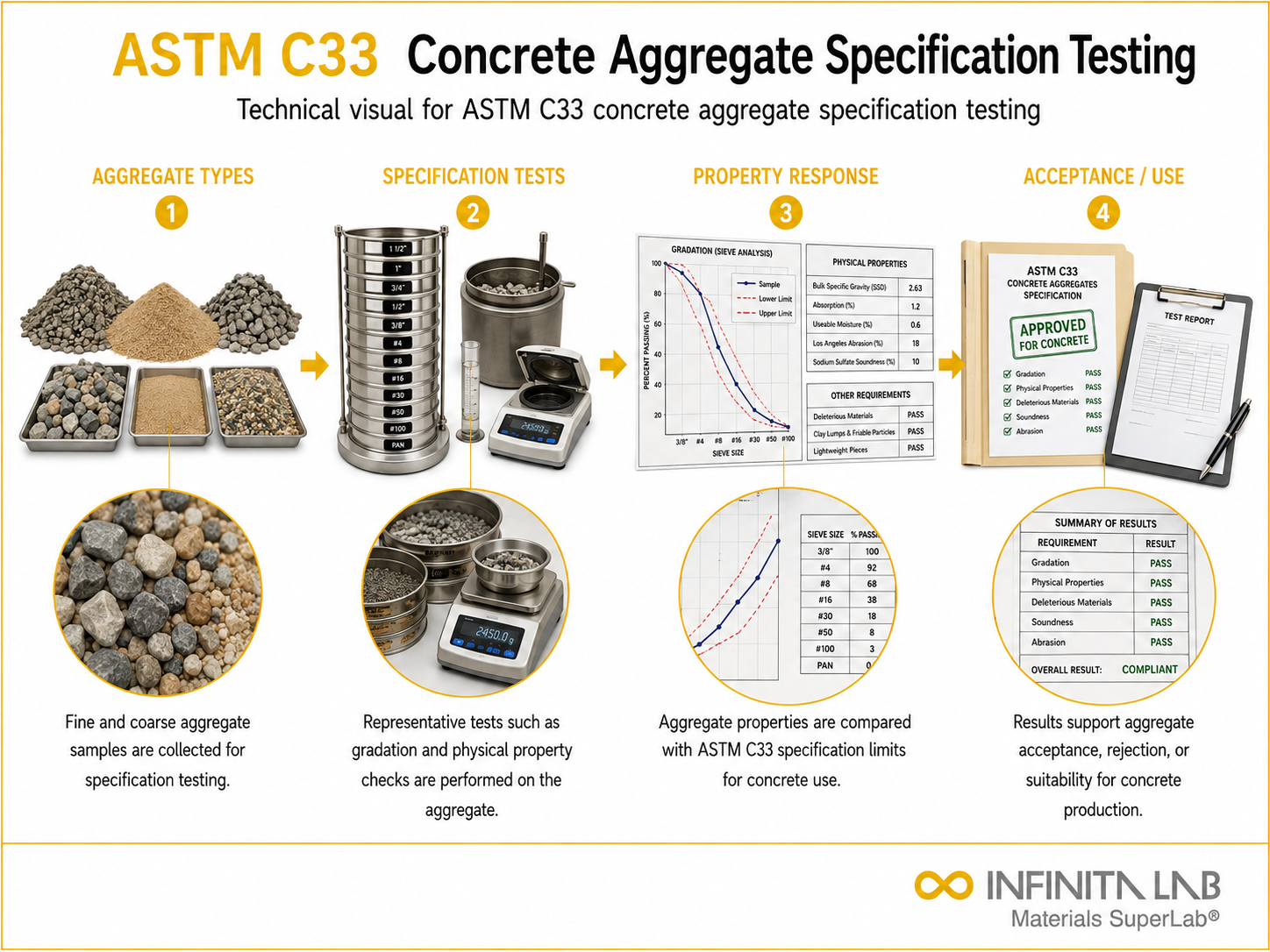
Our ASTM C33 Testing Procedure
Sample Collection
Aggregate samples are collected from stockpiles as per standard procedures.
1Sieve Analysis
Particle size distribution is determined using standard sieves.
2Quality Testing
Tests are conducted for impurities, moisture, and durability properties.
3Evaluation
Results are compared with ASTM C33 limits for compliance verification.
4ASTM C33 Test Parameters and Requirements
| Parameter | Details |
|---|---|
| Material Type | Natural or manufactured fine and coarse aggregates. |
| Maximum Size | Specified nominal maximum aggregate size. |
| Moisture Content | Controlled moisture levels for consistency. |
| Bulk Density | Measured for mix design calculations. |
| Soundness | Resistance to weathering and environmental conditions. |


- Sieve shaker and standard sieve set – separates aggregate particles by size to determine grading and fineness modulus
- Balance/scale – measures sample and retained-fraction weights with the precision required for grading and deleterious substance calculations
- Sample splitter – divides field samples into representative, test-ready portions
- Sulfate soundness test apparatus – conducts repeated immersion and drying cycles in sodium or magnesium sulfate solution to assess weathering resistance
- Los Angeles abrasion machine – rotates coarse aggregate with steel spheres to measure resistance to degradation
- Drying oven – dries samples to constant mass before sieve analysis and other gravimetric testing
- Wash sieve equipment – determines material finer than the No. 200 sieve as part of deleterious substance evaluation
Equipment and Instrumentation Used for ASTM C33 Testing
What You Receive: Test Report, Data, and Certification
- Detailed sieve analysis report showing per cent passing at each specified sieve size for the tested aggregate
- Fineness modulus calculation for fine aggregate, compared against the specification’s allowable range
- Deleterious substance results, including clay lumps, friable particles, coal, lignite, and material passing the No. 200 sieve
- Soundness test results reporting weighted average loss after sulphate immersion cycling
- Abrasion resistance results from Los Angeles abrasion testing
- A final conformance summary indicating whether the aggregate meets ASTM C33 requirements, suitable for source approval or project submittal files
ASTM C33 Concrete Aggregate FAQs
ASTM C33 is a specification that defines quality requirements for aggregates used in concrete, ensuring proper grading, cleanliness, and durability, which are essential for achieving strong and long-lasting concrete structures.
No, lightweight aggregates for concrete are generally covered under ASTM C330.
These are materials like clay lumps, friable particles, or coal that can negatively impact the chemical bond or durability of the concrete.
Proper grading ensures good workability, reduces voids, and improves strength and durability of concrete by optimizing particle packing and cement usage.
Testing frequency depends on project specifications and source consistency to ensure ongoing quality.
Representative aggregate samples are collected from stockpiles, bins, or production streams and reduced to test portions using standardized procedures.
ASTM C33 specifies quality and grading requirements for fine and coarse aggregates used in concrete.
ASTM C33 coarse aggregate refers to crushed stone, gravel, or other approved aggregate meeting the standard's quality and grading requirements for concrete.
Why Choose Infinita Lab for Concrete Aggregate Testing
When your Concrete Aggregate results have to hold up - for compliance, a customer audit, or an engineering decision - ASTM C33 accuracy and an unbiased third-party report matter more than price. Infinita Lab routes your ASTM C33 concrete aggregate testing to ISO/IEC 17025-accredited U.S. partner labs with hands-on method experience, so you get defensible data, transparent reporting, and turnaround times built around your project deadline - not ours.

Need ASTM C33 Concrete Aggregate Testing You Can Rely On?
Send query us at hello@infinitalab.com or call us at (888) 878-3090 to learn more about our services and how we can support you.



Request a Quote
Submit your material details and receive testing procedures, pricing, and turnaround time within 24 hours.
 Quick Turnaround and Hasslefree process
 Confidentiality Guarantee
 Free, No-obligation Consultation
 100% Customer Satisfaction
