


ASTM C1466: Ceramic Foodware Lead Cadmium Gfaas Testing Services
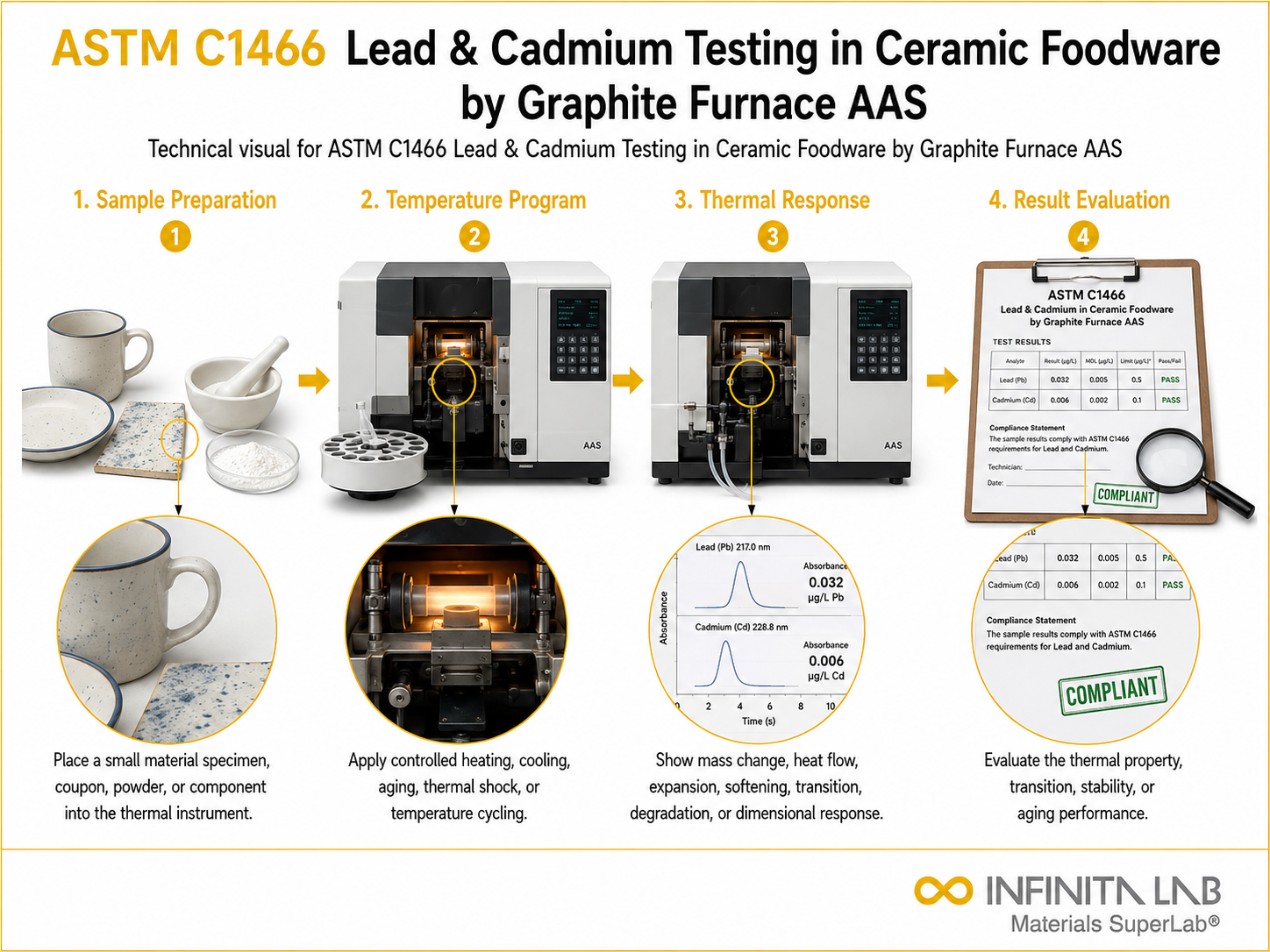
ASTM C1466 is used to determine the amount of lead and cadmium extracted by acetic acid at room temperature from the food-contact surface of foodware. This test method uses graphite furnace atomic absorption spectroscopy (GFAAS).
TRUSTED BY


Get ASTM C1466 compliant results — request your ceramic foodware lead cadmium gfaas testing quote
- Overview
- Scope, Applications, and Benefits
- Test Process
- Specifications
- Instrumentation
- Results and Deliverables
What Is ASTM C1466 Ceramic Foodware Lead Cadmium Gfaas?
ASTM C1466 describes a standard procedure for determining the lead (Pb) and cadmium (Cd) extracted from the surfaces of ceramic and glass that contact food. These toxic heavy metals can migrate into any food or beverage when ceramic bodies or glazes are incorrectly formulated or fired.
The test procedure uses GFAAS, one of the most sensitive analytical techniques for detecting trace levels of Pb and Cd, as required by global food safety regulations. ASTM C1466, therefore, plays a vital role in consumer safety and the validation of ceramic foodware for consumer use.

Applications and Benefits of ASTM C1466 Ceramic Foodware Lead Cadmium Gfaas Testing
Scope
ASTM C1466 outlines procedures for determining the leaching of lead and cadmium from glazed ceramic and glass surfaces intended for food contact.
It evaluates:
- Release of Pb and Cd from food-contact surfaces
- Compliance with regulatory safety limits (FDA, CPSIA, and similar standards)
- Effect of acidic food simulants on metal migration
- Consistency and quality of ceramic glazes and coatings
The method simulates real food-use conditions through controlled acidic extraction.
Applications
- Testing plates, bowls, cups, mugs, and serving ware
- Evaluation of ceramic cookware and bakeware
- Quality control of decorative and glazed tableware
- Safety assessment of glass and crystal food-contact products
- Regulatory compliance and product certification
Benefits
- Ensures consumer safety by detecting toxic metal leaching
- Supports compliance with international food safety regulations
- Provides high-sensitivity measurement at ppb levels
- Identifies glaze formulation or firing issues
- Enhances product quality and brand reliability
Our ASTM C1466 Testing Procedure
Specimen Preparation
Ceramic foodware is inspected, cleaned, and prepared with intact glaze surfaces to ensure accurate extraction behavior.
1Leaching Solution Exposure
A 4% acetic acid solution is applied to food-contact areas to simulate acidic food conditions.
2Controlled Incubation
Samples are held at specified temperature and time conditions to allow potential migration of Pb and Cd into the solution.
3Analysis & Reporting
Extracted solutions are analyzed using GFAAS, and results are compared against regulatory safety limits.
4ASTM C1466 Test Parameters and Requirements
| Parameter | Details |
|---|---|
| Test Principle | Acid extraction followed by trace metal analysis |
| Target Analytes | Lead (Pb), Cadmium (Cd) |
| Extraction Solution | 4% acetic acid |
| Applicable Materials | Glazed ceramics, porcelain, stoneware, glass |
| Result Format | Concentration in ppm or ppb |
| Regulatory Focus | Food safety compliance |


- Graphite Furnace Atomic Absorption Spectrometer (GFAAS)
- Temperature-controlled incubation systems
- Analytical balance
- Acid-resistant extraction vessels
- Sample preparation and cleaning equipment
- Data analysis and reporting software
Equipment and Instrumentation Used for ASTM C1466 Testing
What You Receive: Test Report, Data, and Certification
- Quantitative Pb and Cd concentration values
- Pass/fail determination based on regulatory limits
- Assessment of glaze stability and product safety
- Documentation for regulatory submissions
- Quality control and compliance reports
ASTM C1466 Ceramic Foodware Lead Cadmium Gfaas FAQs
It ensures ceramic materials used for bowls, plates, mugs, cookware, and decorative items comply with safety regulations and do not release toxic metals into food or beverages.
Any glazed ceramic, porcelain, or earthenware product intended to come into contact with food or drinks.
The test specifically measures lead (Pb) and cadmium (Cd) extraction levels.
Why Choose Infinita Lab for Ceramic Foodware Lead Cadmium Gfaas Testing
At the core of this breadth is our network of 2,000+ accredited laboratories across the USA, offering access to over 10,000 testing methods and analytical services. From advanced materials characterization (SEM, TEM, RBS, XPS) to mechanical, chemical, environmental, biological, and standardized ASTM/ISO-compliant testing, we deliver unmatched flexibility, specialization, and scale. You are never limited by geography, facility, or methodology — Infinita Lab connects you to the right expertise and testing solution, every time.

Need ASTM C1466 Ceramic Foodware Lead Cadmium Gfaas Testing You Can Rely On?
Send query us at hello@infinitalab.com or call us at (888) 878-3090 to learn more about our services and how we can support you.



Request a Quote
Submit your material details and receive testing procedures, pricing, and turnaround time within 24 hours.
 Quick Turnaround and Hasslefree process
 Confidentiality Guarantee
 Free, No-obligation Consultation
 100% Customer Satisfaction
