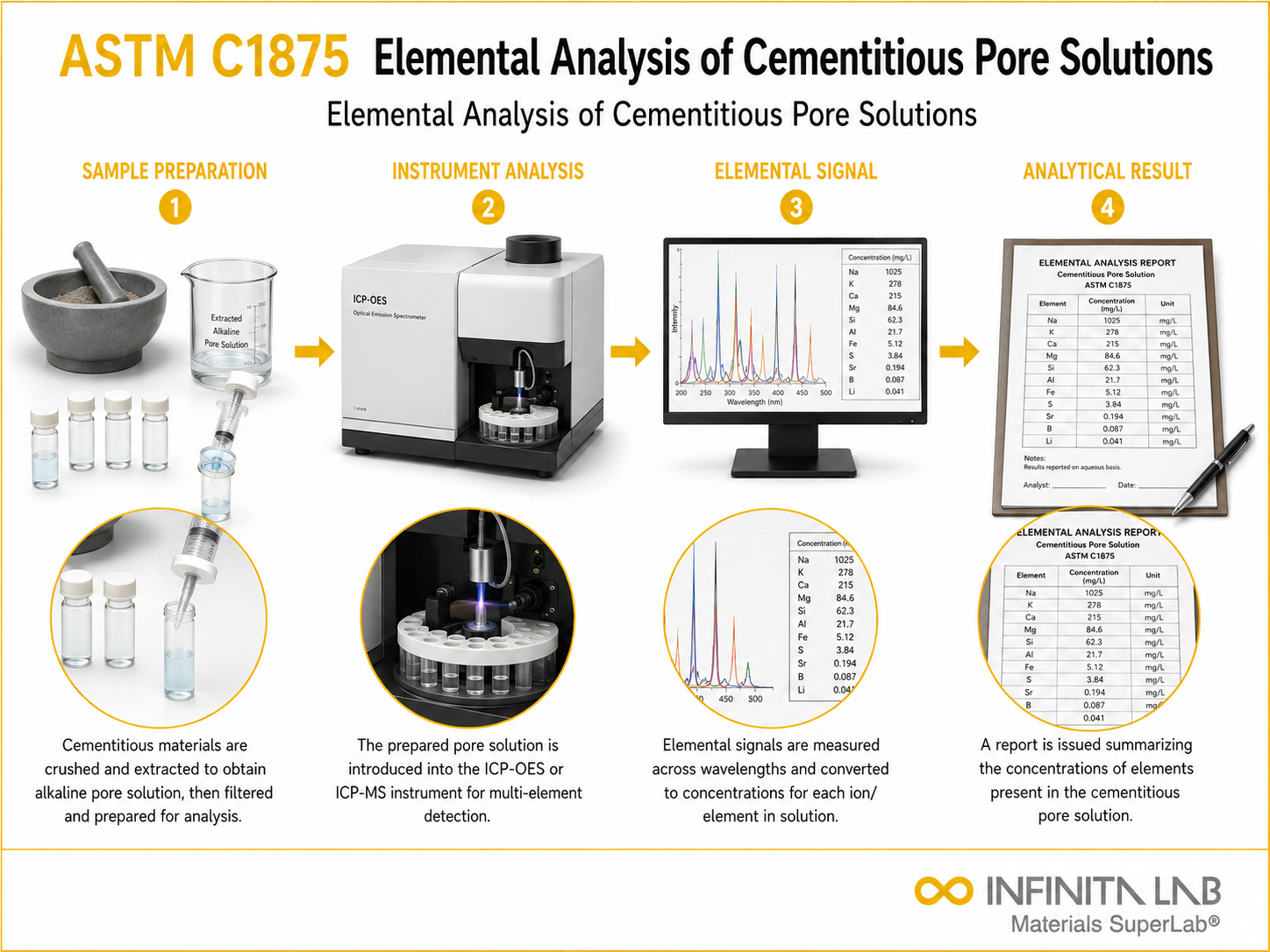


Overview
ASTM C1875 is a standard test method for determining the concentration of major and minor elements in aqueous pore solutions extracted from hardened cementitious paste. It provides a systematic approach to analyzing the ionic composition of pore fluid, which directly governs the chemical environment within concrete and cement-based materials.
The method is critical for evaluating the long-term durability, alkali-silica reaction (ASR) potential, and leaching behavior of cementitious systems. It supports material scientists and engineers in understanding how supplementary cementitious materials (SCMs), admixtures, and binders influence pore solution chemistry over time.

Scope, Applications, and Benefits
Scope
ASTM C1875 covers the extraction and elemental analysis of pore solution from hardened cementitious paste specimens. The standard specifies procedures for pore solution expression using high-pressure extraction equipment and subsequent analysis using techniques such as ICP-OES or ICP-MS.
The scope includes:
- Measurement of major elements: sodium (Na), potassium (K), calcium (Ca), silicon (Si), aluminum (Al), and sulfur (S)
- Measurement of minor/trace elements including chloride and hydroxide species
- Analysis of pore solutions from Portland cement, blended cement, and SCM-containing pastes
- Testing at specified curing ages to track ionic evolution over time
- Applicable to research-grade specimens and performance-based durability studies
Applications
- Alkali-silica reaction (ASR) risk assessment in concrete
- Evaluation of supplementary cementitious materials (fly ash, slag, silica fume, metakaolin)
- Chloride ingress and corrosion initiation studies
- Durability and service life modeling of reinforced concrete structures
- Study of cement hydration and phase evolution
- Assessment of low-alkali and blended binder systems
- Nuclear waste encapsulation and geopolymer research
- R&D on novel binders and green cement formulations
- Leaching behavior studies for environmental compliance
- Quality verification of specialty cementitious products
Benefits
- Provides direct chemical characterization of the concrete pore environment
- Enables early detection of ASR risk before macroscopic damage appears
- Supports optimization of SCM blends for reduced alkali content
- Helps predict reinforcement corrosion initiation thresholds
- Useful for both research-grade and performance-specification testing
- Quantifies the effect of admixtures and water-to-cement ratio on pore chemistry
- Supports compliance with durability-based design codes and standards
- Generates data usable in service life prediction models
Test Process
Specimen Preparation
Specimens are cast and cured to the required age under controlled temperature and humidity.
1Pore Solution Extraction
Hardened paste is subjected to high-pressure extraction to collect pore fluid without contamination.
2Elemental Analysis
Extracted solution is analyzed by ICP-OES or ICP-MS to quantify major and minor elemental concentrations.
3Data Interpretation
Ionic concentrations are calculated and interpreted against durability thresholds or research benchmarks.
4Technical Specifications
| Parameter | Details |
|---|---|
| Specimen Type | Hardened cementitious paste (no aggregate) |
| Extraction Method | High-pressure pore solution expression |
| Applied Pressure | Typically up to 500 MPa depending on paste maturity |
| Elements Analyzed | Na, K, Ca, Si, Al, S, Cl, OH⁻, and minor trace elements |
| Analytical Technique | ICP-OES (primary); ICP-MS for trace-level elements |
| Reporting Units | mmol/L or mg/L per element |
| Detection Limit | Sub-ppm level achievable with ICP-MS |


- High-pressure pore solution expression device (custom or hydraulic press setup)
- Inductively Coupled Plasma – Optical Emission Spectrometry (ICP-OES)
- Inductively Coupled Plasma – Mass Spectrometry (ICP-MS)
- Ion chromatography (IC) for chloride and sulfate verification
- pH meter with calibrated electrode for hydroxide estimation
- Analytical balance for specimen mass recording
- Controlled curing chamber (temperature and humidity regulated)
Instrumentation Used for Testing
Results and Deliverables
- Elemental concentration report for each target ion (Na, K, Ca, Si, Al, S, Cl)
- Hydroxide ion concentration (OH⁻) derived from pH measurement
- Ionic strength and pH of the extracted pore solution
- Tabulated data by curing age for time-series studies
- Comparison against ASR threshold limits or project-specific benchmarks
- Full calibration and QC/QA records for analytical instruments
- Chain-of-custody documentation for sample handling
- Technical report with interpretation notes and test conditions
Frequently Asked Question
ASTM C1875 determines the elemental composition of pore solution extracted from hardened cementitious paste, used to evaluate durability, ASR risk, and the influence of supplementary cementitious materials on internal concrete chemistry.
Pore solution is expressed using a high-pressure extraction device that mechanically compresses the paste specimen, forcing interstitial fluid out through a filter into a sealed collection vessel to prevent carbonation.
The ionic composition of pore solution controls pH, corrosion risk to embedded steel, and the likelihood of deleterious reactions like ASR. It determines how aggressive or protective the internal environment is for long-term durability.
Lower w/c ratios produce more concentrated pore solutions with higher ionic strength. Higher w/c ratios dilute ionic concentrations but increase total porosity, affecting both extractable volume and long-term leaching behavior.
While ASTM C1875 is written for Portland cement-based pastes, the extraction and analytical principles are frequently extended to geopolymer and alkali-activated systems in research applications with appropriate method modifications.
Why Choose Infinita Lab for Advanced Materials Testing and Characterization?
At the core of this breadth is our network of 2,000+ accredited laboratories across the USA, offering access to over 10,000 testing methods and analytical services. From advanced materials characterization (SEM, TEM, RBS, XPS) to mechanical, chemical, environmental, biological, and standardized ASTM/ISO-compliant testing, we deliver unmatched flexibility, specialization, and scale. You are never limited by geography, facility, or methodology — Infinita Lab connects you to the right expertise and testing solution, every time.

Looking for a Trusted Partner for Accurate and Reliable Testing Services?
Send query us at hello@infinitalab.com or call us at (888) 878-3090 to learn more about our services and how we can support you.





