


ASTM C323: Ceramic Clay Chemical Analysis Testing Services
ASTM C323 evaluates the chemical composition of the clays used in the production of ceramic whitewares. The method is used to determine the amount of moisture present on the surface, loss of ignition, and compositional analysis of the constituents of the clay sample in its standard air-dried form. The data obtained is used in the manufacturing, development, and research of ceramic clays.
TRUSTED BY


Get ASTM C323 compliant results — request your ceramic clay chemical analysis testing quote
- Overview
- Scope, Applications, and Benefits
- Test Process
- Specifications
- Instrumentation
- Results and Deliverables
What Is ASTM C323 Ceramic Clay Chemical Analysis?
ASTM C323 provides standardized procedures for the chemical analysis of ceramic clays to determine their composition and suitability for various ceramic applications. It focuses on identifying major and minor oxides such as silica, alumina, iron oxide, and alkali components that influence processing and final product performance.
This test is essential for controlling raw material quality and ensuring consistency in ceramic production. By providing accurate compositional data, ASTM C323 helps manufacturers optimize formulations, reduce defects, and achieve desired physical and chemical properties in finished ceramic products.

Applications and Benefits of ASTM C323 Ceramic Clay Chemical Analysis Testing
Scope
ASTM C323 outlines methods for determining the chemical composition of ceramic clays using wet chemical and instrumental analysis techniques to ensure reliable and reproducible results.
- Applicable to natural and processed ceramic clays
- Determines major and minor oxide constituents
- Covers wet chemical and instrumental methods
- Includes sample preparation and digestion procedures
- Ensures accurate and repeatable analysis
- Supports quality control and material specification
Applications
- Ceramic manufacturing raw material evaluation
- Quality control of clay composition
- Tile, brick, and refractory production
- Research and development of ceramic materials
- Raw material sourcing and verification
- Process optimization in ceramics industry
Benefits
- Provides accurate chemical composition data
- Ensures consistency in ceramic production
- Detects impurities affecting product quality
- Supports formulation optimization
- Enhances product performance and reliability
- Enables compliance with material specifications
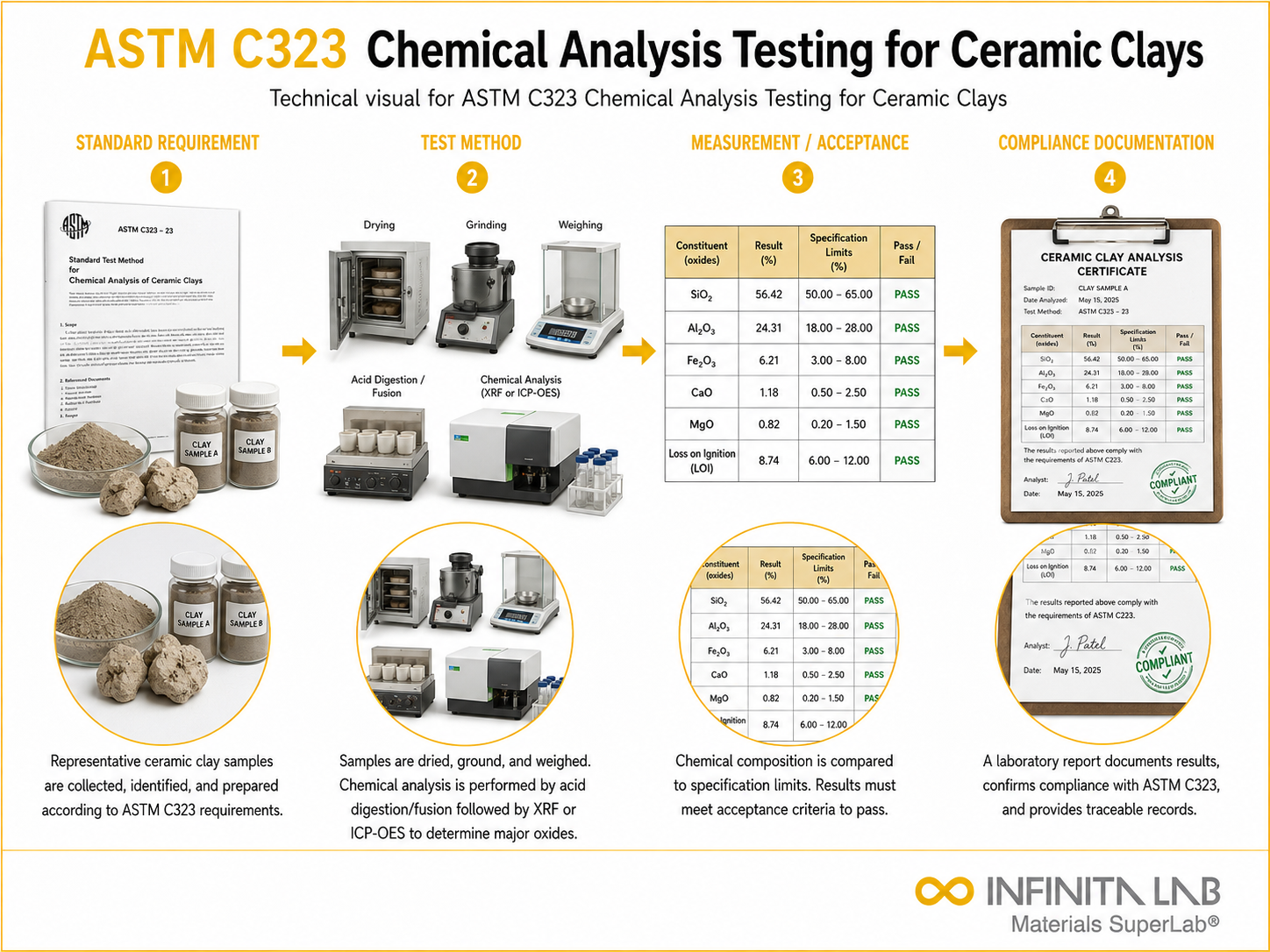
Our ASTM C323 Testing Procedure
Sample Preparation
Dry, crush, and grind the clay sample to obtain a uniform powder.
1Sample Digestion
Dissolve the sample using acids or fusion methods for analysis.
2Chemical Analysis
Determine elemental composition using titration or instrumental techniques.
3Result Calculation
Calculate oxide percentages based on analytical measurements.
4ASTM C323 Test Parameters and Requirements
| Parameter | Details |
|---|---|
| Material Type | Natural and processed ceramic clays |
| Sample Preparation | Drying, crushing, and grinding |
| Digestion Method | Acid digestion or fusion |
| Elements Measured | SiO₂, Al₂O₃, Fe₂O₃, CaO, MgO, Na₂O, K₂O |
| Analytical Techniques | Titration, ICP-OES, AAS |
| Measurement Accuracy | High precision for oxide determination |
| Output Data | Percentage composition of oxides |


- Analytical balance
- Drying oven
- Furnace for fusion
- Acid digestion setup
- ICP-OES or ICP-MS analyzer
- Atomic absorption spectrometer (AAS)
- Volumetric titration apparatus
Equipment and Instrumentation Used for ASTM C323 Testing
What You Receive: Test Report, Data, and Certification
- Oxide composition percentages of clay
- Identification of impurities and trace elements
- Compliance with material specifications
- Quality verification of raw materials
- Comparative compositional analysis
- Detailed analytical report with calculations
ASTM C323 Ceramic Clay Chemical Analysis FAQs
ASTM C323 is used to determine the chemical composition of ceramic clays by analyzing major and minor oxides. It helps manufacturers ensure raw material consistency, optimize formulations, and maintain quality control for producing reliable and high-performance ceramic products.
Chemical composition directly affects properties like plasticity, firing behavior, strength, and color. Accurate analysis ensures the clay meets required specifications and prevents defects in finished ceramic products.
It ensures consistent composition, detects impurities, and verifies compliance with specifications, helping maintain product quality.
Variations in composition influence plasticity, firing temperature, strength, and durability, making accurate analysis critical.
It helps maintain consistency, optimize formulations, reduce production issues, and ensure high-quality ceramic products that meet industry standards and customer requirements.
Why Choose Infinita Lab for Ceramic Clay Chemical Analysis Testing?
At the core of this breadth is our network of 2,000+ accredited laboratories across the USA, offering access to over 10,000 testing methods and analytical services. From advanced materials characterization (SEM, TEM, RBS, XPS) to mechanical, chemical, environmental, biological, and standardized ASTM/ISO-compliant testing, we deliver unmatched flexibility, specialization, and scale. You are never limited by geography, facility, or methodology — Infinita Lab connects you to the right expertise and testing solution, every time.

Need ASTM C323 Ceramic Clay Chemical Analysis Testing You Can Rely On?
Send query us at hello@infinitalab.com or call us at (888) 878-3090 to learn more about our services and how we can support you.



Request a Quote
Submit your material details and receive testing procedures, pricing, and turnaround time within 24 hours.
 Quick Turnaround and Hasslefree process
 Confidentiality Guarantee
 Free, No-obligation Consultation
 100% Customer Satisfaction
