


ASTM D2291: Ring Specimen Glass Resin Composite Testing Services
The ASTM D 2291 Standard Practice is meant to be used to make ring-shaped test specimens that can be used to look at the mechanical properties of resins and reinforcements in composite structures. The procedure describes each step involved in getting test specimens ready, including, when necessary, final specimen machining. There are four other ring arrangements included.
TRUSTED BY


Get ASTM D2291 compliant results — request your ring specimen glass resin composite testing quote
- Overview
- Scope, Applications, and Benefits
- Test Process
- Specifications
- Instrumentation
- Results and Deliverables
What Is ASTM D2291 Ring Specimen Glass Resin Composite?
ASTM D2291 covers the preparation and testing of ring specimens for evaluating the mechanical properties of glass-resin composite materials. The method is commonly used to assess strength characteristics under controlled loading conditions.
This test is widely applied in composite materials, piping systems, and structural components. It helps ensure material reliability and performance in applications involving reinforced polymer composites.

Applications and Benefits of ASTM D2291 Ring Specimen Glass Resin Composite Testing
Scope
ASTM D2291 evaluates glass-resin composites using ring-shaped specimens to determine mechanical behavior under loading. The test provides insight into structural integrity and material strength.
The test evaluates:
- Mechanical strength of composite materials
- Structural integrity of ring specimens
- Behavior under applied loads
- Uniformity of composite construction
- Suitability for structural applications
Applications
- Glass-reinforced plastic (GRP) pipes
- Composite pressure vessels
- Industrial piping systems
- Structural composite components
- Automotive and aerospace composites
- Quality control in composite manufacturing
Benefits
- Provides reliable strength evaluation of composites
- Supports design and structural analysis
- Ensures consistency in composite materials
- Assists in quality control processes
- Enables comparison of composite performance
Our ASTM D2291 Testing Procedure
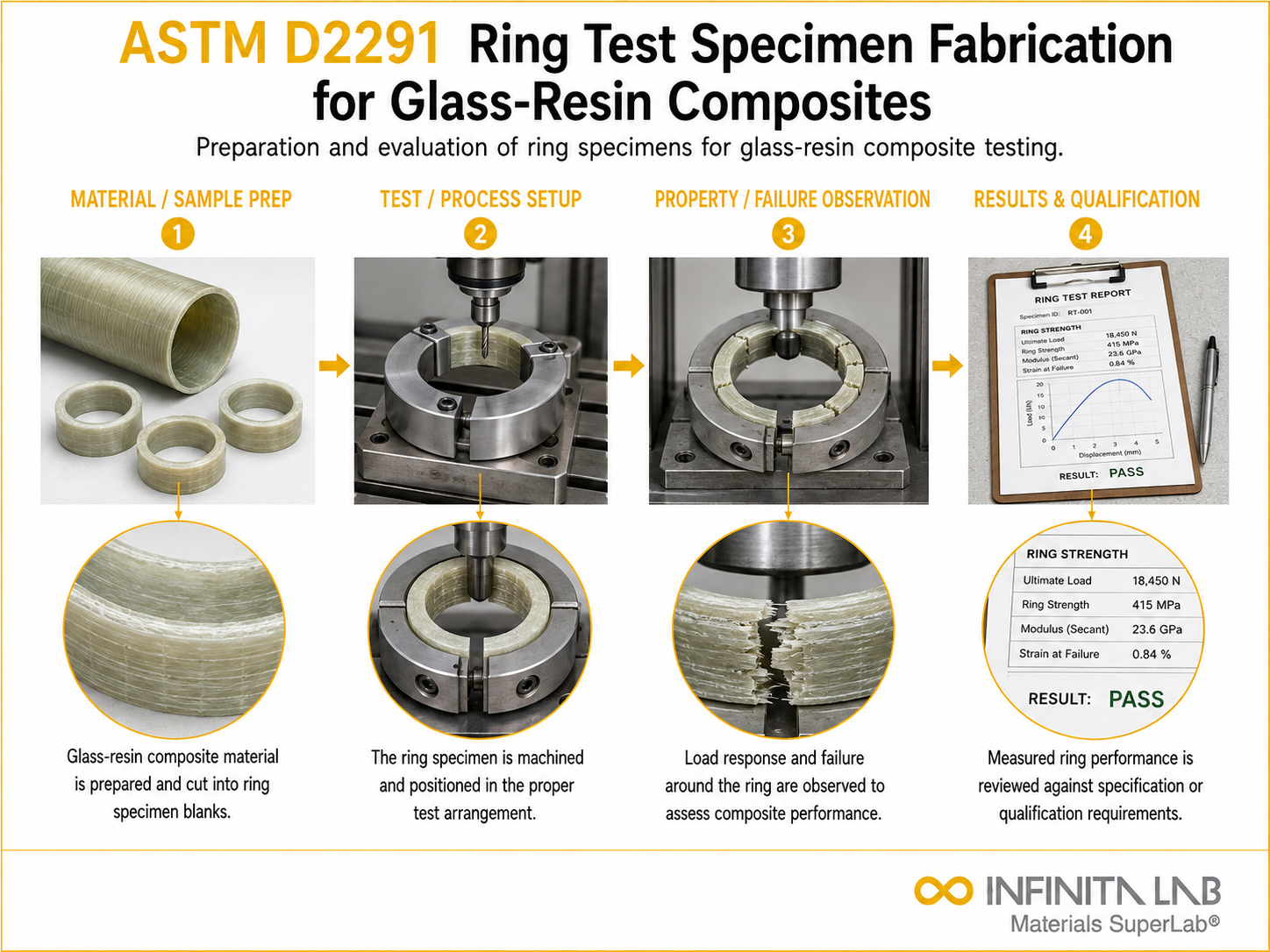
Sample Preparation
Ring specimens are cut from composite materials to specified dimensions.
1Specimen Mounting
Rings are positioned in the testing fixture.
2Load Application
Load Application
3Data Recording & Evaluation
Strength and deformation data are recorded and analyzed.
4ASTM D2291 Test Parameters and Requirements
| Parameter | Details |
|---|---|
| Applicable Materials | Glass-resin composite materials |
| Specimen Geometry | Ring-shaped specimens |
| Diameter Range | ~50 mm to 300 mm |
| Thickness Range | ~3 mm to 25 mm |
| Loading Mode | Diametral compression or tension |
| Measured Outputs | Diametral compression or tension |


- Universal testing machine
- Ring test fixture
- Load cell and control system
- Alignment fixtures
- Measurement tools
- Data acquisition system
Equipment and Instrumentation Used for ASTM D2291 Testing
What You Receive: Test Report, Data, and Certification
- Mechanical strength values
- Load vs deformation data
- Structural performance evaluation
- Comparative composite analysis
- Test condition summary
- ASTM compliance report
ASTM D2291 Ring Specimen Glass Resin Composite FAQs
ASTM D2291 defines preparation and use of ring specimens for testing glass-resin composites. It helps evaluate mechanical properties, especially circumferential strength, relevant for pipes, tanks, and filament-wound structures.
Key parameters include specimen dimensions, ring thickness, cutting method, and alignment. Proper preparation ensures uniform stress distribution during testing and reliable results.
The test supports measurement of hoop tensile strength and related properties. Results indicate structural performance of composite materials under circumferential loading conditions.
ASTM D2291 applies to glass-resin composites such as fiberglass-reinforced plastics used in pipes, pressure vessels, and structural components.
ASTM D2291 focuses on specimen preparation and may require additional tests for full material characterization. Results may be influenced by cutting defects, alignment, or material variability.
Why Choose Infinita Lab for Ring Specimen Glass Resin Composite Testing?
At the core of this breadth is our network of 2,000+ accredited laboratories across the USA, offering access to over 10,000 testing methods and analytical services. From advanced materials characterization (SEM, TEM, RBS, XPS) to mechanical, chemical, environmental, biological, and standardized ASTM/ISO-compliant testing, we deliver unmatched flexibility, specialization, and scale. You are never limited by geography, facility, or methodology — Infinita Lab connects you to the right expertise and testing solution, every time.

Looking for an Accredited Partner for ASTM D2291 Ring Specimen Glass Resin Composite Testing?
Send query us at hello@infinitalab.com or call us at (888) 878-3090 to learn more about our services and how we can support you.



Request a Quote
Submit your material details and receive testing procedures, pricing, and turnaround time within 24 hours.
 Quick Turnaround and Hasslefree process
 Confidentiality Guarantee
 Free, No-obligation Consultation
 100% Customer Satisfaction
