


ASTM E111: Youngs Modulus Tangent Chord Modulus Testing Services
Accredited ASTM E111 youngs modulus tangent chord modulus testing from Infinita Lab, performed to the exact standard requirements - accurate, reproducible results with full documentation for compliance, R&D, and quality control programs.
TRUSTED BY


Get ASTM E111 compliant results - request your young's modulus tangent chord modulus testing quote
- Overview
- Scope, Applications, and Benefits
- Test Process
- Specifications
- Instrumentation
- Results and Deliverables
What Is ASTM E111 Youngs Modulus Tangent Chord Modulus?
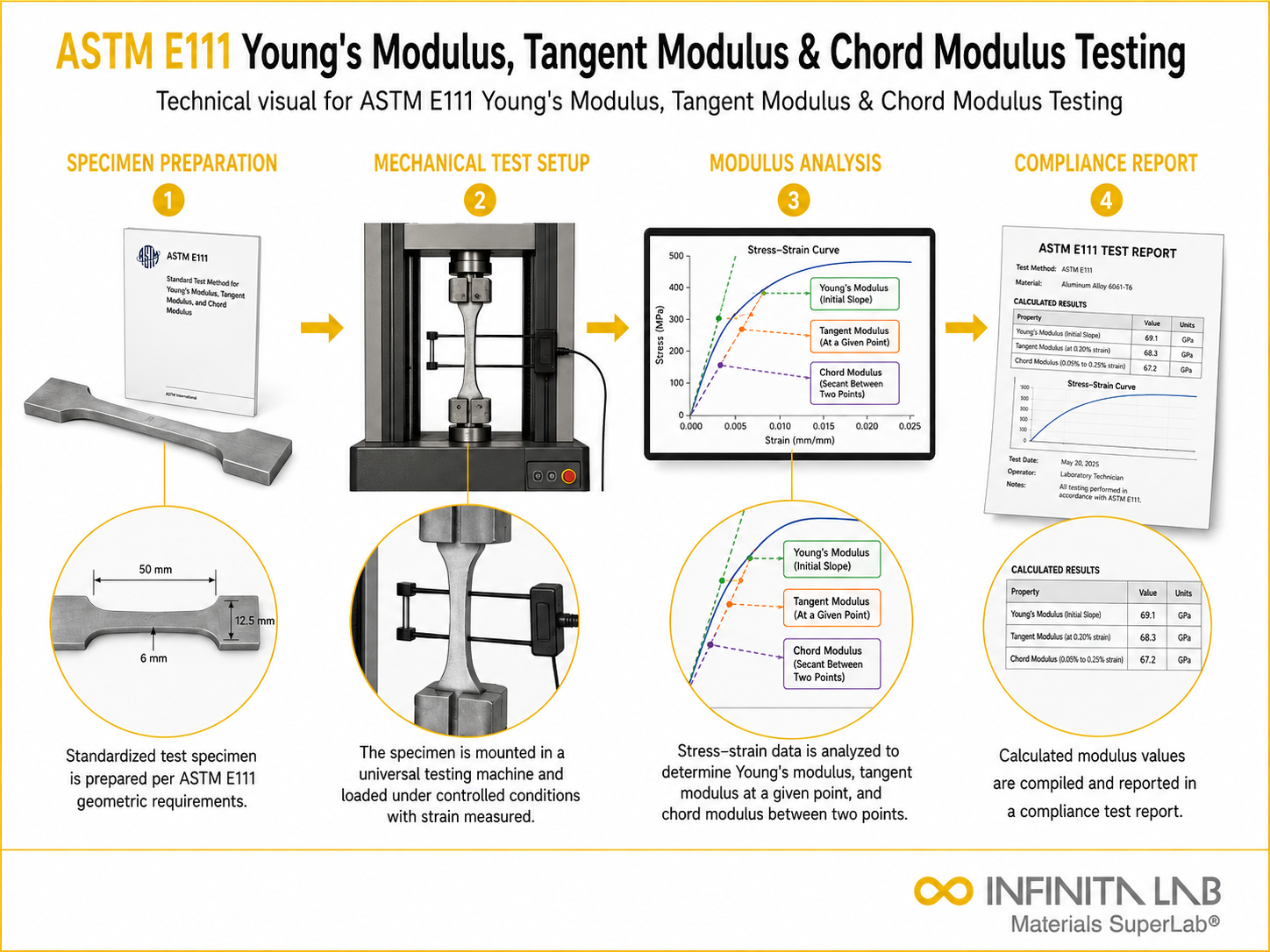
ASTM E111 is the standard test method used to determine Young’s modulus, tangent modulus, and chord modulus of structural materials tested in tension or compression. Each of these three parameters describes material stiffness from a different vantage point on the stress-strain curve generated during a uniaxial loading test, and understanding the distinction between them is essential to selecting the correct value for design calculations or material qualification work.
Young’s modulus is defined as the ratio of stress to strain below the material’s proportional limit – in practical terms, the slope of the initial, straight-line portion of the stress-strain curve, where the material behaves elastically and returns to its original dimensions once the load is removed. Tangent modulus, by contrast, is the slope of the stress-strain curve at any single specified stress or strain point. Within the elastic region, tangent modulus and Young’s modulus coincide; beyond the proportional limit, where the curve begins to bend, tangent modulus captures the local stiffness at that particular point rather than an average across the whole elastic range. Chord modulus is the slope of a straight line, or chord, drawn between two specified points on the stress-strain curve, both of which must fall below the elastic limit; it is useful for characterising materials whose stress-strain response is not perfectly linear even within the elastic range.
To generate these values, a specimen is instrumented with a Class B-1 or better extensometer conforming to ASTM E83, loaded on a calibrated universal testing machine at a controlled rate, and the resulting stress-strain data is analysed according to the modulus definition required by the customer’s specification. The method is valid only when creep deformation is negligible relative to the strain produced immediately upon loading, making it well suited to metals and other structural materials used in load-bearing applications.

Applications and Benefits of ASTM E111 Youngs Modulus Tangent Chord Modulus Testing
Scope
- This test method determines Young’s modulus, tangent modulus, and chord modulus of structural materials under uniaxial tensile or compressive loading.
- It applies to materials in which creep deformation is negligible compared with the strain produced immediately upon loading.
- Testing is conducted using a calibrated extensometer or deflectometer to measure strain corresponding to applied stress or force.
- The method covers determination of modulus values below the proportional or elastic limit of the material.
- Initial tangent modulus and secant modulus are excluded from this standard due to the experimental difficulty of obtaining reliable values for those parameters.
- The standard specifies minimum extensometer accuracy classes, specimen alignment tolerances, and loading rate considerations to ensure repeatable results.
- Both metallic and non-metallic structural materials with a linear or near-linear elastic response can be evaluated under this method.
- A minimum of three test runs per specimen is recommended to establish a representative modulus value.
- The method can be performed at ambient temperature or, with appropriate equipment, at elevated or reduced temperatures.
- Results generated under this method are intended to support engineering design, material specification, and quality verification activities.
Applications
- Structural engineers use E111 modulus data to calculate deflection, stiffness, and load-carrying capacity in beams, columns, and other load-bearing members.
- Material producers rely on this test to verify that incoming or outgoing stock meets specified stiffness requirements before release.
- Aerospace and automotive manufacturers use modulus testing to qualify metals and composites for weight-sensitive, stiffness-critical components.
- Quality assurance programs incorporate E111 testing into incoming material inspection and periodic requalification schedules.
- Research and development teams use tangent and chord modulus data to characterise new alloys, polymers, and composite formulations.
- Failure analysis investigations use modulus data to compare in-service material behaviour against original design assumptions.
- Construction and infrastructure projects use the results to confirm that structural steel, aluminium, and other framing materials meet project specifications.
Benefits
- Provides a standardised, repeatable method for comparing the stiffness of different material lots, suppliers, or formulations.
- Distinguishes between three related but distinct modulus definitions, allowing engineers to select the value most relevant to their design condition.
- Supports accurate finite element modelling and structural analysis by supplying validated input stiffness values.
- Helps manufacturers demonstrate compliance with customer, industry, or regulatory material specifications.
- Reduces the risk of in-service deformation or failure by confirming stiffness properties before a material enters production or construction.
- Generates data that is traceable, defensible, and suitable for inclusion in engineering documentation and material certifications.
Our ASTM E111 Testing Procedure
Specimen Preparation
A standardized test specimen is prepared with defined dimensions and surface quality.
1Load Application
Controlled tensile or compressive load is applied while measuring corresponding deformation.
2Data Acquisition
Stress and strain values are continuously recorded during loading.
3Modulus Calculation
Elastic moduli are calculated from the stress–strain curve using defined methods.
4ASTM E111 Test Parameters and Requirements
| Parameter | Details |
|---|---|
| Test Type | Tensile / Compressive |
| Measured Properties | Young’s, Tangent & Chord Modulus |
| Materials Tested | Metals, plastics, composites, ceramics |
| Strain Measurement | Extensometer / Strain gauge |
| Result Output | Stress–strain curve & modulus values |
| Test Environment | Ambient laboratory conditions |


- Universal Testing Machine (UTM) – Applies controlled tensile or compressive load to the specimen and provides the force data used in stress calculations.
- Extensometer – Measures axial strain directly on the specimen gauge length with the accuracy required to resolve elastic-region deformation.
- Deflectometer – Measures strain or displacement during compression testing where a conventional extensometer is not suitable.
- Load Cell – Provides calibrated, traceable measurement of the applied force throughout the test.
- Specimen Grips and Fixtures – Wedge, hydraulic, or compression fixtures that hold the specimen securely and maintain axial alignment during loading.
- Data Acquisition System – Captures synchronised load and strain readings at the sampling rate needed to construct an accurate stress-strain curve.
- Environmental Chamber – Used when testing is required at elevated or reduced temperatures rather than ambient conditions.
Equipment and Instrumentation Used for ASTM E111 Testing
What You Receive: Test Report, Data, and Certification
- A detailed test report documenting specimen identification, test conditions, and the applicable ASTM E111 procedure followed.
- Calculated Young’s modulus, tangent modulus, and chord modulus values for each specimen and test run.
- Stress-strain curve plots showing the data points and slope calculations used to derive each reported modulus value.
- A summary of individual run results alongside averaged values where multiple runs were performed.
- Documentation of extensometer class, calibration status, and specimen dimensions used in the test.
- Optional certification or compliance statement confirming the test was performed in accordance with ASTM E111.
ASTM E111 Youngs Modulus Tangent Chord Modulus FAQs
ASTM E111 determines Young's modulus, tangent modulus, and chord modulus of structural materials.
Young’s modulus represents material stiffness in the linear elastic region, indicating resistance to deformation under load. It is essential for design calculations, structural analysis, and predicting how materials behave under mechanical stress in engineering applications.
Tangent modulus is the slope of the stress–strain curve at a specific point, reflecting instantaneous stiffness. Unlike Young’s modulus, it accounts for non-linear behavior, making it useful for analyzing materials beyond the initial linear elastic region.
Chord modulus is calculated between two defined points on the stress–strain curve. It provides an average stiffness over a strain range, useful for materials with non-linear elastic behavior where a single slope does not represent the response accurately.
Factors include strain measurement precision, load accuracy, specimen alignment, and data resolution. Errors in any of these can distort the stress–strain curve and lead to incorrect modulus values.
What Is ASTM E111 Standard Test Method Young's Modulus Tangent Modulus Chord Modulus?
Chord modulus is calculated as the slope of a straight line connecting two specified points on a stress-strain curve. It provides an average stiffness over the selected strain range rather than the instantaneous slope at a single point.
Why Choose Infinita Lab for Youngs Modulus Tangent Chord Modulus Testing
When your Youngs Modulus Tangent Chord Modulus results have to hold up - for compliance, a customer audit, or an engineering decision - ASTM E111 accuracy and an unbiased third-party report matter more than price. Infinita Lab routes your ASTM E111 youngs modulus tangent chord modulus testing to ISO/IEC 17025-accredited U.S. partner labs with hands-on method experience, so you get defensible data, transparent reporting, and turnaround times built around your project deadline - not ours.

Need ASTM E111 Youngs Modulus Tangent Chord Modulus Testing You Can Rely On?
Send query us at hello@infinitalab.com or call us at (888) 878-3090 to learn more about our services and how we can support you.



Request a Quote
Submit your material details and receive testing procedures, pricing, and turnaround time within 24 hours.
 Quick Turnaround and Hasslefree process
 Confidentiality Guarantee
 Free, No-obligation Consultation
 100% Customer Satisfaction
