


ASTM D7836: Yield Stress Paints Inks Testing Services
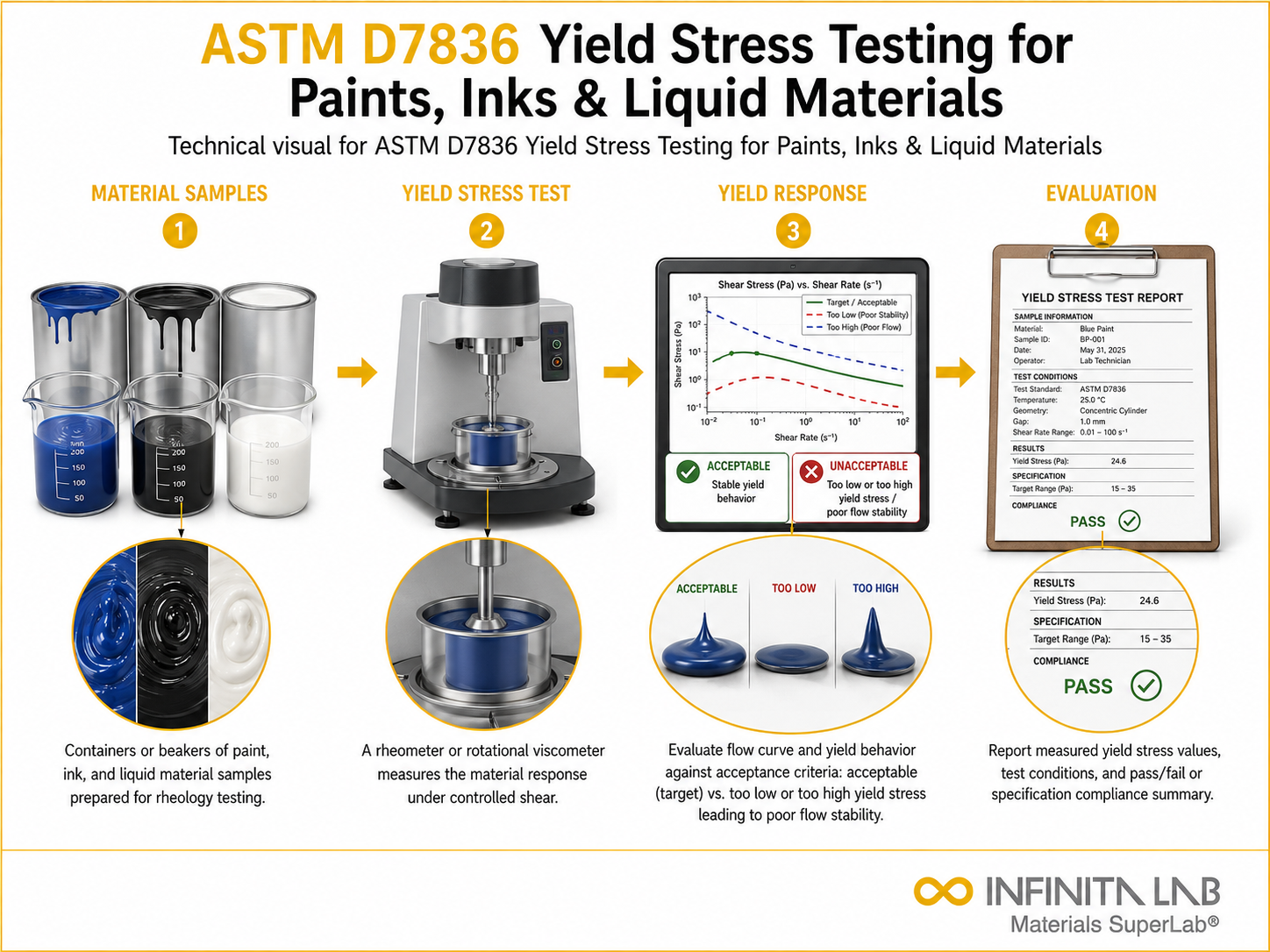
ASTM D7836 covers three approaches for measuring the yield stress values of paints, inks, and related liquid materials. It is done by using a viscometer with a coaxial cylinder, cone/plate, or plate/plate geometry, a rheometer, and a viscometer with a vane spindle. The applied stress ramp on the material increases the yield stress of that material. The yield stress depends on the maximum torque value.
TRUSTED BY


Get ASTM D7836 compliant results — request your yield stress paints inks testing quote
- Overview
- Scope, Applications, and Benefits
- Test Process
- Specifications
- Instrumentation
- Results and Deliverables
What Is ASTM D7836 Yield Stress Paints Inks?
ASTM D7836 describes a standard test method for measuring the yield stress of paints, inks, and related liquid materials using a controlled stress rheometer. Yield stress is the minimum shear stress required to initiate flow in a structured fluid — below this value, the material behaves as a viscoelastic solid; above it, it flows as a viscous liquid.
Yield stress measurement is critical for formulating sag-resistant paints, leveling coatings, and pumpable slurries, and for understanding the application behavior, storage stability, and transport characteristics of coating and ink systems.

Applications and Benefits of ASTM D7836 Yield Stress Paints Inks Testing
Scope
ASTM D7836 evaluates:
- Static and dynamic yield stress of structured liquids
- Yield stress as a function of temperature
- Effect of formulation variables (pigment loading, thickeners) on yield stress
- Comparison of yield stress across paint and ink grades
Applications
- Architectural and industrial paint formulation optimization
- Printing ink flow and leveling characterization
- Anti-sag and anti-settling additive evaluation
- Paste and high-solid coating rheology
- Cosmetic and personal care product flow behavior
Benefits
- Quantifies the flow threshold critical for sag and leveling behavior
- Enables prediction of storage stability and settling resistance
- Guides thickener and rheology modifier selection
- Reproducible, instrument-based measurement replaces subjective assessment
- Applicable to a wide viscosity range of liquid and semi-solid materials
Our ASTM D7836 Testing Procedure
Sample Loading
The paint or ink sample is loaded into the rheometer geometry (cone-plate, parallel plate, or vane) at the test temperature; edge effects are minimized and the geometry gap is set precisely.
1Pre-Shear & Rest
A standardized pre-shear cycle is applied to erase sample loading history, followed by a rest period to allow structure recovery before the yield stress measurement.
2Stress Ramp / Oscillation
A controlled stress ramp or low-amplitude oscillatory strain sweep is applied; the transition from solid-like (elastic) to liquid-like (viscous) behavior marks the yield stress.
3Yield Stress Determination
The yield stress is identified from the stress–strain curve at the inflection point, crossover of G' and G'', or tangent intersection method, per the ASTM D7836 protocol.
4ASTM D7836 Test Parameters and Requirements
| Parameter | Details |
|---|---|
| Instrument | Controlled-stress rotational rheometer |
| Geometry | Cone-plate, parallel plate, or vane |
| Test Temperature | 23 °C (standard) or as specified |
| Measurement Method | Stress ramp, oscillatory strain sweep, or creep |
| Yield Stress Range | 0.01–1000 Pa (material dependent) |


- Controlled-stress rotational rheometer (e.g., Anton Paar, TA Instruments, Malvern)
- Cone-plate, parallel plate, and vane geometries
- Peltier temperature control plate
- Solvent trap to prevent evaporation
- Rheometer data analysis software
Equipment and Instrumentation Used for ASTM D7836 Testing
What You Receive: Test Report, Data, and Certification
- Yield stress value (Pa) with the determination method noted
- Stress–strain or G’/G” curves with yield point annotation
- Temperature-dependent yield stress data (if tested)
- Comparative yield stress table for formulation screening
- Full rheology report per ASTM D7836
ASTM D7836 Yield Stress Paints Inks FAQs
Yield stress determines sag resistance — how well a paint stays where applied on vertical surfaces before it begins to level or sag. Higher yield stress improves sag resistance; if too high, it impairs leveling and brush mark removal. Optimal yield stress is balanced for application and leveling performance.
Static yield stress is the stress required to initiate flow from rest (relevant to sag and settling). Dynamic yield stress is the stress at which flow ceases on deceleration (relevant to leveling). Static yield stress is typically higher than dynamic yield stress for structured fluids.
HEUR and HASE associative thickeners form reversible network structures in latex paint that contribute to yield stress and sag resistance. Concentration, type, and compatibility with other formulation components strongly influence the magnitude and type of yield behavior.
Very low-viscosity inks may have yield stresses below the sensitivity limit of standard rheometers (<0.01 Pa). For such fluids, vane geometries or specialized low-torque instruments may be required, or yield stress may be indirectly inferred from creep compliance experiments.
Rheometer testing consumes only a small quantity of material (1–2 mL for cone-plate geometry). After testing, the sample is typically discarded. The material remaining in the bulk container is unaffected.
Why Choose Infinita Lab for Yield Stress Paints Inks Testing
At the core of this breadth is our network of 2,000+ accredited laboratories across the USA, offering access to over 10,000 testing methods and analytical services. From advanced materials characterization (SEM, TEM, RBS, XPS) to mechanical, chemical, environmental, biological, and standardized ASTM/ISO-compliant testing, we deliver unmatched flexibility, specialization, and scale. You are never limited by geography, facility, or methodology — Infinita Lab connects you to the right expertise and testing solution, every time.

Looking for an Accredited Partner for ASTM D7836 Yield Stress Paints Inks Testing?
Send query us at hello@infinitalab.com or call us at (888) 878-3090 to learn more about our services and how we can support you.



Request a Quote
Submit your material details and receive testing procedures, pricing, and turnaround time within 24 hours.
 Quick Turnaround and Hasslefree process
 Confidentiality Guarantee
 Free, No-obligation Consultation
 100% Customer Satisfaction
