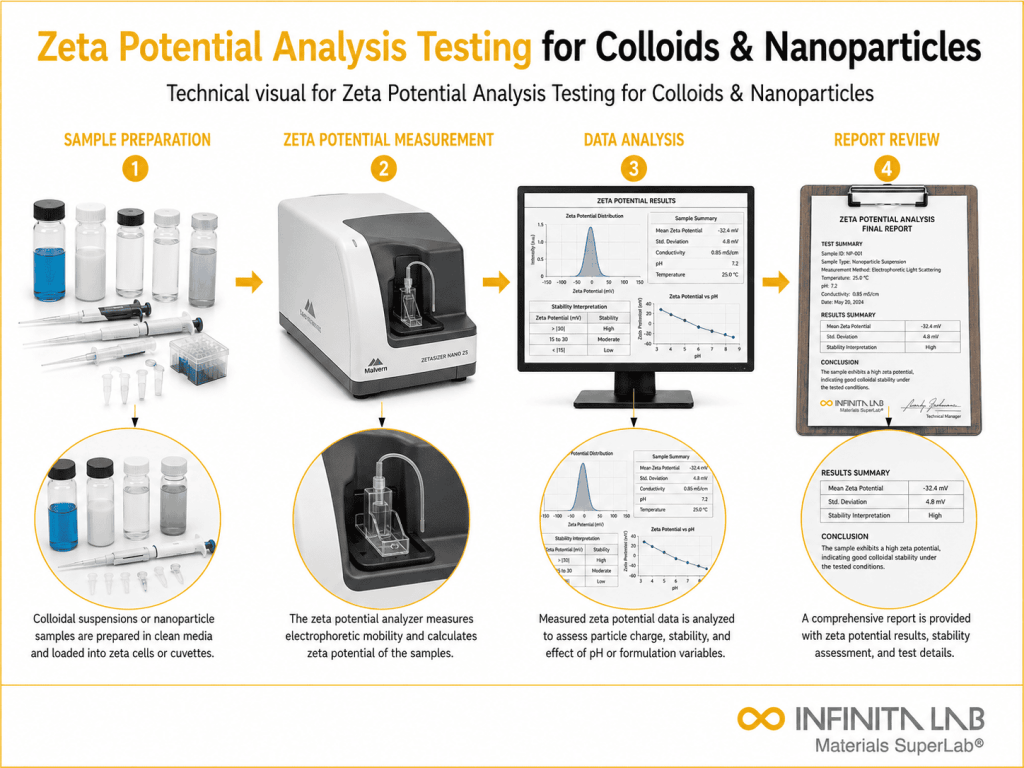


What Is Zeta Potential Analysis?
Zeta Potential Analysis is a critical electrokinetic technique used to quantify the surface charge characteristics of particles dispersed in a liquid medium by measuring the electrical potential at the slipping plane. This parameter reflects the balance between electrostatic repulsion and attractive forces governing interparticle interactions. The measurement is typically performed using electrophoretic light scattering, where particle mobility under an applied electric field is converted into zeta potential through theoretical models such as Smoluchowski or Huckel approximations.
This analysis plays a fundamental role in understanding colloidal stability, aggregation kinetics, and dispersion behavior across a wide range of systems. It is extensively used to evaluate the influence of pH, ionic strength, surfactants, and additives on particle interactions. By providing insight into the electrical double layer structure and interfacial chemistry, zeta potential analysis supports formulation optimization, stability prediction, and quality control in complex multiphase systems.
Applications and Benefits of Zeta Potential Analysis Testing
Scope
Zeta potential analysis focuses on evaluating the surface charge characteristics and electrostatic behavior of dispersed particles in liquid systems. It provides a quantitative measure of how the electrical double layer surrounding particles influences stability, aggregation, and interaction dynamics under varying chemical conditions.
- Determines electrokinetic potential of particles in suspension
- Applicable to colloids, nanoparticles, emulsions, and dispersions
- Evaluates effects of pH, ionic strength, and electrolytes
- Assesses stability against aggregation and flocculation
- Enables determination of isoelectric point
- Supports formulation optimization and quality control
Applications
- Nanoparticle and colloidal stability analysis
- Pharmaceutical suspension formulation
- Water treatment and coagulation studies
- Paints, inks, and coatings stability
- Food and emulsion systems evaluation
- Chemical and material research
Benefits
- Rapid assessment of dispersion stability
- Predicts aggregation and flocculation behavior
- Supports formulation optimization
- Sensitive to surface chemistry changes
- Non-destructive measurement technique
- Applicable across multiple industries
Our Testing Procedure
Sample Preparation
The dispersion is diluted and conditioned to ensure stable suspension and appropriate conductivity for measurement.
1Electric Field Application
An electric field is applied, causing charged particles to move according to their surface charge.
2Mobility Measurement
Particle velocity is measured using electrophoretic light scattering or similar techniques.
3Zeta Potential Calculation
Electrophoretic mobility is converted into zeta potential using appropriate theoretical models.
4Test parameters and requirements
| Parameter | Details |
|---|---|
| Measurement Principle | Electrophoretic mobility to zeta potential conversion |
| Sample Type | Colloids, suspensions, emulsions |
| Measurement Parameter | Zeta potential (surface charge) |
| Detection Method | Electrophoretic light scattering |
| Measurement Range | Typically ±200 mV |
| Sample Condition | Dilute and stable dispersion |
| Temperature Control | Maintained for consistency |
| Output Units | Millivolts (mV) |


- Zeta potential analyzer
- Electrophoretic light scattering system
- Laser source and detector
- Sample cells and electrodes
- Temperature control unit
- Data analysis software
Equipment and Instrumentation Used for Testing
What You Receive: Test Report, Data, and Certification
- Zeta potential value (mV)
- Stability assessment report
- Particle interaction analysis
- Effect of pH and ionic strength data
- Comparative formulation results
- Test certification documentation
Zeta Potential Analysis FAQs
Zeta potential is measured at the slipping plane rather than the particle surface because it represents the effective electrostatic boundary influencing particle motion in a fluid, directly governing interparticle interactions and stability behavior.
The distribution of ions around a charged particle forms a Stern layer and diffuse layer, and the potential at the boundary of these layers determines the measured zeta potential.
Higher ionic strength compresses the electrical double layer, reducing zeta potential magnitude and increasing the likelihood of particle aggregation.
Surface charge density cannot be directly measured in dispersed systems, whereas zeta potential reflects the effective electrostatic environment at the slipping plane, which governs particle motion, interaction forces, and real dispersion stability behavior.
It reflects instantaneous electrostatic conditions but does not account for slow processes like sedimentation or chemical changes.
A zeta potential test measures the electrical potential near the surface of particles suspended in a liquid. The sample is placed in a zeta potential analyzer, which applies an electric field and measures particle movement using electrophoretic light scattering. The results help assess particle interactions, dispersion stability, and the likelihood of aggregation or flocculation.
Zeta potential analysis evaluates the surface-charge behavior of particles in suspensions, emulsions, and colloidal systems. The instrument measures electrophoretic mobility and calculates zeta potential in millivolts (mV). Results are interpreted alongside factors such as pH, temperature, and ionic strength to understand dispersion stability and optimize material formulations.
Colloidal stability assessment examines whether particles repel one another or tend to aggregate. A zeta potential of approximately −30 mV often indicates moderate electrostatic repulsion and may suggest reasonable dispersion stability. However, stability also depends on factors such as pH, ionic strength, particle concentration, and the composition of the liquid medium. Additional measurements, such as particle size or sedimentation, can help confirm stability.
Why Choose Infinita Lab for Zeta Potential Analysis Testing
When your Zeta Potential Analysis results have to hold up - for compliance, a customer audit, or an engineering decision - accuracy and an unbiased third-party report matter more than price. Infinita Lab routes your zeta potential analysis testing to ISO/IEC 17025-accredited U.S. partner labs with hands-on method experience, so you get defensible data, transparent reporting, and turnaround times built around your project deadline - not ours.

Looking for an Accredited Partner for Zeta Potential Analysis Testing?
Send query us at hello@infinitalab.com or call us at (888) 878-3090 to learn more about our services and how we can support you.



