


ASTM D2734: Composite Void Content Testing Services
The ASTM D 2734 Standard Test Methods addresses the void content of reinforced polymers or "composites." The test procedures can be used with composites whose materials' reactions to ignition are known. This category includes most plastics, glass, and reinforcements. The effects of ignition on the plastics do not apply to these test techniques for composite materials.
TRUSTED BY


Get ASTM D2734 compliant results — request your composite void content testing quote
- Overview
- Scope, Applications, and Benefits
- Test Process
- Specifications
- Instrumentation
- Results and Deliverables
What Is ASTM D2734 Composite Void Content?
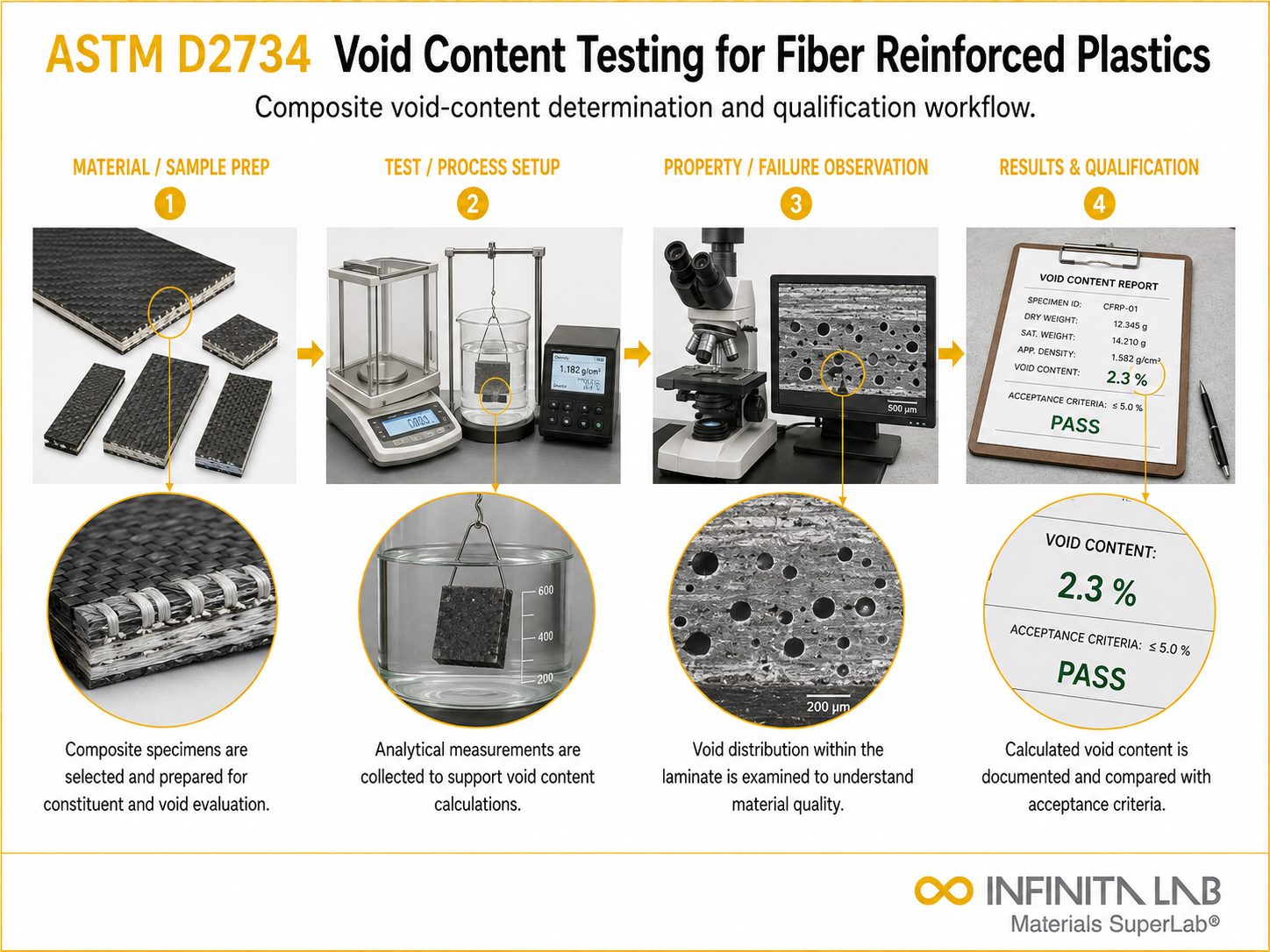
ASTM D2734 establishes a method for determining the void content in reinforced plastic composites by comparing measured density with theoretical density. Voids are trapped air or gas pockets formed during manufacturing, which can significantly reduce mechanical strength, stiffness, and long-term durability of composite materials. Accurate quantification of void content is critical for ensuring structural integrity and performance.
This test is widely used in composite manufacturing processes such as molding, filament winding, and lamination. By identifying void levels, manufacturers can optimize processing parameters, improve consolidation, and ensure high-quality composite structures for demanding applications requiring strength, reliability, and consistency.

Applications and Benefits of ASTM D2734 Composite Void Content Testing
Scope
ASTM D2734 defines procedures for calculating void content in reinforced plastics using density measurements and theoretical composition data.
- Applicable to fiber-reinforced plastic composites
- Determines void content based on density comparison
- Requires knowledge of resin and reinforcement proportions
- Supports evaluation of manufacturing quality and consolidation
- Suitable for laboratory testing and quality assurance processes
Applications
- Aerospace composite component evaluation
- Automotive structural composite testing
- Marine and wind energy composite structures
- Quality control in composite manufacturing
- Research and development of reinforced plastics
Benefits
- Identifies internal defects affecting performance
- Improves mechanical strength and durability of composites
- Supports optimization of manufacturing processes
- Enhances product reliability and consistency
- Enables comparison of composite quality
Our ASTM D2734 Testing Procedure
Specimen Preparation
Composite sample is cut and conditioned to obtain representative material for density measurement.
1Density Measurement
Actual density is determined using appropriate methods such as displacement or mass-volume calculation.
2Theoretical Density Calculation
Density is calculated based on known proportions of resin and reinforcement materials.
3Void Content Determination
Void percentage is calculated by comparing measured density with theoretical density values.
4ASTM D2734 Test Parameters and Requirements
| Parameter | Details |
|---|---|
| Material Type | Fiber-reinforced polymer composites |
| Test Principle | Density comparison between actual and theoretical values |
| Measurement Output | Void content expressed as percentage (%) |
| Density Method | Displacement or mass-volume calculation |
| Input Requirement | Resin and fiber weight fractions |
| Environment | Controlled laboratory conditions |


- Analytical balance
- Density measurement setup (displacement apparatus)
- Calipers or micrometer
- Sample cutting tools
- Conditioning chamber
- Data calculation tools
- Calibration standards
Equipment and Instrumentation Used for ASTM D2734 Testing
What You Receive: Test Report, Data, and Certification
- Actual and theoretical density values
- Calculated void content (%)
- Assessment of composite quality
- ASTM D2734 compliant test report
- Recommendations for process improvement
ASTM D2734 Composite Void Content FAQs
ASTM D2734 is a standard test method used to determine void content in reinforced plastic composites by comparing actual and theoretical density. It is important because voids can significantly reduce strength, durability, and overall structural performance of composite materials.
Void content directly affects strength, stiffness, and fatigue resistance. High void levels can lead to premature failure, making it essential to control and measure voids for high-performance applications.
The test relies on accurate composition data and density measurements. It does not provide detailed information about void distribution, requiring additional methods for comprehensive analysis.
It significantly contributes by identifying void-related defects, but overall reliability also depends on material selection, processing conditions, and additional performance testing.
Factors include improper curing, inadequate pressure, resin viscosity, air entrapment, and processing conditions, all of which can affect the formation of voids during manufacturing.
Why Choose Infinita Lab for Composite Void Content Testing?
At the core of this breadth is our network of 2,000+ accredited laboratories across the USA, offering access to over 10,000 testing methods and analytical services. From advanced materials characterization (SEM, TEM, RBS, XPS) to mechanical, chemical, environmental, biological, and standardized ASTM/ISO-compliant testing, we deliver unmatched flexibility, specialization, and scale. You are never limited by geography, facility, or methodology — Infinita Lab connects you to the right expertise and testing solution, every time.

Need ASTM D2734 Composite Void Content Testing You Can Rely On?
Send query us at hello@infinitalab.com or call us at (888) 878-3090 to learn more about our services and how we can support you.



Request a Quote
Submit your material details and receive testing procedures, pricing, and turnaround time within 24 hours.
 Quick Turnaround and Hasslefree process
 Confidentiality Guarantee
 Free, No-obligation Consultation
 100% Customer Satisfaction
