


ASTM E285: Method Oxyacetylene Ablation Of Thermal Insulation Meterials Testing Services
Accredited ASTM E285 method oxyacetylene ablation of thermal insulation materials testing from Infinita Lab, performed to the exact standard requirements - accurate, reproducible results with full documentation for compliance, R&D, and quality control programs.
TRUSTED BY


Get ASTM E285 compliant results - request your method oxyacetylene ablation of thermal insulation materials testing quote
- Overview
- Scope, Applications, and Benefits
- Test Process
- Specifications
- Instrumentation
- Results and Deliverables
What Is ASTM E285 Method Oxyacetylene Ablation Of Thermal Insulation Meterials?
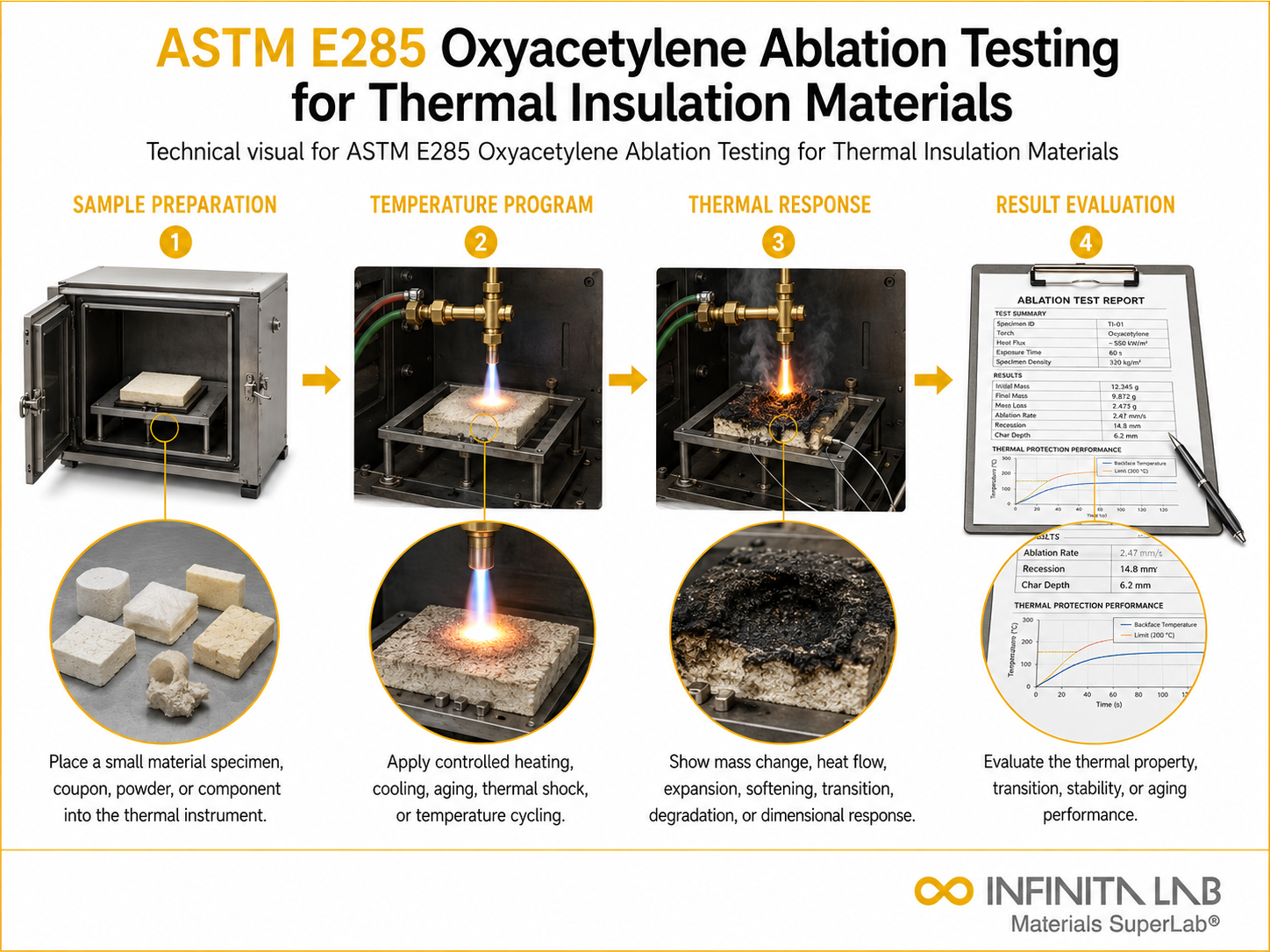
ASTM E285 is the test method ASTM International’s Subcommittee E21.08 developed to gauge how well ablative and thermal insulation materials hold up under brief, extremely high-heat-flux exposure. Its full title is “Standard Test Method for Oxyacetylene Ablation Testing of Thermal Insulation Materials,” and the version in force today is ASTM E285-08, reapproved in 2020 with no technical changes to the original 2008 procedure. The test is fairly direct in concept, if demanding in execution: a steady oxyacetylene flame, burning at roughly 3000°C, is aimed at the exposed face of a flat panel specimen under tightly controlled lab conditions – closer to what happens inside a rocket motor or another high-temperature propulsion system than radiant or convective heating methods ever get.
While the flame runs, technicians watch the specimen’s back face with thermocouples or optical pyrometers, timing how long it takes to reach set temperature-rise increments. They also track erosion, mass loss, ablation depth, charring, cracking, and any melting, then work out an erosion rate by dividing the specimen’s original thickness by its burn-through time. Together, these numbers produce insulation index values that rank candidate materials against one another – not predictions of how a material will behave in any particular real-world application.
That distinction matters. ASTM is explicit that E285 is a screening test: results shouldn’t be used for design work or to forecast in-service performance. What it’s genuinely good at is weeding out weak candidates early, supporting quality control, and comparing ablative formulations before anyone commits to pricier, application-specific testing. That’s why aerospace, defence, and propulsion manufacturers lean on E285 data when down-selecting thermal protection materials, nozzle liners, and heat shield composites early in a program – it trims the cost and risk of full-scale ablation or arc-jet testing later in qualification.

Applications and Benefits of ASTM E285 Method Oxyacetylene Ablation Of Thermal Insulation Meterials Testing
Scope
- Applies to ablative and thermal insulation materials meant for high-heat-flux, short-duration exposure environments.
- Covers materials tested as flat panel specimens exposed to a controlled oxyacetylene flame under standardised lab conditions.
- Quantifies relative thermal insulation effectiveness through back-face temperature rise, erosion rate, and mass loss measurements.
- Functions primarily as a screening and ranking tool, not as a predictor of in-service performance.
- Covers rigid, semi-rigid, and composite ablative materials, including both charring and non-charring formulations.
- Does not simulate any specific rocket motor, re-entry vehicle, or fire scenario, and shouldn’t be used for structural or thermal design calculations.
- Sits under ASTM Subcommittee E21.08, part of Committee E21 on Space Simulation and Applications of Space Technology.
- Extends to materials evaluated for quality control, lot acceptance, and comparative material selection.
- Isn’t intended to provide a direct fire hazard classification under actual fire conditions.
Applications
- Screening candidate ablative and thermal protection materials for rocket motor nozzle liners and internal insulation.
- Evaluating reentry vehicle heat shield composites for their relative resistance to extreme convective and radiant heat flux.
- Running quality control and lot-to-lot consistency checks on ablative insulation manufacturing.
- Comparing formulation changes across charring ablatives, silicone- and phenolic-based composites, and fibre-reinforced insulation systems.
- Down-selecting materials for aerospace and defence propulsion programs ahead of costly arc-jet or full-scale motor testing.
- Assessing thermal barrier performance for solid rocket motor case insulation and igniter components.
- Generating comparative data that feeds research and development of next-generation ablative thermal protection systems.
Benefits
- Rapid, cost-effective comparative data before you commit to expensive full-scale or arc-jet qualification testing.
- Standardised, repeatable results that support objective material ranking and selection decisions.
- Early identification of clearly inferior materials, which cuts downstream engineering and program risk.
- Quantitative erosion rate and insulation index data suitable for quality control documentation.
- Traceable, standardised reporting that meets aerospace and defence customer expectations.
- The ability to screen multiple candidate formulations efficiently, all under identical, controlled exposure conditions.
Our ASTM E285 Testing Procedure
Specimen Preparation
Prepare insulation specimens to the specified dimensions and conditions.
1Initial Measurements
Record initial thickness, mass, and surface condition
2Specimen Positioning
Mount the specimen at the prescribed distance from the flame
3Data Recording
Document all observations and measured values
4ASTM E285 Test Parameters and Requirements
| Parameter | Details |
|---|---|
| Heat Source | Oxyacetylene flame |
| Flame Temperature | ~3000 °C (nominal) |
| Exposure Duration | As specified by test requirement |
| Specimen Shape | Flat slab or specified geometry |
| Measured Properties | Mass loss, thickness loss, ablation depth |
| Result Type | Comparative / performance evaluation |


- Oxyacetylene Torch Assembly – Generates and directs the high-temperature flame onto the specimen face.
- Oxygen and Acetylene Gas Supply System – Supplies regulated fuel and oxidiser flow to keep the flame stable.
- Gas Flow Regulators and Control Valves – Hold gas flow rates steady and let technicians monitor them throughout the exposure.
- Thermocouples / Optical Pyrometers – Measure back-face temperature rise on the unexposed specimen surface.
- Specimen Holding Fixture – Positions and secures the panel at the prescribed standoff distance and angle.
- Data Acquisition System – Logs temperature, time, and exposure data throughout the test.
- Precision Balance and Callipers – Capture pre- and post-test specimen mass and thickness for erosion rate calculations.
Equipment and Instrumentation Used for ASTM E285 Testing
What You Receive: Test Report, Data, and Certification
- A detailed test report covering specimen identification, exposure conditions, and test configuration.
- Back-face temperature rise data and time-to-threshold values for each specimen tested.
- A calculated erosion rate, expressed as thickness loss per unit exposure time.
- Insulation index values that let you rank candidate materials directly against one another.
- Photographic documentation of post-test char, cracking, melting, and other surface degradation.
- Raw data records suitable for engineering review, regulatory submission, or material qualification files.
ASTM E285 Method Oxyacetylene Ablation Of Thermal Insulation Meterials FAQs
ASTM E285-08 is a standard test method used to evaluate ablation resistance of thermal insulation materials using an oxyacetylene flame under controlled high-temperature conditions.
ASTM E285-08 is important because it assesses material performance under extreme heat, ensuring suitability for aerospace, fire protection, and high-temperature insulation applications.
ASTM E285-08 involves exposing a material to an oxyacetylene flame and measuring material loss or erosion to evaluate ablation resistance.
ASTM E285-08 requires an oxyacetylene torch, sample holder, measurement tools, and safety equipment for controlled high-temperature testing.
ASTM E285-08 results are reported as ablation rate or material loss, indicating resistance to high-temperature erosion.
Why Choose Infinita Lab for Method Oxyacetylene Ablation Of Thermal Insulation Meterials Testing
When your Method Oxyacetylene Ablation Of Thermal Insulation Materials results have to hold up - for compliance, a customer audit, or an engineering decision - ASTM E285 accuracy and an unbiased third-party report matter more than price. Infinita Lab routes your ASTM E285 method oxyacetylene ablation of thermal insulation materials testing to ISO/IEC 17025-accredited U.S. partner labs with hands-on method experience, so you get defensible data, transparent reporting, and turnaround times built around your project deadline - not ours.

Need ASTM E285 Method Oxyacetylene Ablation Of Thermal Insulation Meterials Testing You Can Rely On?
Send query us at hello@infinitalab.com or call us at (888) 878-3090 to learn more about our services and how we can support you.



Request a Quote
Submit your material details and receive testing procedures, pricing, and turnaround time within 24 hours.
 Quick Turnaround and Hasslefree process
 Confidentiality Guarantee
 Free, No-obligation Consultation
 100% Customer Satisfaction
