


ASTM E1545: Glass Transition TMA Testing Services
Accredited ASTM E1545 glass transition TMA testing from Infinita Lab, performed to the exact standard requirements - accurate, reproducible results with full documentation for compliance, R&D, and quality control programs.
TRUSTED BY


Get ASTM E1545 compliant results - request your glass transition TMA testing quote
- Overview
- Scope, Applications, and Benefits
- Test Process
- Specifications
- Instrumentation
- Results and Deliverables
What Is ASTM E1545 Glass Transition TMA?
ASTM E1545-22, Standard Test Method for Assignment of the Glass Transition Temperature by Thermomechanical Analysis, describes procedures for assigning the glass transition temperature (Tg) of a material on heating, using thermomechanical measurements made under compression. It is an active test method, not a specification, developed by ASTM Committee E37 on Thermal Measurements under subcommittee E37.10. The current edition dates from 2022 and replaces E1545-11 (reapproved 2016). It’s short, about five pages, and sits in Volume 14.01 of the ASTM Book of Standards.
The method suits amorphous materials and partially crystalline ones, as long as they’re rigid enough below the glass transition to resist indentation by the sensing probe. Heating a specimen through Tg increases chain mobility. The material softens or changes its linear expansion rate. A thermomechanical analyzer records that change as a dimensional signal against temperature; Tg is assigned from the resulting curve. Because the technique responds to hardness and expansion rather than heat flow, it complements calorimetric methods.
The normal operating range runs from -100 °C to 600 °C, and can be extended depending on the instrument. SI units are standard. Tg depends on thermal history, as the standard notes, so that the value can reveal information about processing, stability, reaction progress, and mechanical and electrical behavior. It’s intended for research and development, as well as quality control or specification acceptance.
E1545 covers Tg assignment only. Earlier editions note that the coefficient of linear thermal expansion falls outside its scope (ISO 11359-2 addresses it) and that its heating rate is slower than the one in IEC 61006. Detailed procedural parameters are in the paywalled text, which is why Infinita Lab uses the purchased standard for every job.

Applications and Benefits of ASTM E1545 Glass Transition TMA Testing
Scope
ASTM E1545 measures a material’s dimensional changes as a function of temperature to determine Tg. It ensures accurate characterization of thermal transitions.
The test evaluates:
- The standard describes procedures for assigning the glass transition temperature of a material on heating.
- Measurements are thermomechanical, made under compression.
- Amorphous materials are covered, such as many thermoset and glassy polymers.
- Partially crystalline materials fit too, provided they’re rigid enough below Tg to resist indentation by the sensing probe.
- Normal operating range: -100 °C to 600 °C, extendable depending on the instrumentation.
- SI units are the standard units of the method.
- What comes out is a single assigned Tg, not a full thermal expansion characterization.
- Coefficient of linear thermal expansion isn’t covered by this method; a separate standard addresses it.
- Not every safety concern is addressed, and the user is responsible for appropriate safety and health practices.
Applications
- Checking the cured state of thermoset resins, adhesives, and composite matrices by comparing Tg against a reference value.
- Printed circuit board laminates and electronic packaging materials get qualified where Tg limits assembly temperatures.
- Coatings, films, and sealants can be screened for softening behavior against service temperature.
- Incoming inspection and quality control by comparing batches of a polymer.
- Studying how processing, aging, or chemical reaction affects a material, read through its thermal history.
- Specification acceptance, whenever a contract or drawing calls for a Tg value.
Benefits
- Relatively quick detection of the change in hardness or linear expansion that marks the glass transition.
- One consistent procedure serves research, quality control, and acceptance testing.
- Tg values can point to processing history and degree of reaction without a separate chemical test.
- Operating range is wide, covering cryogenic through high-temperature materials.
- A published ASTM procedure gives customers and auditors a common reference for how Tg was assigned.
- TMA responds to mechanical softening, which can be easier to relate to service performance than a heat-flow signal.
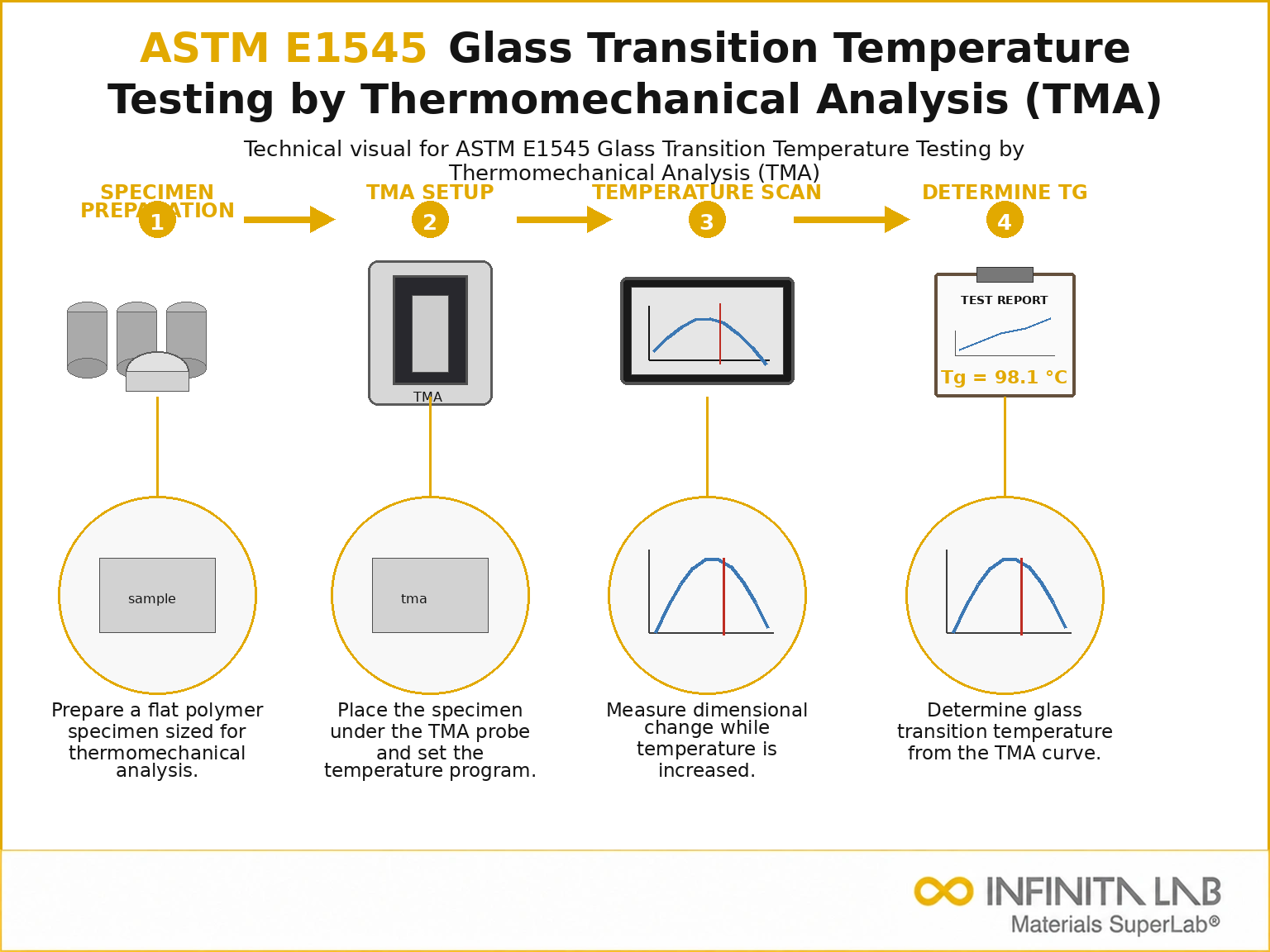
Our ASTM E1545 Testing Procedure
Sample Preparation
Material sample is prepared with required dimensions.
1Instrument Setup
Sample is placed in thermomechanical analyzer.
2Controlled Heating
Temperature is increased at a defined rate.
3Data Recording & Evaluation
Dimensional change is recorded to determine Tg.
4ASTM E1545 Test Parameters and Requirements
| Parameter | Details |
|---|---|
| Applicable Materials | Polymers, resins, composites |
| Heating Rate | Typically 2°C/min to 10°C/min |
| Load Applied | Small constant force (e.g., 0.01–0.1 N) |
| Temperature Range | Typically -50°C to 300°C |
| Measured Outputs | Measured Outputs |


- Thermomechanical Analyzer (TMA) – measures the dimensional change of the specimen as a function of temperature. It’s the core instrument of the method.
- Sensing Probe – rests on the specimen under compression, detecting softening or change in linear expansion at the glass transition.
- Programmable Furnace – heats the specimen through the transition on a controlled temperature program.
- Cooling Accessory – brings the furnace to low starting temperatures when the transition lies below ambient.
- Displacement Transducer – converts probe movement into the dimensional signal plotted against temperature.
- Reference Thermocouple – tracks specimen-zone temperature; checked during calibration of the analyzer.
Equipment and Instrumentation Used for ASTM E1545 Testing
What You Receive: Test Report, Data, and Certification
- A dimensional change versus temperature curve showing the glass transition region.
- Assigned glass transition temperature for each specimen tested.
- Test conditions stated: specimen description, probe and load, and temperature program.
- Calibration and instrument information for the analyzer used.
- A signed report from an accredited partner lab; raw data available on request.
ASTM E1545 Glass Transition TMA FAQs
ASTM E1545 is a standard test method used to determine glass transition temperature of materials using thermomechanical analysis, measuring dimensional changes as temperature varies under controlled loading conditions.
ASTM E1545 is important because glass transition temperature indicates material behavior changes, helping engineers understand flexibility, stiffness, and service temperature limits for polymers and other materials.
ASTM E1545 measures dimensional changes of a specimen under a constant load while heating, identifying the temperature at which a change in expansion rate indicates the glass transition region.
ASTM E1545 requires a thermomechanical analyzer, controlled heating system, calibrated probes, and proper sample preparation to ensure accurate and repeatable measurements.
Results are reported as glass transition temperature values, typically determined from inflection points in dimensional change curves, helping evaluate thermal performance and material suitability for applications.
Why Choose Infinita Lab for Glass Transition TMA Testing
When your Glass Transition TMA results have to hold up - for compliance, a customer audit, or an engineering decision - ASTM E1545 accuracy and an unbiased third-party report matter more than price. Infinita Lab routes your ASTM E1545 glass transition TMA testing to ISO/IEC 17025-accredited U.S. partner labs with hands-on method experience, so you get defensible data, transparent reporting, and turnaround times built around your project deadline - not ours.

Need ASTM E1545 Glass Transition TMA Testing You Can Rely On?
Send query us at hello@infinitalab.com or call us at (888) 878-3090 to learn more about our services and how we can support you.



Request a Quote
Submit your material details and receive testing procedures, pricing, and turnaround time within 24 hours.
 Quick Turnaround and Hasslefree process
 Confidentiality Guarantee
 Free, No-obligation Consultation
 100% Customer Satisfaction
