


ASTM E457: Slug Calorimeter Heat Transfer Rate Testing Services
ASTM E457 test method describes the measurement of heat transfer rate using a thermal capacitance-type calorimeter that assumes one-dimensional heat conduction into a cylindrical piece of material (slug) with known physical properties. This method is quantified by SI units as standard.
TRUSTED BY


Get ASTM E457 compliant results — request your slug calorimeter heat transfer rate testing quote
- Overview
- Scope, Applications, and Benefits
- Test Process
- Specifications
- Instrumentation
- Results and Deliverables
What Is ASTM E457 Slug Calorimeter Heat Transfer Rate?
ASTM E 457 heat transfer rate testing is the standardized test method for measuring thermal energy flux per unit area using a thermal capacitance slug calorimeter — determining heat transfer rate by measuring the temperature rise rate of a cylindrical slug of known mass, specific heat, and cross-sectional area exposed to a defined thermal environment under the assumption of one-dimensional heat conduction. ASTM E 457 defines the slug calorimeter configuration, recorder calibration procedures, steady-state environment requirements, and heat loss correction methods required to accurately determine heat transfer rate — providing aerospace engineers, thermal protection system designers, and researchers with reliable heat flux data for thermal environment characterization, material screening, and test facility calibration programs.

Applications and Benefits of ASTM E457 Slug Calorimeter Heat Transfer Rate Testing
Scope
ASTM E 457 measures heat transfer rate by exposing a thermally isolated cylindrical slug to a steady-state thermal environment and recording the temperature rise rate using a calibrated millivolt recorder — calculating heat transfer rate per unit area from the slug’s thermal capacitance (mass × specific heat) and measured temperature rise rate, then correcting for back-face heat loss using the post-exposure cooling rate.
ASTM E 457 heat transfer rate testing evaluates:
- Heat transfer rate per unit area in defined thermal environments, including plasma arc, radiant, and convective sources
- One-dimensional heat conduction assumption validity through back-face temperature monitoring
- Heat loss correction assessment by comparing the cooling rate slope to the heating rate slope per ASTM E 457
- Thermal environment steady-state verification before slug calorimeter exposure
- Repeatability and consistency of heat transfer rate measurements across multiple test exposures
Applications
- Aerospace thermal protection system material screening and heat flux environment characterization
- Plasma arc jet and high-enthalpy flow facility heat transfer rate measurement programs
- Ablative thermal protection material test environment calibration programs
- Rocket nozzle, re-entry vehicle, and hypersonic vehicle thermal environment measurement
- Research and test facility thermal environment characterization requires standardized heat flux measurement
Benefits
- Provides reliable heat transfer rate per unit area data for thermal environment characterization
- Supports test facility calibration and thermal protection material screening programs
- Identifies heat conduction loss errors through back-face temperature and cooling rate comparison
- Delivers traceable heat flux measurement records for engineering and research submissions
- Reduces thermal testing uncertainty by verifying steady-state environment conditions before exposure
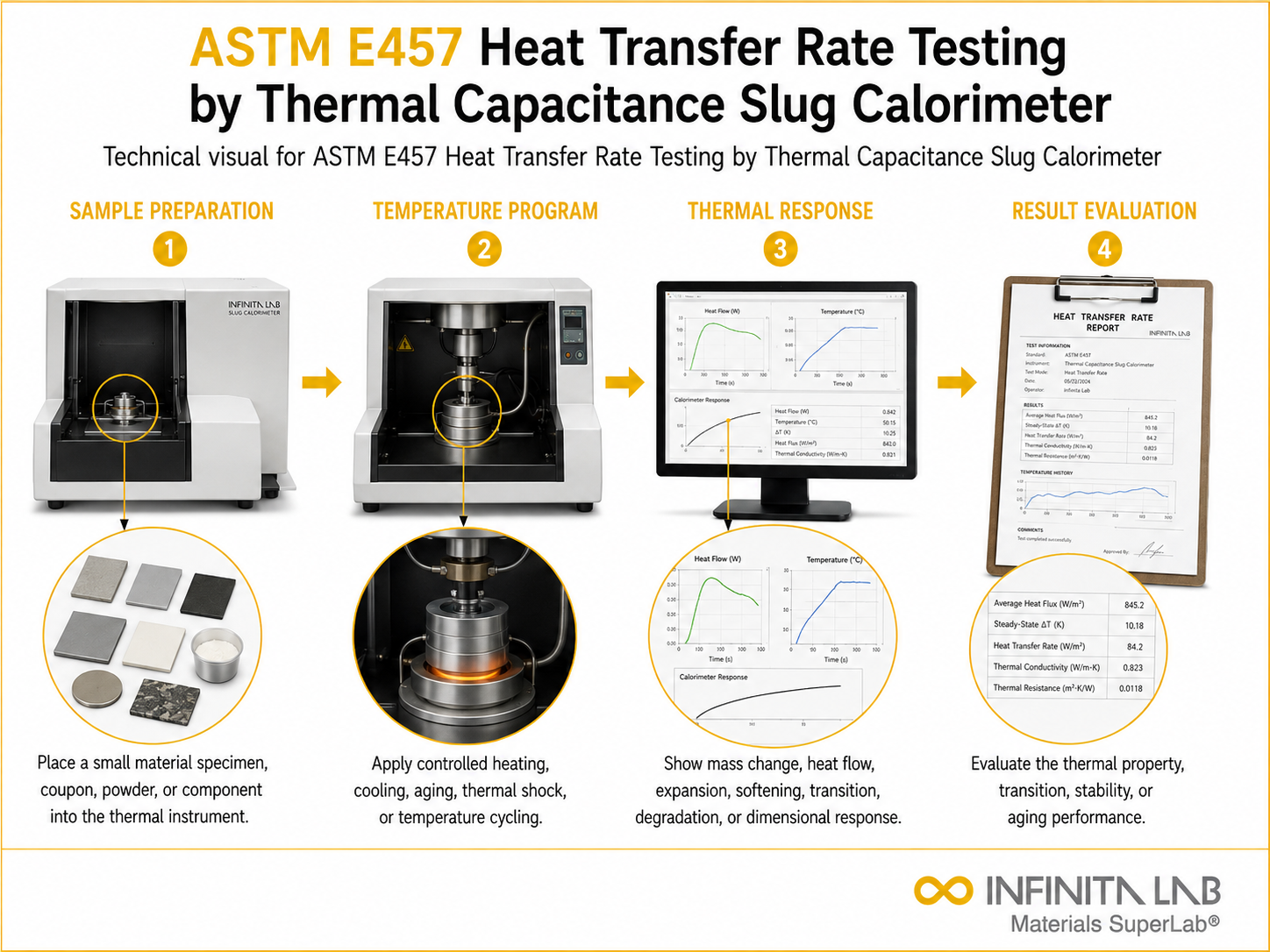
Our ASTM E457 Testing Procedure
Environment Steady-State Verification
Thermal energy source operated at steady-state conditions before slug calorimeter exposure.
1Recorder Calibration
Data recorder calibrated on millivolt scale at defined recorder speed before calorimeter exposure.
2Slug Exposure
Calorimeter exposed to thermal environment as rapidly as possible recording slug temperature rise.
3Heat Loss Correction
Post-exposure cooling rate measured and compared to heating rate slope to assess conduction losses per ASTM E 457.
4ASTM E457 Test Parameters and Requirements
| Parameter | Details |
|---|---|
| Applicable Environments | Plasma arc, radiant, convective, and combined thermal environments requiring heat flux measurement |
| Geometry | Cylindrical slug with known mass, specific heat, and cross-sectional area per ASTM E 457 |
| Heat Transfer Rate Equation | q = (m × Cp / A) × (dT/dt) where m is slug mass, Cp is specific heat, A is cross-sectional area, dT/dt is temperature rise rate |
| Recorder Calibration | Millivolt scale calibration at appropriate recorder speed before each calorimeter exposure |
| Heat Loss Assessment | Cooling rate slope compared to heating rate slope — significant discrepancy indicates conduction losses to calorimeter body |
| Measured Outputs | Heat transfer rate per unit area (W/cm² or W/m²), temperature-time trace, and test compliance result |


- Thermal capacitance slug calorimeter with a cylindrical slug of known physical properties
- Calibrated millivolt recorder with defined chart speed for temperature-time data recording
- A thermocouple attached to the slug’s back face for temperature rise and cooling rate measurement
- Steady-state thermal environment source — plasma arc jet, radiant lamp, or convective heater
- Rapid insertion mechanism for controlled calorimeter exposure to thermal environment
- Data acquisition and heat transfer rate calculation system
Equipment and Instrumentation Used for ASTM E457 Testing
What You Receive: Test Report, Data, and Certification
- Temperature-time trace data showing slug heating and post-exposure cooling rates
- Calculated heat transfer rate per unit area from slug thermal capacitance and temperature rise rate
- Heat loss correction assessment from cooling rate versus heating rate slope comparison
- Thermal environment steady-state verification records per ASTM E 457 requirements
- Test compliance result assessed against heat transfer rate measurement acceptance criteria
- ASTM E 457 heat flux measurement report for thermal environment characterization, facility calibration, and research submissions
ASTM E457 Slug Calorimeter Heat Transfer Rate FAQs
Copper is the most common ASTM E 457 slug material due to its high thermal conductivity — which minimizes internal temperature gradients ensuring the one-dimensional heat conduction assumption is valid — combined with well-characterized specific heat values and oxidation resistance under short-duration thermal exposures.
ASTM E 457 slug calorimeters accurately measure heat transfer rates from approximately 10 W/cm² to over 1000 W/cm² depending on slug material, mass, and cross-sectional area — with copper slugs most suited to lower flux ranges and tungsten or graphite slugs used for extreme heat flux environments above 500 W/cm².
Non-steady-state thermal environments produce time-varying heat flux during slug exposure — causing the measured temperature rise rate to reflect transient environment changes rather than a representative heat transfer rate, invalidating the constant dT/dt assumption underlying the ASTM E 457 thermal capacitance heat flux calculation.
ASTM E 457 compares the post-exposure cooling rate slope to the heating rate slope — significant discrepancy between these values indicates substantial lateral heat conduction losses to the calorimeter body during exposure, signaling that the one-dimensional assumption is violated and the measured heat transfer rate is underestimated.
ASTM E 457 heat flux data is used to characterize plasma arc jet test environments for ablative heat shield screening in NASA, DoD, and commercial re-entry vehicle programs — including phenolic-impregnated carbon ablator, PICA, and ceramic matrix composite thermal protection system material evaluation programs.
Why Choose Infinita Lab for Slug Calorimeter Heat Transfer Rate Testing?
At the core of this breadth is our network of 2,000+ accredited laboratories across the USA, offering access to over 10,000 testing methods and analytical services. From advanced materials characterization (SEM, TEM, RBS, XPS) to mechanical, chemical, environmental, biological, and standardized ASTM/ISO-compliant testing, we deliver unmatched flexibility, specialization, and scale. You are never limited by geography, facility, or methodology — Infinita Lab connects you to the right expertise and testing solution, every time.

Looking for an Accredited Partner for ASTM E457 Slug Calorimeter Heat Transfer Rate Testing?
Send query us at hello@infinitalab.com or call us at (888) 878-3090 to learn more about our services and how we can support you.



Request a Quote
Submit your material details and receive testing procedures, pricing, and turnaround time within 24 hours.
 Quick Turnaround and Hasslefree process
 Confidentiality Guarantee
 Free, No-obligation Consultation
 100% Customer Satisfaction
