


Scanning Acoustic Tomography SAT Testing Services
Accredited scanning acoustic tomography SAT testing from Infinita Lab, performed to the exact standard requirements - accurate, reproducible results with full documentation for compliance, R&D, and quality control programs.
TRUSTED BY


Get compliant results - request your scanning acoustic tomography SAT testing quote
- Overview
- Scope, Applications, and Benefits
- Test Process
- Specifications
- Instrumentation
- Results and Deliverables
What Is Scanning Acoustic Tomography SAT?
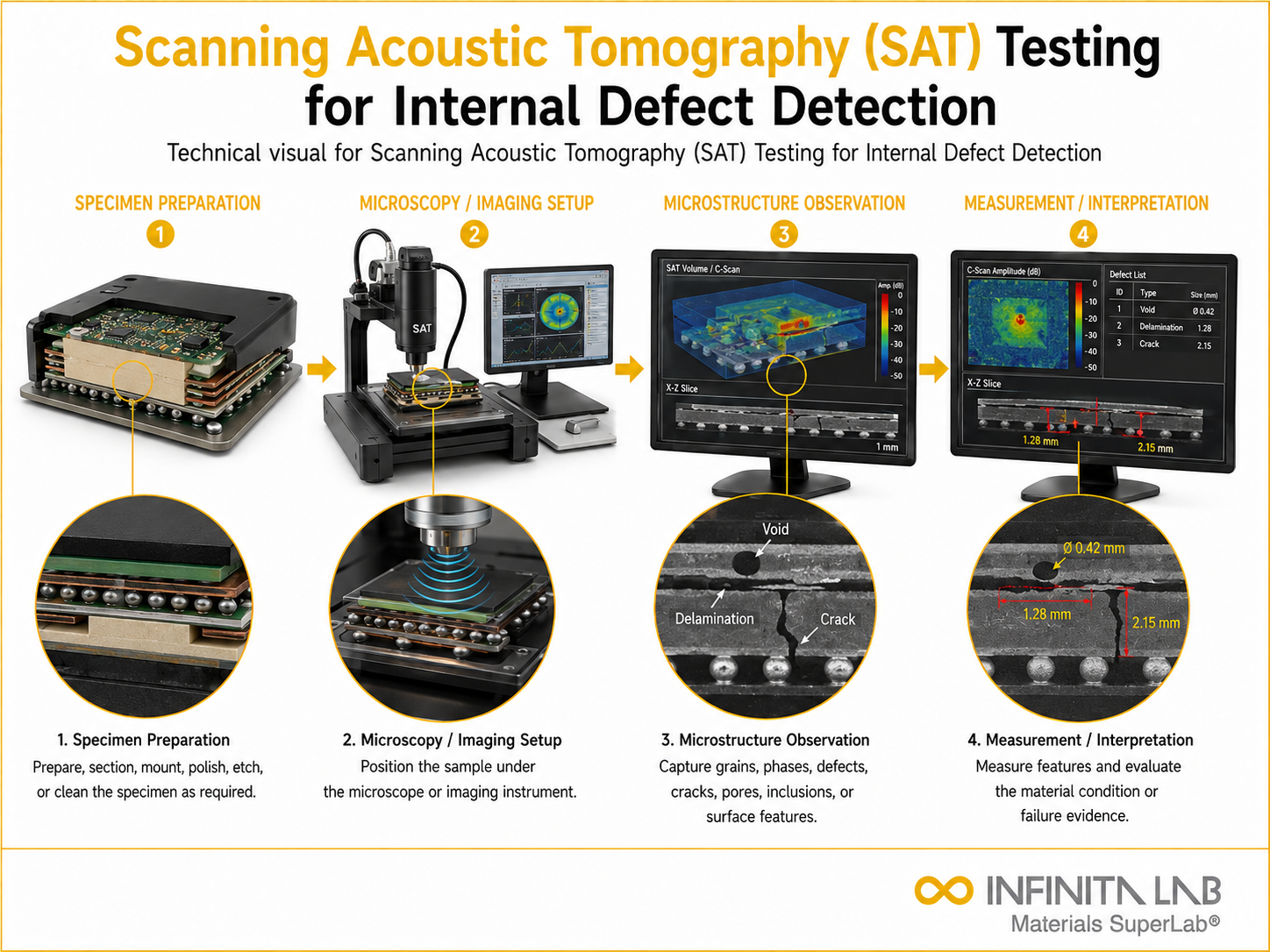
Scanning Acoustic Tomography (SAT) is a non-destructive testing technique that uses high-frequency ultrasonic waves to detect any internal defects in a material or electronic component. SAT is a non-destructive technique that creates acoustic images of a component and provides information about its internal structures without any damage to the component.
SAT is a non-destructive technique that is commonly applied to inspect semiconductor packages, electronic components, composite structures, and bonded structures. SAT is useful in detecting defects in a component, such as delamination, voids, cracks, and bonding.

Applications and Benefits of Scanning Acoustic Tomography SAT Testing
Scope
Scanning Acoustic Tomography evaluates the internal integrity of materials and electronic components using ultrasonic imaging techniques. The method enables detection of hidden defects and structural irregularities without altering or damaging the test specimen.
The scope includes:
Detection of internal defects and delamination
Inspection of semiconductor and electronic packages
Evaluation of bonding and interface integrity
Identification of voids, cracks, and inclusions
Non-destructive evaluation of composite materials
Applications
Semiconductor and microelectronic components
Printed circuit boards (PCBs)
Integrated circuit (IC) packages
Composite materials and bonded structures
Electronics manufacturing and quality control
Benefits
Non-destructive inspection method
Detects hidden internal defects
Provides high-resolution acoustic images
Improves product reliability and performance
Supports failure analysis and quality assurance
Our Testing Procedure
Sample Preparation
The specimen is cleaned and placed in the testing system, often immersed in a water medium for acoustic transmission.
1Ultrasonic Scanning
High-frequency ultrasonic waves are transmitted into the specimen using a scanning microscope.
2Signal Detection
Reflected acoustic signals from internal structures are captured by sensors.
3Image Analysis
The collected signals are processed to generate acoustic images that reveal internal defects and structural features.
4Test parameters and requirements
| Parameter | Details |
|---|---|
| Frequency Range | Typically 10–300 MHz |
| Inspection Type | Non-destructive evaluation (NDT) |
| Imaging Mode | A-scan, B-scan, and C-scan |
| Applicable Materials | Electronics, composites, bonded structures |
| Test Medium | Water or acoustic coupling liquid |
| Output Data | Acoustic images and defect mapping |


Scanning Acoustic Microscope (SAM)
Ultrasonic Transducer
Water Coupling Tank
Signal Processing Unit
Imaging and Analysis Software
Equipment and Instrumentation Used for Testing
What You Receive: Test Report, Data, and Certification
Acoustic scan images (A-scan, B-scan, C-scan)
Identification of internal defects
Delamination and void detection report
Structural integrity evaluation
Detailed inspection report with analysis
Scanning Acoustic Tomography SAT FAQs
Scanning Acoustic Tomography (SAT) is a non-destructive ultrasonic imaging technique used to inspect the internal structure of materials and electronic components. It helps detect hidden defects such as delamination, voids, cracks, and bonding issues.
SAT can detect internal defects including delamination between layers, air voids, cracks, inclusions, and poor adhesive bonding. These defects are often invisible externally but can affect the reliability and performance of electronic or composite components.
SAT testing is widely used in semiconductor, electronics manufacturing, aerospace, automotive, and composite industries. It is particularly useful for inspecting microelectronic packages, circuit boards, and layered materials where internal defects must be detected.
SAT systems typically operate with ultrasonic frequencies ranging from approximately 10 MHz to 300 MHz. Higher frequencies provide improved resolution, enabling detailed imaging of small internal features and microscopic defects.
SAT helps detect hidden internal defects during manufacturing and quality inspection. By identifying issues such as delamination or voids early, manufacturers can prevent product failures and improve long-term reliability of electronic devices.
SAT is a non-destructive testing method that uses high-frequency ultrasonic waves to inspect the internal structure of materials and electronic components. The waves reflect from internal interfaces and defects, and the returned signals are converted into images to identify voids, cracks, and delamination. This method helps assess bonding quality and detect hidden defects without damaging the specimen.
Why Choose Infinita Lab for Scanning Acoustic Tomography SAT Testing?
When your Scanning Acoustic Tomography SAT results have to hold up - for compliance, a customer audit, or an engineering decision - accuracy and an unbiased third-party report matter more than price. Infinita Lab routes your scanning acoustic tomography SAT testing to ISO/IEC 17025-accredited U.S. partner labs with hands-on method experience, so you get defensible data, transparent reporting, and turnaround times built around your project deadline - not ours.

Looking for an Accredited Partner for Scanning Acoustic Tomography SAT Testing?
Send query us at hello@infinitalab.com or call us at (888) 878-3090 to learn more about our services and how we can support you.



Request a Quote
Submit your material details and receive testing procedures, pricing, and turnaround time within 24 hours.
 Quick Turnaround and Hasslefree process
 Confidentiality Guarantee
 Free, No-obligation Consultation
 100% Customer Satisfaction
