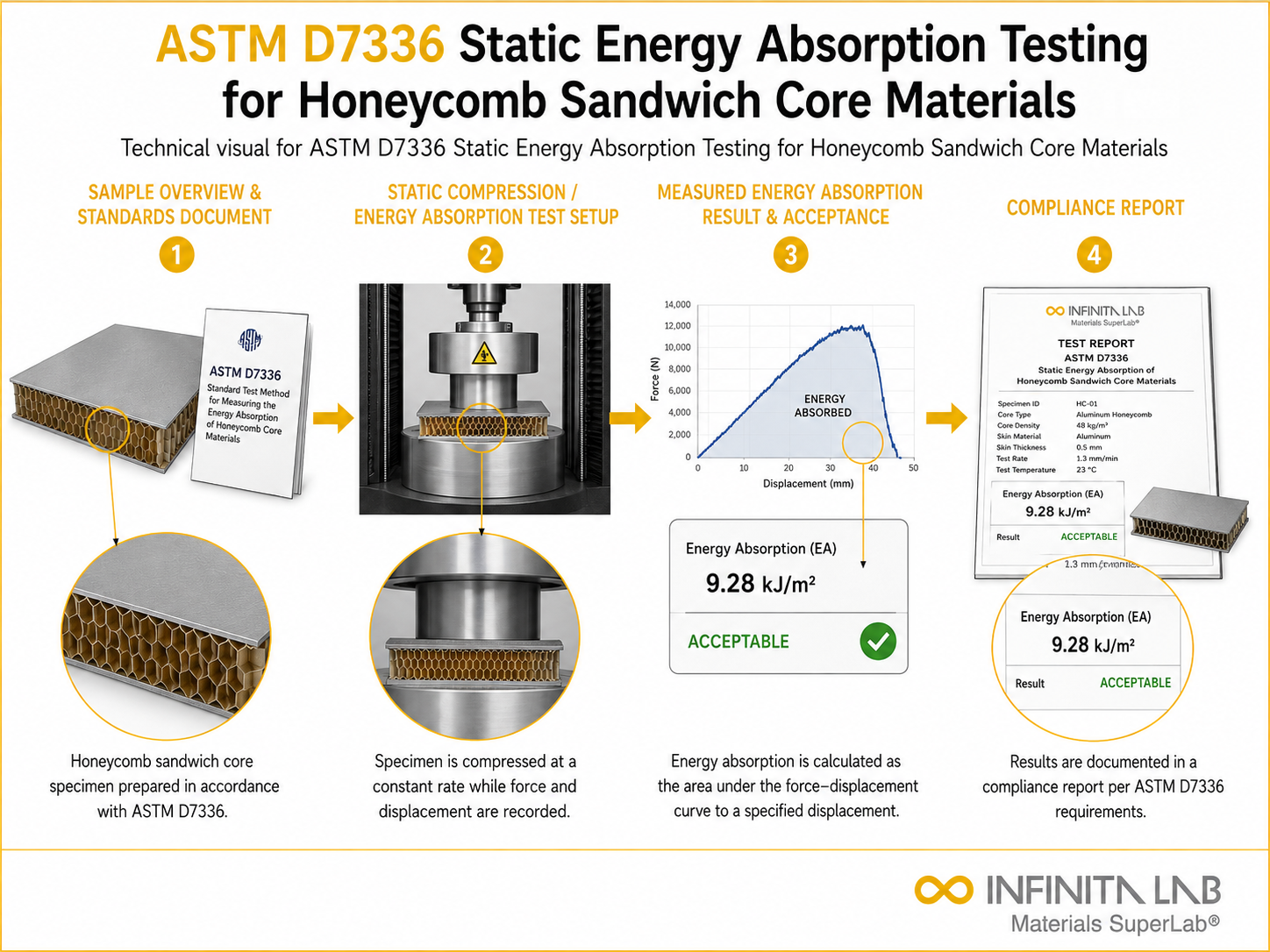


What Is ASTM D7336 Honeycomb Sandwich Core Energy Absorption?
ASTM D7336 describes a test method for determining the static energy absorption properties of honeycomb sandwich core materials under uniaxial compressive loading. As honeycomb cores crush progressively under impact or quasi-static load, they absorb energy — a property critical for crashworthy structures in aerospace, automotive, and transportation applications.
This test characterizes the plateau stress, crush efficiency, and total energy absorbed per unit volume of honeycomb core, enabling material selection for protective and energy-absorbing structural designs.

Applications and Benefits of ASTM D7336 Honeycomb Sandwich Core Energy Absorption Testing
Scope
ASTM D7336 applies to honeycomb cores made from metallic or non-metallic materials and determines:
- Initial peak crush stress
- Plateau stress during progressive crushing
- Crush efficiency and specific energy absorption
- Total energy absorbed up to defined crush strain
Applications
- Aircraft seat and floor structure crashworthiness design
- Automotive side door, bumper, and crush zone energy absorbers
- Protective packaging energy absorption characterization
- Rail vehicle and bus structural impact protection
- Space vehicle landing and parachute touchdown cushioning
Benefits
- Provides complete energy absorption characterization under controlled quasi-static crush
- Enables comparison of honeycomb materials for energy absorption efficiency
- Supports design of passive safety systems with predictable crush response
- Applicable to aluminum, aramid (Nomex), thermoplastic, and other honeycomb types
- Complements dynamic impact test data with quasi-static baseline properties
Our ASTM D7336 Testing Procedure
Specimen Preparation
Honeycomb core specimens of defined height (typically 50–75 mm) are cut with faces perpendicular to the crush direction (L or W core axis).
1Compressive Loading
The specimen is compressed between rigid platens at a slow rate (≈5–10 mm/min) to a set strain.
2Load-Displacement Recording
Load and displacement are recorded during crushing and converted to stress–strain data.
3Energy Absorption Calculation
Energy per unit volume is calculated from the stress–strain curve area, and crush efficiency is the ratio of average plateau stress to peak stress.
4ASTM D7336 Test Parameters and Requirements
| Parameter | Details |
|---|---|
| Standard | ASTM D7336 |
| Test Principle | Quasi-static uniaxial compression to defined crush strain |
| Applicable Materials | Metallic, aramid, thermoplastic honeycomb core |
| Loading Rate | 5–10 mm/min (quasi-static) |
| Crush Strain | Typically 50–70% of original height |
| Measured Outputs | Peak stress (MPa), plateau stress, SEA (J/cm³), crush efficiency |


- Universal compression testing machine with large-capacity load cell
- Rigid, flat platens sized to cover specimen footprint
- Crosshead displacement measurement system
- High-resolution data acquisition for load-displacement recording
- Calipers and balance for specimen dimension and density measurement
Equipment and Instrumentation Used for ASTM D7336 Testing
What You Receive: Test Report, Data, and Certification
- Load-displacement and stress-strain curves
- Initial peak stress and plateau stress values
- Specific energy absorption (SEA in J/g or J/cm³)
- Crush efficiency as percentage
- Comparison to design target values and alternative material data
ASTM D7336 Honeycomb Sandwich Core Energy Absorption FAQs
Plateau stress is the relatively constant stress level maintained during the progressive, stable crushing phase after the initial peak — it represents the useful energy-absorbing region of the stress-strain curve.
The initial peak corresponds to the elastic buckling load of the honeycomb cell walls; after cells buckle, they fold progressively at a lower load level, creating the plateau region.
SEA normalizes absorbed energy by mass, enabling fair comparison between different material types and densities; higher SEA indicates more efficient energy absorption per unit weight — critical for lightweight aerospace and automotive design.
Yes — the L-direction (ribbon direction) typically provides 20–30% higher crush strength and energy absorption than the W-direction due to cell wall geometry differences.
Quasi-static crush data provides baseline energy absorption properties; dynamic effects (strain rate hardening) generally increase crush strength at higher impact velocities, so quasi-static values are often conservative for impact design.
A honeycomb core flat crush test evaluates the resistance of honeycomb material to crushing under compressive loading. The specimen is placed between parallel compression platens, and a testing machine applies a controlled force. The load and deformation are recorded to assess crushing strength and energy absorption, depending on the test method. ASTM D7336/D7336M addresses static energy absorption of honeycomb sandwich core materials.
A honeycomb compression test measures the ability of a core material to withstand compressive forces. The specimen is positioned between loading platens and compressed in a specified direction while force and deformation are measured. The results help determine compressive strength and, where applicable, compression modulus for structural design and quality control. ASTM C365/C365M covers flatwise compressive properties of sandwich cores, including honeycomb cores.
Why Choose Infinita Lab for Honeycomb Sandwich Core Energy Absorption Testing
When your Honeycomb Sandwich Core Energy Absorption results have to hold up - for compliance, a customer audit, or an engineering decision - ASTM D7336 accuracy and an unbiased third-party report matter more than price. Infinita Lab routes your ASTM D7336 honeycomb sandwich core energy absorption testing to ISO/IEC 17025-accredited U.S. partner labs with hands-on method experience, so you get defensible data, transparent reporting, and turnaround times built around your project deadline - not ours.

Looking for an Accredited Partner for ASTM D7336 Honeycomb Sandwich Core Energy Absorption Testing?
Send query us at hello@infinitalab.com or call us at (888) 878-3090 to learn more about our services and how we can support you.





