


ASTM D2583: Barcol Hardness Testing Services
ASTM D2583, the Barcol Hardness Test, is a specialized standard for professionals assessing the hardness of plastics and softer metals. This guide provides a clear, accessible overview of the test, emphasizing its practical applications and procedural essentials, ensuring compliance and accuracy in material testing.
TRUSTED BY


Get ASTM D2583 compliant results — request your barcol hardness testing quote
- Overview
- Scope, Applications, and Benefits
- Test Process
- Specifications
- Instrumentation
- Results and Deliverables
What Is ASTM D2583 Barcol Hardness?
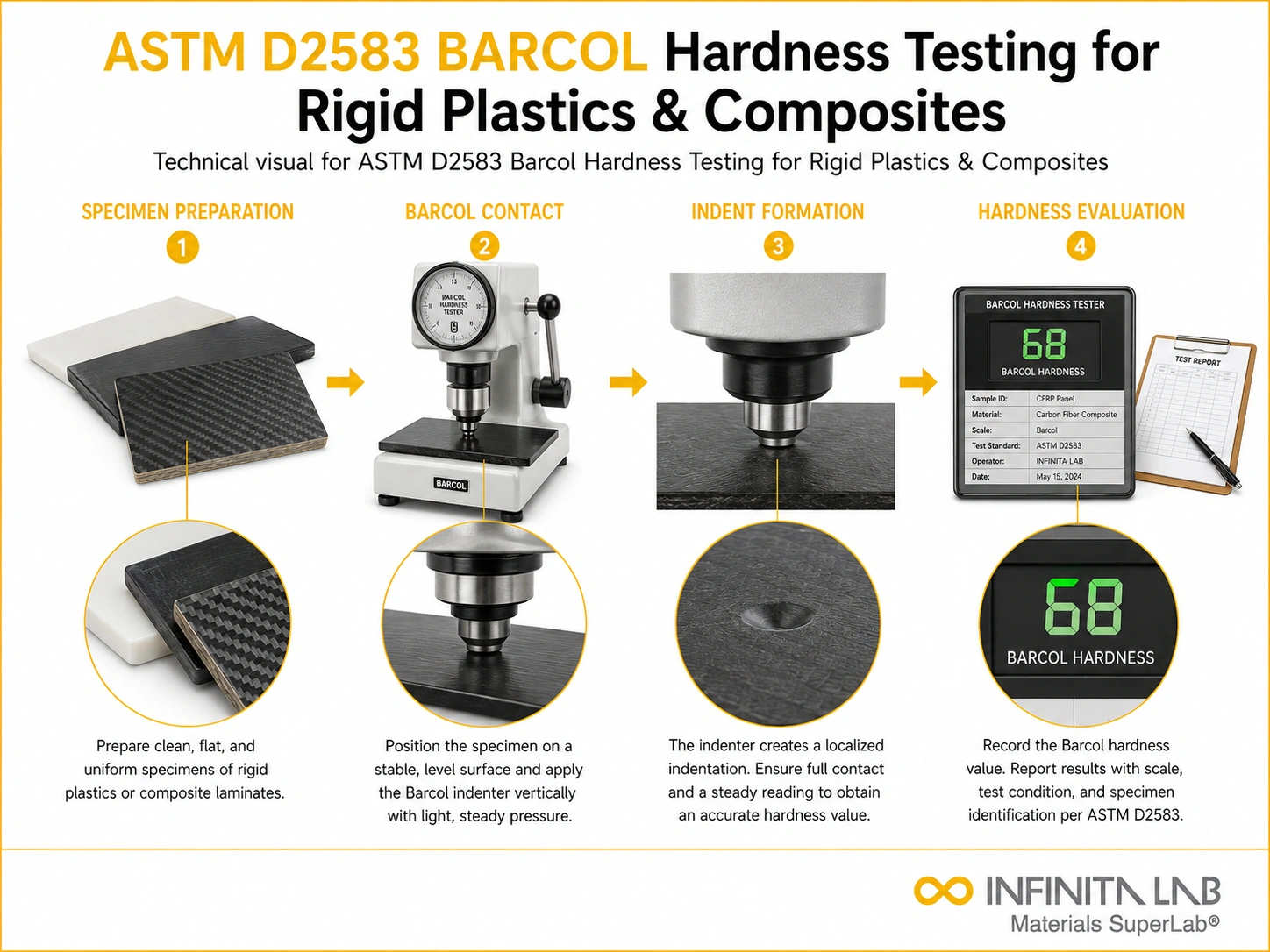
ASTM International ASTM D2583 describes a procedure for testing the Barcol hardness of reinforced and unreinforced rigid plastics using a portable indentation test device called a Barcol hardness impressor. The test involves measuring the resistance of the test material’s surface to indentation by a spring force, giving a rapid indication of the hardness of the test material.
The test procedure is often utilized for testing fiber-reinforced plastics, thermosets, and composite laminates. The test device is portable and simple to operate, and the test procedure can be performed in the field and in the laboratory. The test procedure is often utilized for assessing the curing status of composite materials, product quality, and uniformity of composite products like tanks, pipes, and panels.

Applications and Benefits of ASTM D2583 Barcol Hardness Testing
Scope
ASTM D2583 covers the determination of hardness of rigid plastics using a Barcol hardness impressor.
The method is suitable for both reinforced and unreinforced plastic materials, especially composites used in industrial applications.
The scope includes:
Measurement of Barcol hardness of rigid plastics
Testing of fiber-reinforced plastic (FRP) composites
Evaluation of degree of cure in thermoset resins
Hardness measurement of laminates and molded parts
Quality control and material comparison
Applications
- Cure verification of polyester, epoxy, and vinyl ester laminates
- Wind turbine blade cure QC during manufacture and post-cure
- Marine hull, deck, and vessel inspection — new build and refit
- Chemical storage tank acceptance testing (FRP and dual-laminate tanks)
- RTM and VARTM process control — verifying cure before demoulding
- Pultruded fiberglass profile QC — structural sections, ladders, gratings
Benefits
- Quick, portable hardness testing — readings in seconds with a hand-held impressor
- Reliable indicator of resin cure in polyester, epoxy, and vinyl ester laminates
- Minimal sample preparation — no machining, conditioning, or specimen cutting required
- Suitable for both laboratory QC and on-site field inspection of large FRP parts
- Non-destructive — leaves only a microscopic indentation, allowing testing on production parts
Our ASTM D2583 Testing Procedure
Specimen Preparation
The specimen surface is cleaned and ensured to be smooth and rigid enough for accurate hardness measurement.
1Instrument Setup
The Barcol hardness impressor is calibrated and positioned perpendicular to the specimen surface.
2Hardness Measurement
The impressor is pressed against the specimen, allowing the indenter to penetrate the surface under a spring-loaded force.
3Reading and Recording Results
The hardness value is read directly from the instrument scale and recorded as the Barcol hardness number.
4ASTM D2583 Test Parameters and Requirements
| Parameter | Details |
|---|---|
| Applicable Materials | Rigid plastics, reinforced thermoset composites, cured FRP laminates, gel coats |
| Indenter Type | Truncated steel cone |
| Indenter Geometry | 26° half-angle, 0.157 mm tip radius |
| Spring Force | 9.8 N (1 kgf) |
| Hardness Scale Range | 0 to 100 Barcol |
| Minimum Specimen Thickness | Approximately 3 mm |
| Minimum Indent Spacing | 3 mm |
| Minimum Number of Readings | 10 per ASTM D2583 |
| Measurement Principle | Depth of penetration of spring-loaded indenter |
| Reported Output | Average Barcol hardness number with standard deviation |


- Barcol GYZJ 935 portable hardness impressor (or GYZJ 934-1 for softer materials)
- Aluminum reference verification disks (supplied with instrument)
- Specimen support fixture for thin laminates
- Cleaning solvent and lint-free wipes for surface preparation
- Calibration certificate traceable to ASTM D2583 reference standards
Equipment and Instrumentation Used for ASTM D2583 Testing
What You Receive: Test Report, Data, and Certification
ASTM D2583 Barcol Hardness FAQs
ASTM D2583 evaluates the indentation hardness of reinforced plastics and rigid polymer composites, helping determine surface hardness and indirectly assess the curing condition of thermosetting resins.
Barcol hardness testing is commonly used during manufacturing and field inspections of fiberglass laminates, composite panels, and reinforced plastic structures to quickly verify proper curing and material consistency.
Industries such as marine, construction, automotive, and chemical processing frequently use ASTM D2583 to evaluate fiberglass-reinforced plastics, storage tanks, pipelines, and other composite structures.
Hardness values are reported directly on the Barcol scale, which reflects the resistance of the material surface to indentation by the impressor’s indenter under controlled spring force.
Barcol hardness testing offers a quick, portable, and non-destructive method to evaluate composite materials, making it useful for on-site inspections and rapid quality control checks.
Why Choose Infinita Lab for Barcol Hardness Testing
At the core of this breadth is our network of 2,000+ accredited laboratories across the USA, offering access to over 10,000 testing methods and analytical services. From advanced materials characterization (SEM, TEM, RBS, XPS) to mechanical, chemical, environmental, biological, and standardized ASTM/ISO-compliant testing, we deliver unmatched flexibility, specialization, and scale. You are never limited by geography, facility, or methodology — Infinita Lab connects you to the right expertise and testing solution, every time.

Need ASTM D2583 Barcol Hardness Testing You Can Rely On?
Send query us at hello@infinitalab.com or call us at (888) 878-3090 to learn more about our services and how we can support you.



Request a Quote
Submit your material details and receive testing procedures, pricing, and turnaround time within 24 hours.
 Quick Turnaround and Hasslefree process
 Confidentiality Guarantee
 Free, No-obligation Consultation
 100% Customer Satisfaction
