


ASTM F2877 Structural Insulation Fire Testing for Steel Class Divisions
The ASTM F2877 method is specific for evaluating insulation installed on structural aluminum or steel divisions, as defined in IMO resolution A.754 (18), to ensure that the insulation does not deteriorate in the event of a shock. The values are stated in inch-pound units.
TRUSTED BY


Precision-driven testing for dimensional accuracy and compliance
- Overview
- Scope, Applications, and Benefits
- Test Process
- Specifications
- Instrumentation
- Results and Deliverables
Overview
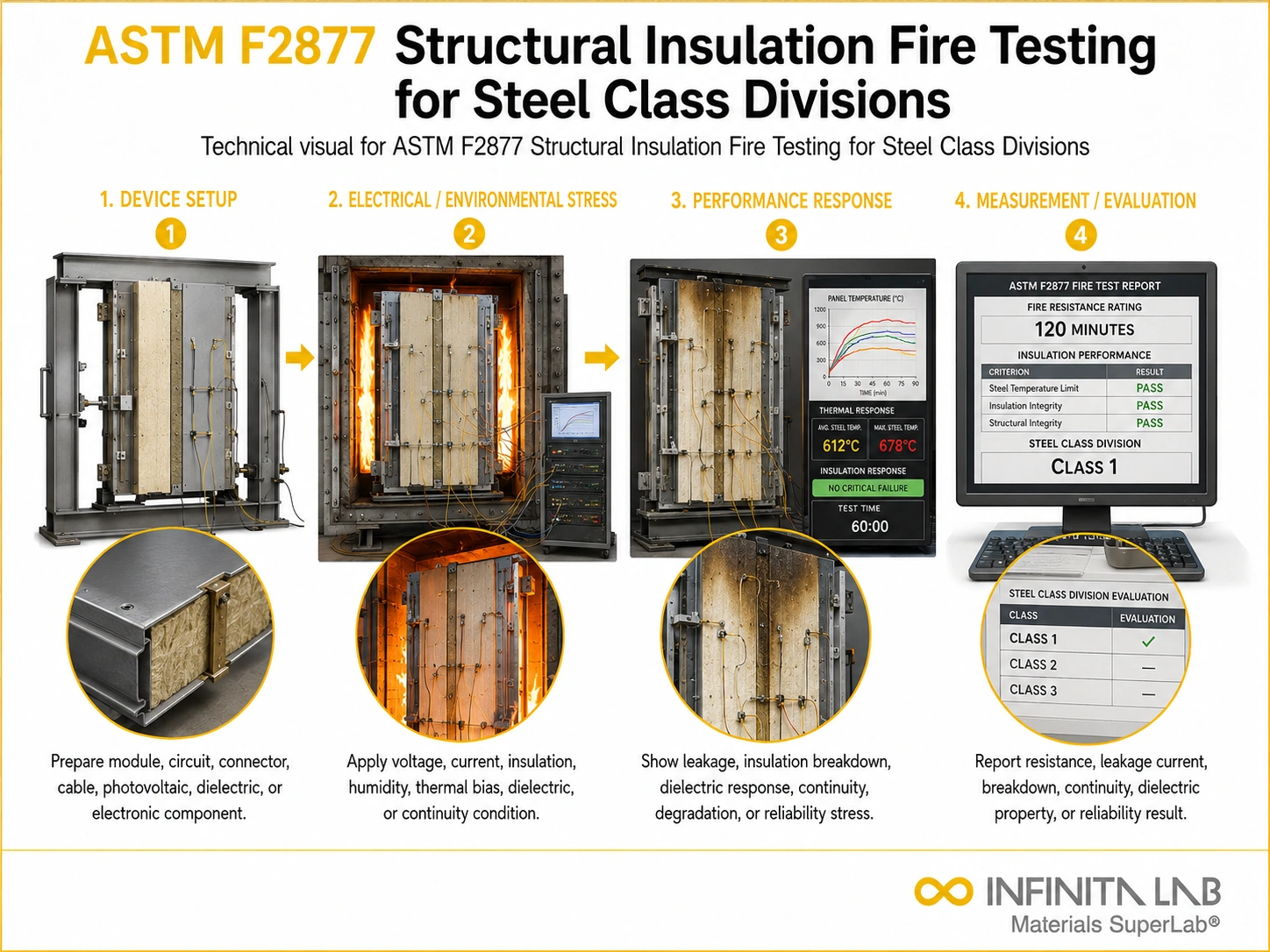
ASTM F2877 is used to evaluate the fire resistance performance of structural insulation systems applied to A-class divisions constructed of steel or aluminum. The test determines how effectively insulated bulkheads or deck assemblies limit heat transfer and maintain structural integrity during fire exposure.
This method is commonly applied in marine and offshore applications where fire-rated divisions are required to prevent the spread of fire and heat. The test helps assess insulation performance under standardized fire conditions and supports material selection for fire-protected structural assemblies.

Scope, Applications, and Benefits
Scope
ASTM F2877 evaluates the fire resistance of insulated A-class divisions by exposing steel or aluminum structures with insulation systems to controlled fire conditions. The test determines the assembly’s ability to limit temperature rise and maintain its integrity during fire exposure.
ASTM F2877 evaluates:
- Fire resistance of insulated structural divisions
- Heat transfer through insulated steel or aluminum assemblies
- Temperature rise on the unexposed surface
- Performance of insulation systems under fire conditions
- Structural integrity during fire exposure
Applications
- Marine vessel bulkheads and deck divisions
- Offshore platforms and structures
- Shipbuilding and naval construction
- Fire-rated partitions in industrial facilities
- Insulated structural panels
- Fire protection systems for metallic structures
Benefits
- Provides standardized fire resistance evaluation of insulated structures
- Helps assess thermal insulation performance under fire exposure
- Supports compliance with fire safety requirements in marine applications
- Assists in selecting suitable insulation systems
- Enables comparison of fire-resistant structural assemblies
Test Process
Sample Preparation
Steel or aluminum structural assemblies are constructed with the insulation system applied as per specification.
1Fire Exposure
The assembly is exposed to controlled fire conditions following a defined temperature-time curve.
2Temperature Monitoring
Temperatures on the unexposed surface are measured during fire exposure to assess heat transfer.
3Data Recording & Evaluation
The assembly is evaluated for temperature rise, insulation performance, and structural integrity.
4Technical Specifications
| Parameter | Details |
|---|---|
| Applicable Materials | Steel or aluminum structures with insulation systems |
| Assembly Type | A-class divisions (bulkheads and decks) |
| Fire Exposure | Standardized fire resistance furnace conditions |
| Evaluation Criteria | Temperature rise and structural integrity |
| Monitoring Requirement | Unexposed surface temperature measurement |
| Measured Outputs | Fire resistance performance and insulation effectiveness |


- Fire-resistant furnace
- Temperature monitoring sensors (thermocouples)
- Structural mounting and support system
- Insulation installation tools
- Data acquisition and recording system
- Observation and measurement equipment
Instrumentation Used for Testing
Results and Deliverables
- Temperature rise measurement data
- Fire resistance performance results
- Insulation effectiveness evaluation
- Structural integrity observations
- Test condition summary
- ASTM compliance report
Frequently Asked Question
ASTM F2877 includes fire exposure duration up to 60 minutes, temperature rise limits on unexposed surface, insulation thickness, material type, and structural integrity, ensuring A-Class divisions maintain fire resistance in marine environments.
ASTM F2877 applies to steel or aluminum bulkheads with insulation systems, including mineral wool, ceramic fibers, and composite insulation materials designed to provide fire protection.
ASTM F2877 defines requirements for limiting temperature rise, maintaining structural integrity, and preventing flame passage during fire exposure for specified durations.
ASTM F2877 is used in marine vessels, offshore platforms, and shipbuilding where A-Class divisions are required to provide fire-resistant separation between compartments.
ASTM F2877 evaluates fire performance under controlled furnace conditions and may not fully represent real fire scenarios involving structural movement, ventilation changes, or combined material systems affecting insulation performance.
Why Choose Infinita Lab for Advanced Materials Testing and Characterization?
At the core of this breadth is our network of 2,000+ accredited laboratories across the USA, offering access to over 10,000 testing methods and analytical services. From advanced materials characterization (SEM, TEM, RBS, XPS) to mechanical, chemical, environmental, biological, and standardized ASTM/ISO-compliant testing, we deliver unmatched flexibility, specialization, and scale. You are never limited by geography, facility, or methodology — Infinita Lab connects you to the right expertise and testing solution, every time.

Looking for a Trusted Partner for Accurate and Reliable Testing Services?
Send query us at hello@infinitalab.com or call us at (888) 878-3090 to learn more about our services and how we can support you.



Request a Quote
Submit your material details and receive testing procedures, pricing, and turnaround time within 24 hours.
 Quick Turnaround and Hasslefree process
 Confidentiality Guarantee
 Free, No-obligation Consultation
 100% Customer Satisfaction
