


ASTM C329: Fired Ceramic Whiteware Specific Gravity Testing Services
ASTM C329 is used to determine the Specific Gravity of Fired Ceramic Whiteware Materials under a given condition. Specific gravity is the ratio of the density of a substance to the density of a standard.
TRUSTED BY


Get ASTM C329 compliant results — request your fired ceramic whiteware specific gravity testing quote
- Overview
- Scope, Applications, and Benefits
- Test Process
- Specifications
- Instrumentation
- Results and Deliverables
What Is ASTM C329 Fired Ceramic Whiteware Specific Gravity?
ASTM C329 defines a standardized method for determining the specific gravity of fired ceramic whiteware materials. Specific gravity reflects the density of the material relative to water and is a key indicator of porosity, composition, and overall material quality after firing.
This test is essential for evaluating the physical properties of ceramic products such as tiles, porcelain, and sanitaryware. By measuring specific gravity, ASTM C329 helps manufacturers assess firing efficiency, detect defects, and ensure consistency in finished ceramic materials.

Applications and Benefits of ASTM C329 Fired Ceramic Whiteware Specific Gravity Testing
Scope
ASTM C329 outlines procedures for determining the specific gravity of fired ceramic whiteware materials using immersion techniques under controlled conditions.
- Applicable to fired ceramic whiteware materials
- Determines specific gravity relative to water
- Uses immersion and weight measurement methods
- Includes sample preparation and conditioning
- Ensures accurate and repeatable measurements
- Supports quality control and product evaluation
Applications
- Ceramic tiles and porcelain products
- Sanitaryware and tableware materials
- Fired ceramic quality control
- Material property evaluation
- Production process monitoring
- Research and development of ceramic bodies
Benefits
- Provides accurate specific gravity values
- Helps evaluate porosity and densification
- Supports consistency in ceramic production
- Detects defects and processing issues
- Enhances quality control processes
- Enables reliable comparison of materials
Our ASTM C329 Testing Procedure
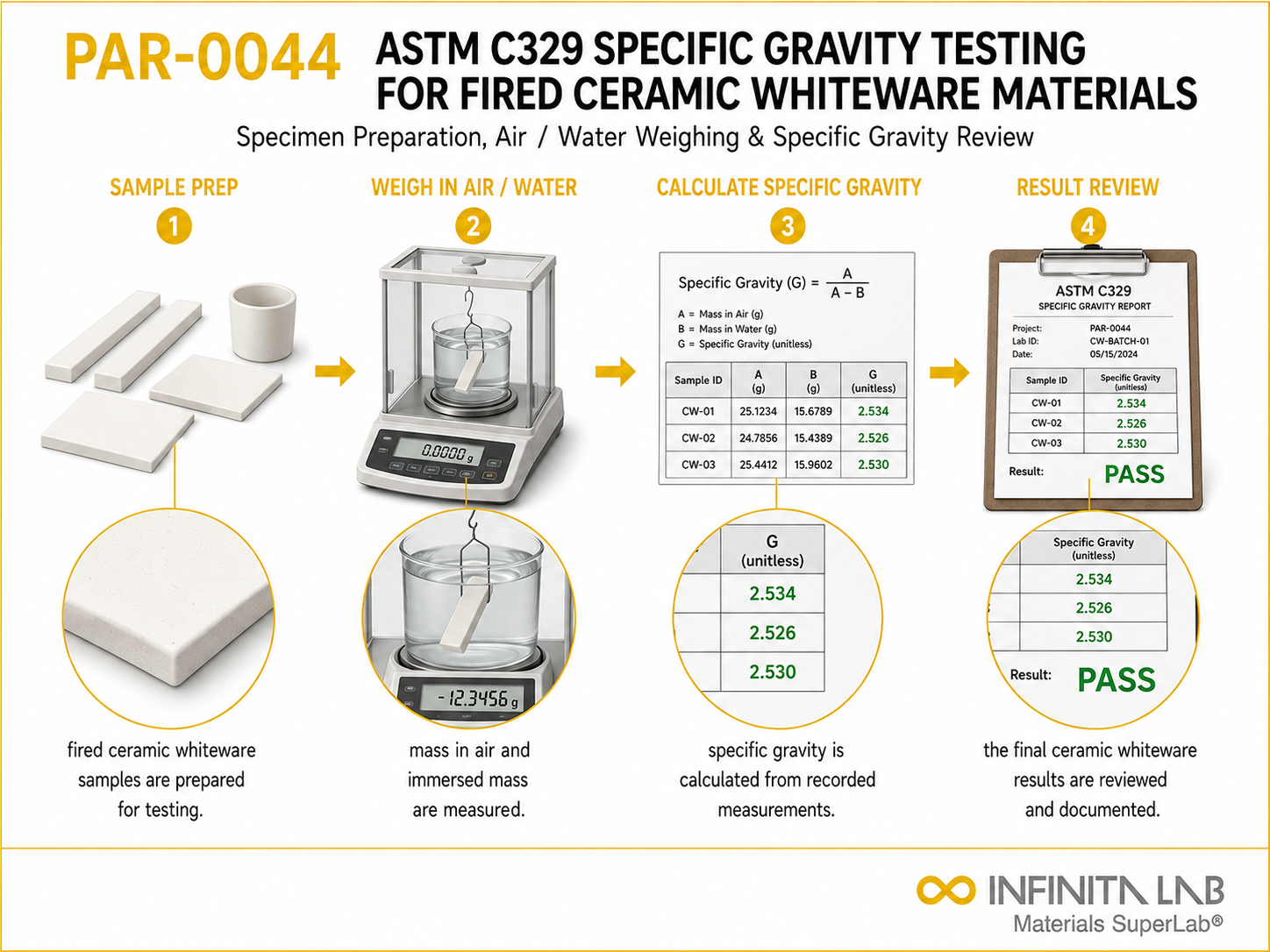
Specimen Preparation
Clean and dry the fired ceramic specimen to remove contaminants.
1Dry Weight Measurement
Weigh the specimen in air using a calibrated balance.
2Immersion Measurement
Weigh the specimen while submerged in water to determine buoyant force.
3Specific Gravity Calculation
Calculate specific gravity using dry and immersed weight values.
4ASTM C329 Test Parameters and Requirements
| Parameter | Details |
|---|---|
| Material Type | Fired ceramic whiteware |
| Measurement Parameter | Specific gravity |
| Units | Dimensionless ratio |
| Sample Condition | Clean, dry, and fully fired |
| Measurement Accuracy | High precision weight measurement |
| Test Environment | Ambient laboratory conditions |
| Medium | Water (for immersion) |
| Output Data | Calculated specific gravity value |


- Analytical balance with immersion setup
- Water container or immersion tank
- Suspension wire or basket
- Drying oven
- Cleaning tools for specimen preparation
- Data recording system
Equipment and Instrumentation Used for ASTM C329 Testing
What You Receive: Test Report, Data, and Certification
- Specific gravity values of ceramic material
- Dry and immersed weight measurements
- Assessment of material density and porosity
- Quality verification of fired products
- Comparative analysis of samples
- Detailed test report with calculations
ASTM C329 Fired Ceramic Whiteware Specific Gravity FAQs
Specific gravity defines how dense or heavy the ceramic materials are, which also ensures uniformity and dependability in the use of the materials.
Higher porosity reduces specific gravity because void spaces decrease overall density. Lower porosity results in higher specific gravity and better material strength.
Since temperature affects water density, the readings are strictly at certain limits (t1 and t2).
Factors include air bubbles during immersion, improper drying, and measurement errors, which must be controlled for reliable results.
It helps manufacturers monitor density, improve firing processes, reduce defects, and ensure consistent production of high-quality ceramic materials that meet industry standards and performance expectations.
Why Choose Infinita Lab for Fired Ceramic Whiteware Specific Gravity Testing
At the core of this breadth is our network of 2,000+ accredited laboratories across the USA, offering access to over 10,000 testing methods and analytical services. From advanced materials characterization (SEM, TEM, RBS, XPS) to mechanical, chemical, environmental, biological, and standardized ASTM/ISO-compliant testing, we deliver unmatched flexibility, specialization, and scale. You are never limited by geography, facility, or methodology — Infinita Lab connects you to the right expertise and testing solution, every time.

Looking for an Accredited Partner for ASTM C329 Fired Ceramic Whiteware Specific Gravity Testing?
Send query us at hello@infinitalab.com or call us at (888) 878-3090 to learn more about our services and how we can support you.



Request a Quote
Submit your material details and receive testing procedures, pricing, and turnaround time within 24 hours.
 Quick Turnaround and Hasslefree process
 Confidentiality Guarantee
 Free, No-obligation Consultation
 100% Customer Satisfaction
