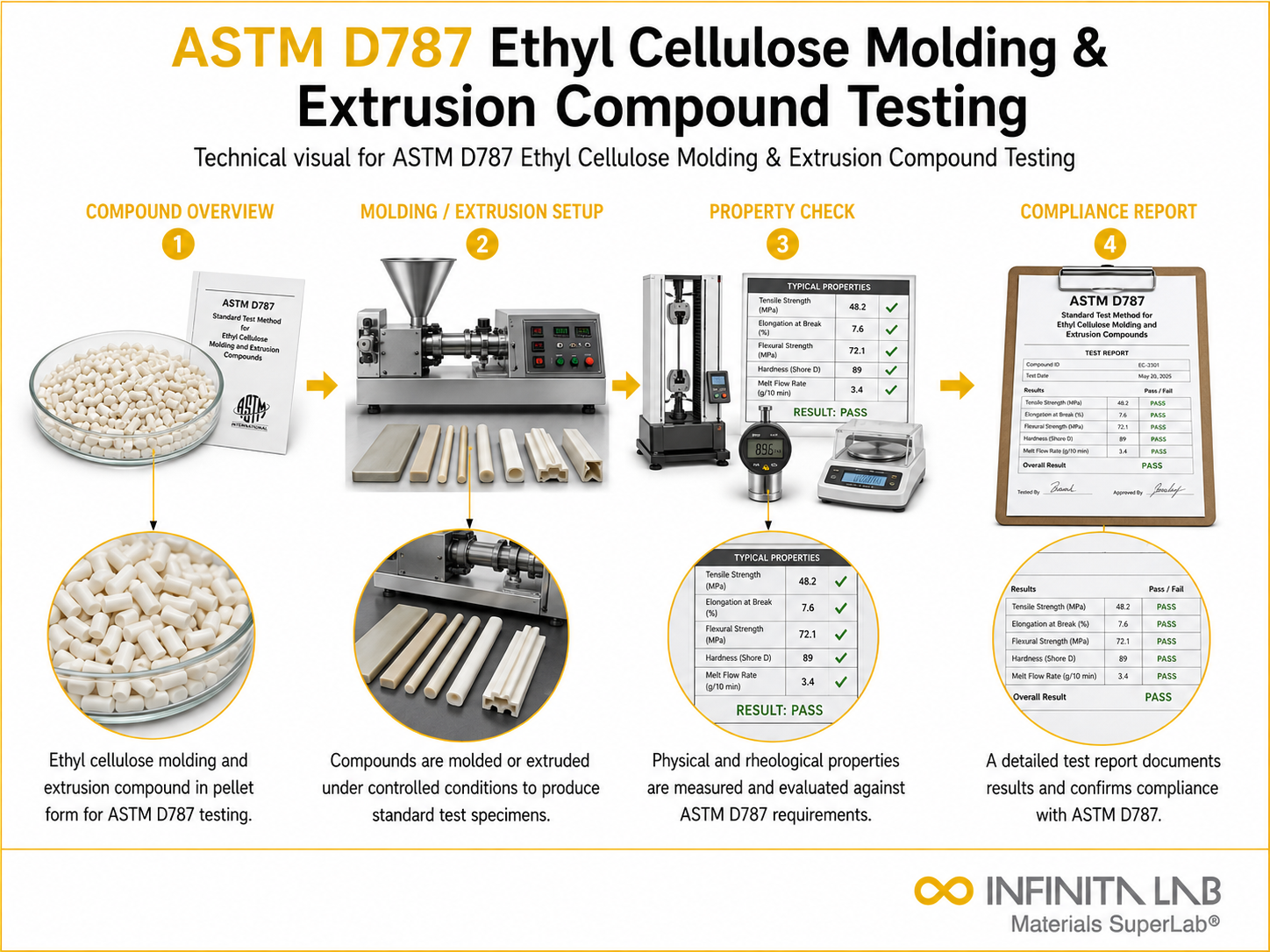


Overview
ASTM D 787 testing is the standard material specification and test method for ethyl cellulose molding and extrusion compounds. It evaluates the physical, mechanical, and thermal properties required to classify and confirm the performance of ethyl cellulose compounds for industrial, consumer, and specialty product applications. ASTM D 787 outlines the property requirements, test procedures, and classification criteria necessary to ensure that ethyl cellulose compounds meet minimum performance standards for material approval, incoming inspection, and product design validation programs.

Scope, Applications, and Benefits
Scope
ASTM D 787 classifies and evaluates ethyl cellulose compounds by measuring a specific set of physical and mechanical properties, including flow rate, tensile strength, flexural properties, impact resistance, and thermal characteristics. This process helps material suppliers, processors, and end users confirm that the compound meets the classification and acceptance requirements of ASTM D 787.
ASTM D 787 testing evaluates:
- Melt flow rate and processing characteristics of ethyl cellulose molding and extrusion compounds
- Tensile strength, elongation, and mechanical performance of ethyl cellulose material specimens
- Flexural strength and modulus of ethyl cellulose compounds under defined loading conditions
- Impact resistance and notched Izod performance of ethyl cellulose molding compounds
- Thermal and physical property compliance against ASTM D 787 classification requirements
Applications
- Industrial tool handles, knobs, and mechanical component assemblies
- Consumer product housings, closures, and decorative component applications
- Electrical insulation and specialty component applications requiring ethyl cellulose materials
- Flexible packaging and specialty film applications requiring ethyl cellulose compound data
- Material suppliers and compounders requiring ASTM D 787 product verification
Benefits
- Supports ASTM D 787 material approval and product specification compliance
- Provides verified physical and mechanical test data for material supply agreements
- Identifies ethyl cellulose compound property deficiencies before production processing
- Delivers traceable test records aligned with ASTM D 787 classification requirements
- Reduces production risk by verifying compound performance early in the approval cycle
Test Process
Sample Preparation
Ethyl cellulose specimens molded or conditioned per ASTM D 787 requirements.
1Physical & Mechanical Testing
Specimens tested for tensile, flexural, impact, and flow properties.
2Thermal & Flow Characterization
Melt flow rate and thermal properties measured under ASTM D 787 conditions.
3Data Analysis & Reporting
Measured properties compared against ASTM D 787 criteria to determine test compliance result.
4Technical Specifications
| Parameter | Details |
|---|---|
| Applicable Materials | Ethyl cellulose molding and extrusion compounds |
| Specimen Geometry | Defined specimen dimensions per ASTM D 787 requirements |
| Specimen Conditioning | Pre-test conditioning per ASTM D 787 temperature and humidity requirements |
| Measured Parameters | Tensile strength, flexural modulus, impact resistance, melt flow rate, thermal properties |
| Measured Outputs | Physical, mechanical, thermal property data, and test compliance result |


- Universal testing machine for tensile and flexural property measurement
- Notched Izod impact testing apparatus per ASTM D 256
- Melt flow indexer for ethyl cellulose compound flow rate characterization
- Specimen conditioning chamber with temperature and humidity control
- Precision dimensional measurement tools for specimen verification
- Data acquisition and test reporting system
Instrumentation Used for Testing
Results and Deliverables
- Physical and mechanical property test data for all evaluated ethyl cellulose specimens
- Melt flow rate and thermal characterization results per ASTM D 787 conditions
- ASTM D 787 classification determination and property grade assignment
- Test compliance result assessed against ASTM D 787 minimum property requirements
- ASTM D 787 test report for material approval and product design submissions
Frequently Asked Question
ASTM D787 outlines the classification and specification requirements for ethyl cellulose molding and extrusion compounds. It helps manufacturers identify material grades, physical properties, and composition requirements for consistent processing and product performance.
ASTM D787 sets standard guidelines for ethyl cellulose compounds used in molding and extrusion processes. This ensures that materials have consistent quality, processing behavior, and performance in industrial and commercial applications.
ASTM D787 outlines requirements for material composition, physical properties, and processing characteristics. These requirements help confirm that ethyl cellulose compounds meet performance standards for molding, extrusion, and manufacturing applications.
Ethyl cellulose compounds defined by ASTM D787 are used in coatings, plastics, packaging, pharmaceutical formulations, and specialty industrial products that need controlled processing behavior and material stability.
ASTM D787 sets out classification and material requirements. However, it does not directly assess performance in specific environmental conditions. This means further testing may be necessary to confirm suitability for specialized applications.
Why Choose Infinita Lab for Advanced Materials Testing and Characterization?
At the core of this breadth is our network of 2,000+ accredited laboratories across the USA, offering access to over 10,000 testing methods and analytical services. From advanced materials characterization (SEM, TEM, RBS, XPS) to mechanical, chemical, environmental, biological, and standardized ASTM/ISO-compliant testing, we deliver unmatched flexibility, specialization, and scale. You are never limited by geography, facility, or methodology — Infinita Lab connects you to the right expertise and testing solution, every time.

Looking for a Trusted Partner for Accurate and Reliable Testing Services?
Send query us at hello@infinitalab.com or call us at (888) 878-3090 to learn more about our services and how we can support you.





