

What Is ASTM C127 Coarse Aggregate Specific Gravity Absorption?
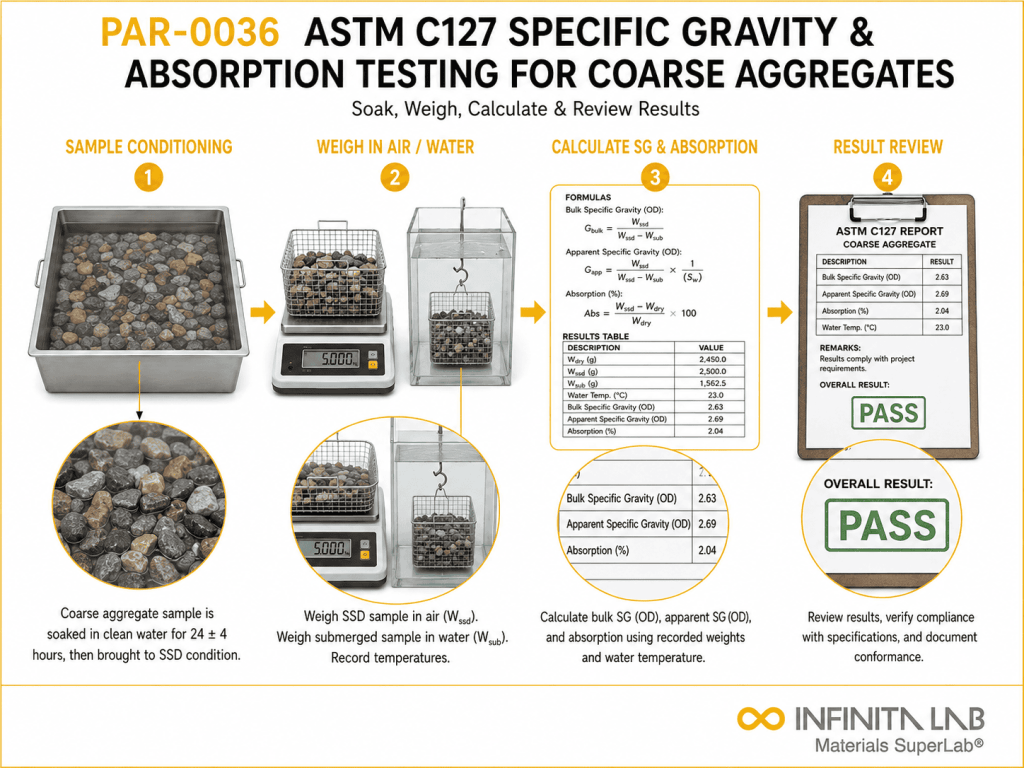
ASTM C127 specifies the test method for determining the relative density (specific gravity) and water absorption of coarse aggregates. These properties are essential for evaluating aggregate quality, durability, and suitability for use in concrete and construction applications.
This standard is widely used in construction and civil engineering industries where aggregate properties significantly influence concrete strength, workability, and durability. ASTM C127 ensures consistent measurement of density and absorption, supporting quality control and material selection in infrastructure projects.
Applications and Benefits of ASTM C127 Coarse Aggregate Specific Gravity Absorption Testing
Scope
ASTM C127 covers the determination of bulk relative density, apparent relative density, and water absorption of coarse aggregates. It includes procedures for sample preparation, soaking, weighing, and calculation to ensure accurate and repeatable results.
Includes:
- Measurement of bulk and apparent relative density
- Determination of water absorption of aggregates
- Sample preparation and soaking procedures
- Mass measurement in air and water
- Standardized calculation methods
Applications
- Concrete mix design
- Road and pavement construction
- Structural engineering projects
- Aggregate quality assessment
- Infrastructure development
- Material testing laboratories
Benefits
- Ensures accurate aggregate characterization
- Improves concrete mix performance
- Supports quality control in construction
- Helps predict durability and strength
- Standardized and reliable testing method
- Cost-effective evaluation process
Our ASTM C127 Testing Procedure
Sample Preparation
Coarse aggregate samples are cleaned and dried to remove dust and impurities.
1Soaking Process
Aggregates are soaked in water for a specified period to achieve saturated surface dry condition.
2Weighing Measurements
Mass of aggregates is measured in air and submerged in water to determine density.
3Calculation of Results
Relative density and water absorption are calculated using measured weights and standard formulas.
4ASTM C127 Test Parameters and Requirements
| Parameter | Details |
|---|---|
| Material Type | Coarse aggregates |
| Properties Measured | Bulk density, apparent density, water absorption |
| Sample Condition | Oven-dried and saturated surface dry states |
| Soaking Duration | Typically 24 hours |
| Measurement Units | Dimensionless for density, percentage for absorption |
| Calculation Basis | Standard formulas using measured masses |
| Output | Relative density values and absorption percentage |


- Weighing balance
- Water tank or container
- Wire basket for immersion
- Drying oven
- Thermometer
- Measuring containers
Equipment and Instrumentation Used for ASTM C127 Testing
What You Receive: Test Report, Data, and Certification
- Relative density test report
- Water absorption results
- Mass measurement records
- Calculation sheets
- Compliance certification as per ASTM C127
- Test summary and evaluation
ASTM C127 Coarse Aggregate Specific Gravity Absorption FAQs
ASTM C127 is used to determine the relative density and water absorption of coarse aggregates, helping engineers evaluate aggregate quality and suitability for use in concrete and construction applications requiring durability and strength.
Relative density, also known as specific gravity, measures the ratio of aggregate density to water density, indicating material quality and its effect on concrete properties.
Water absorption indicates the porosity of aggregates, affecting concrete strength, durability, and workability, making it a critical parameter in mix design.
Aggregate density and absorption influence concrete strength, durability, and workability, making accurate measurement essential for optimal mix design.
Higher porosity increases water absorption, which can reduce concrete strength and durability, making it an important factor in material evaluation.
The specific gravity of coarse aggregate is the ratio of the density of aggregate particles to the density of water. It indicates the relative density of materials such as crushed stone and gravel and helps determine aggregate proportions in concrete and asphalt mixtures. Typical values for normal-weight aggregates range from approximately 2.4 to 2.9, depending on the material.
The test determines the oven-dry, saturated-surface-dry (SSD), and apparent specific gravity of coarse aggregate. The sample is soaked in water, brought to an SSD condition, weighed in air and water, and then oven-dried and weighed again. These measurements are used to calculate specific gravity and water absorption according to ASTM C127.
ASTM C128-12 describes the determination of specific gravity and water absorption of fine aggregate, such as sand. The test uses a pycnometer to measure the mass of the dry and saturated-surface-dry sample and the water displaced by the aggregate. The measurements are used to calculate bulk specific gravity, SSD specific gravity, apparent specific gravity, and absorption. ASTM C128 applies to fine aggregate, not coarse aggregate.
Why Choose Infinita Lab for Coarse Aggregate Specific Gravity Absorption Testing
When your Coarse Aggregate Specific Gravity Absorption results have to hold up - for compliance, a customer audit, or an engineering decision - ASTM C127 accuracy and an unbiased third-party report matter more than price. Infinita Lab routes your ASTM C127 coarse aggregate specific gravity absorption testing to ISO/IEC 17025-accredited U.S. partner labs with hands-on method experience, so you get defensible data, transparent reporting, and turnaround times built around your project deadline - not ours.

Need ASTM C127 Coarse Aggregate Specific Gravity Absorption Testing You Can Rely On?
Send query us at hello@infinitalab.com or call us at (888) 878-3090 to learn more about our services and how we can support you.



